How to Price Homemade Food (2026): a Simple Method That Pays You
Cover your ingredients, your time and a margin, then check it against the market. That is the whole method.
Most home food sellers price by looking at what the person next to them charges, then shaving a dollar off. That is how you end up working a full Saturday for less than your ingredients cost. Pricing that holds up covers three things: what the food costs to make, the time you put in and a margin on top. Here is a simple way to set it.
Start with your cost per batch
Add up every ingredient in one batch, down to the vanilla and the parchment. Include the packaging and the label. Divide by the number of units the batch yields. That is your cost per unit, the floor no price should ever drop below.
Add your time
Decide what an hour of your kitchen time is worth and count the real hours: shopping, prep, baking, cooling, packaging and cleanup. Divide that labor across the units in the batch. A price that ignores your time is a price that quietly pays you nothing.
Add a margin, then check it against the market
On top of cost plus time, add a margin so the work builds something. A common starting point for shelf-stable baked goods is to price at two to three times the ingredient-and-packaging cost, then sanity-check that number against what similar products sell for at your market. If your number lands far below the going rate, raise it. If it lands far above, look at whether your batch size or your ingredient sourcing can come down.
Price markets and online differently
A farmers-market table costs you a booth fee, usually somewhere from $20 to $75 a day, plus the hours you stand there. Online sales carry listing and payment fees instead, plus shipping in many cases. Your price at each channel should absorb that channel's costs. The same cookie can carry a different price at the market and on your website without either being wrong.
Watch your state's sales cap
Several states cap what a cottage operation can earn in a year, from $9,000 in one state to $250,000 in another, with many in the $30,000 to $50,000 range. Your price times your volume has to stay under that ceiling, so the cap is a pricing input, not an afterthought. Your state page shows your cap.
Turn a first sale into a repeat one
The cheapest sale to make is the second one to a buyer who already trusts you. A card in the bag with your name and how to reorder does more for your income than shaving a dollar off the price. Pricing for margin is what gives you room to do that.
Price for profit from day one
From the team behind this library
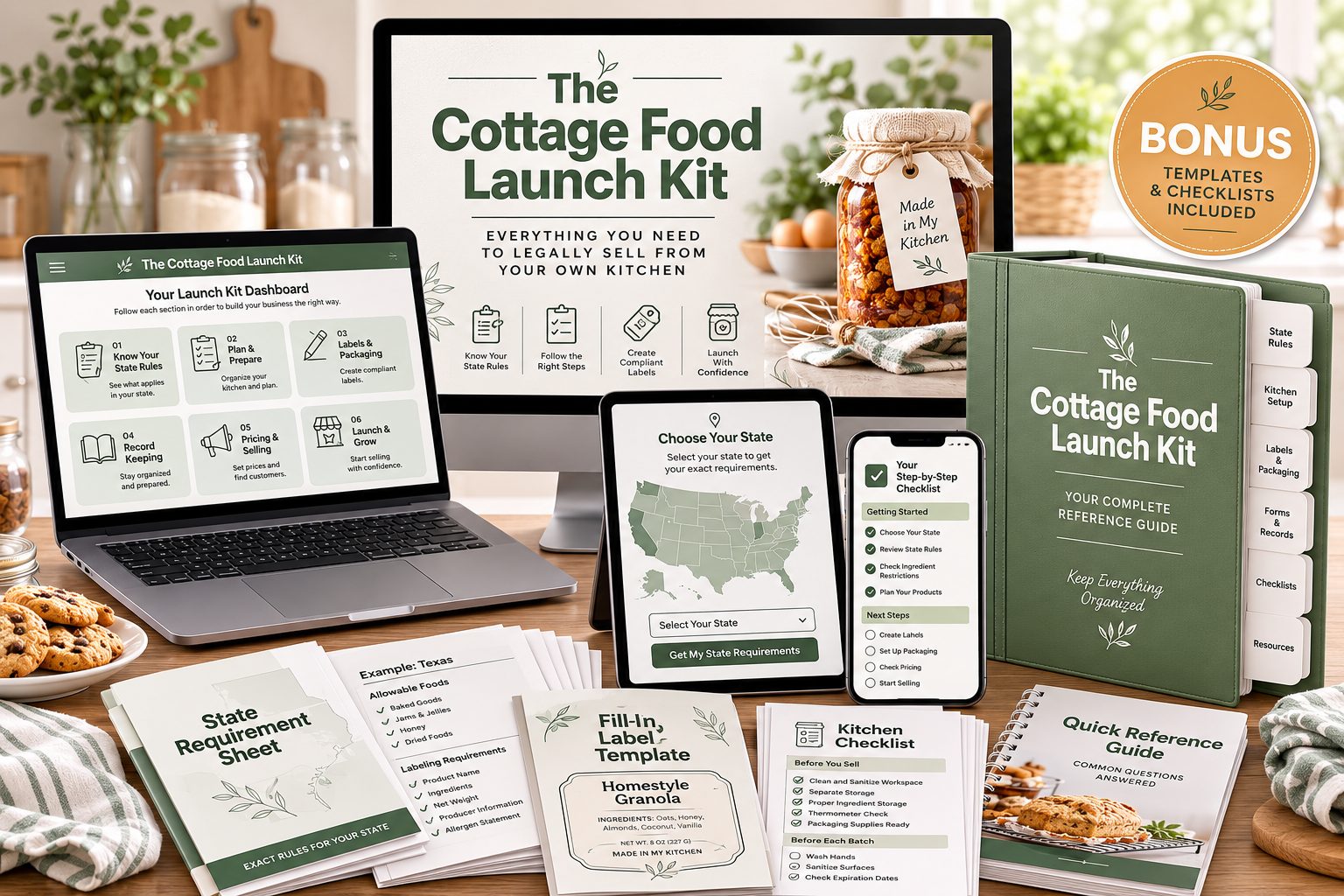
The Cottage Food Launch Kit
Want the whole path in one place? The Cottage Food Launch Kit turns the rules for your state into one ordered walkthrough: your requirement sheet, a fill-in label template with the exact required wording, the allowed-foods checker, the ordered checklist and your first-market plan.
This guide is educational information, not legal advice or financial advice. The figures here are typical ranges, not guarantees. Confirm your own costs and your state's sales cap before you set prices.
Pricing FAQ
Are cottage food businesses profitable?
They can be. The margin depends on your pricing and your volume more than on the food itself. Shelf-stable baked goods and jams carry low ingredient costs, so a price set at two to three times the ingredient-and-packaging cost leaves room for your time and a margin. The two things that decide whether it pays are pricing that counts your labor and staying under your state's annual sales cap. This library does not promise any income figure. What it can show you is how to price so the work builds something.