How to Start a Cottage Food Business (2026): the Step-by-Step Path
The same six steps work in every state. What changes at the state line is the detail. Your state page fills that in.
Selling food from your own kitchen is legal in every US state and the District of Columbia under a cottage food law. The path has the same shape everywhere: find out what your state requires, do the steps in the right order and get a compliant label on every package. What changes at the state line is the detail, whether you register, whether you train, whether an inspector visits and what your label must say. This guide walks the order. Your state page fills in the exact rules.
The six steps, in order
Work them top to bottom. Doing a later step before an earlier one is what stalls most new sellers.
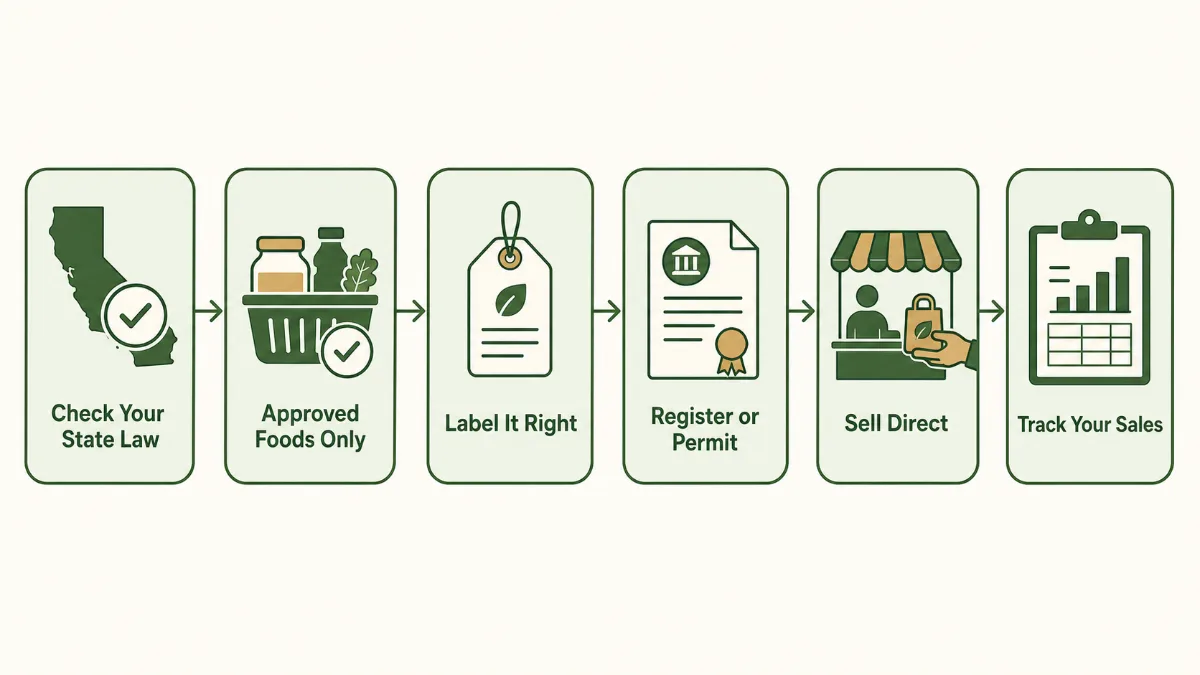
- Open your state page and read the whole path first. Every state page on this site opens with a plain yes or no on whether you need a license, then lays out the cap, the label, the allowed foods and where you can sell. Read it once before you do anything so the whole path is visible.
- Confirm your product is allowed. Check your food against your state's allowed and prohibited lists. Shelf-stable baked goods, jams, candy, granola and dried mixes are allowed almost everywhere. Meat, seafood, low-acid canned goods and most dairy are prohibited in most states. Refrigerated foods sit in a separate lane that some states allow only after extra steps.
- Handle any registration or permit. Seventeen jurisdictions require no state registration at all. The rest ask for a registration, a permit or a license. A few, New Jersey and Washington the heaviest, ask for several steps before your first sale. Your state page names the office and links its form.
- Do the food-safety training if your state asks for it. Nineteen jurisdictions require a food-safety or food-handler course. These run about $15 to $50 and finish online in a couple of hours. Some states accept a basic food-handler card, a few want a fuller food-manager certification.
- Prepare for an inspection only if your state requires one. Most states never inspect a home kitchen. Massachusetts, Maine, North Carolina, Pennsylvania and Washington are the states where a home-kitchen inspection is part of the process. If yours is one, run a kitchen self-check before you request the visit.
- Build a compliant label and make your first sale. Put the required elements and the exact disclosure wording on every package, then apply to your first market or open your first channel. The labeling guide covers the wording in detail.
Get it done in an evening
From the team behind this library
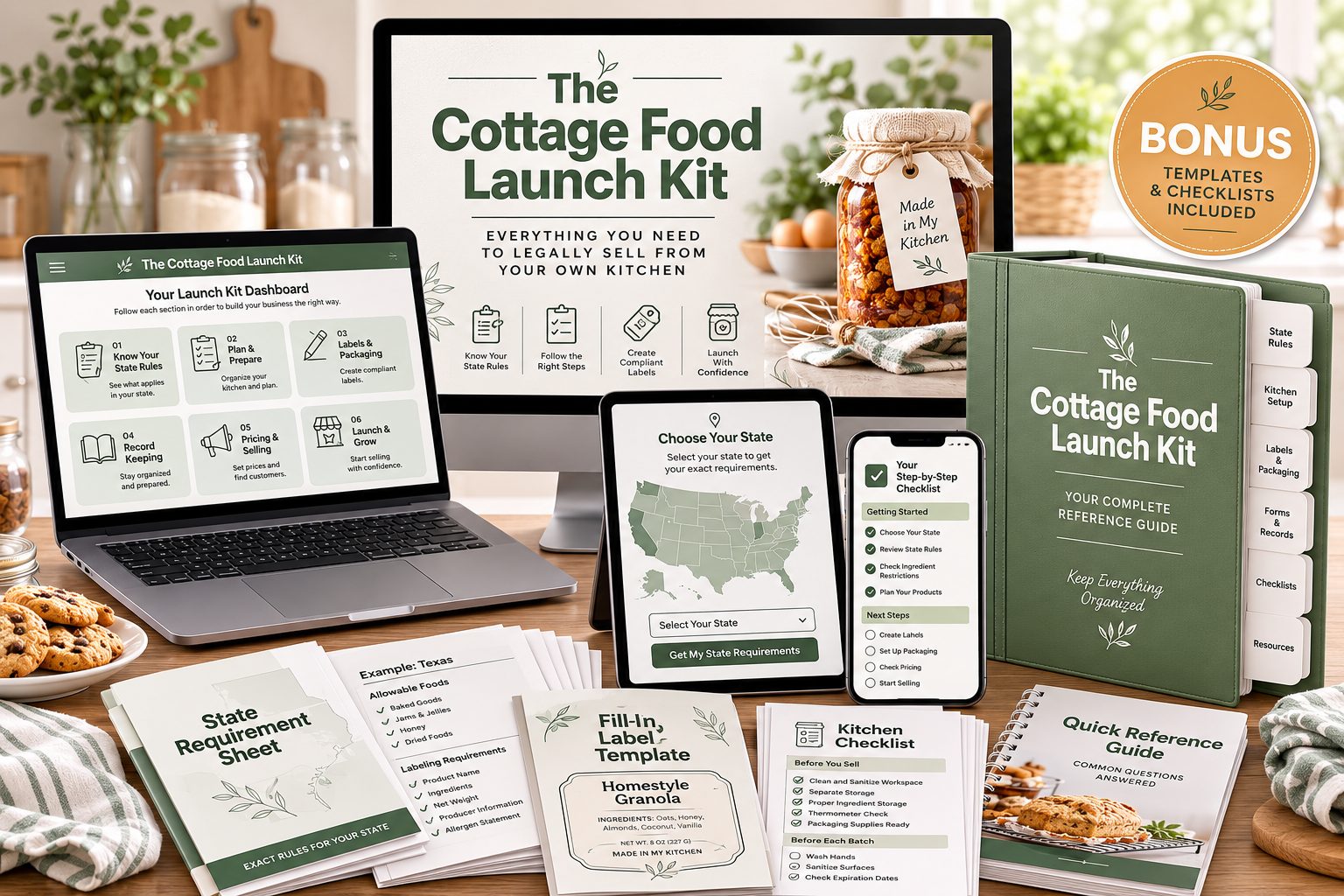
The Cottage Food Launch Kit
Want the whole path in one place? The Cottage Food Launch Kit turns the rules for your state into one ordered walkthrough: your requirement sheet, a fill-in label template with the exact required wording, the allowed-foods checker, the ordered checklist and your first-market plan.
What trips people up
Three things cause most of the stalls. The first is the prerequisite spiral, where each requirement turns out to need two more done first. Reading the whole path before you start is the fix. The second is the label disclosure wording, which several states mandate word for word and which forums get wrong. The third is the sales cap, which runs from $9,000 in one state to $250,000 in another and quietly caps your growth if you miss it.
Find your state
Open your state's page for the exact permit rules, the sales cap, the label wording and where you can sell, each cited to the state statute or agency and dated.
This guide is educational information, not legal advice. Confirm the current rules with your state and county before you sell.
Getting started FAQ
Is it legal to sell baked goods from home?
Yes, in every US state. Shelf-stable baked goods like cookies, cakes, breads and muffins are the most widely allowed cottage food category in the country. A few states ask you to register or take a short food-safety course first, but baked goods are on the allowed side nearly everywhere.
Can I sell baked goods from home?
In almost every case, yes. Non-refrigerated baked goods are allowed under cottage food law in all 50 states and DC. The catch is any filling or frosting that needs refrigeration, like cream, custard or cream cheese, which many states move into a separate lane or prohibit. Check your state page for where the line sits.
How long does it take to get a cottage food license?
It depends on your state's steps. In the seventeen states with no registration, you can start as soon as your label is right, so it comes down to days. Where a registration, a food-safety course or a kitchen inspection applies, expect a few days to a few weeks, driven mostly by the course and any inspection scheduling. Your state page lists the steps in order.
What is the easiest food to sell from home?
Shelf-stable baked goods and sugar-based items are the simplest to start with. Cookies, breads, candy, granola, jams and dried mixes are allowed in almost every state, need no refrigeration and carry the lightest rules. They avoid the extra steps that refrigerated, canned or meat products trigger, which makes them the usual first product.
Can I sell food in front of my house or at the roadside?
Often, yes, but it depends on the state and on local rules. Many states allow direct sales from your home, a farm stand or a roadside table, while a few limit where cottage foods can be sold. Zoning and local ordinances can add conditions on top of the state law. Check your state page for the allowed venues, then confirm any home-sales or signage rules with your city or county.