California Cottage Food Law (2026): Rules, Limits and How to Start
Do you need a license to sell homemade food in California?
California lets you sell homemade food under two tiers. Class A covers direct-to-consumer sales only and needs just a county registration, while Class B adds indirect sales through stores and restaurants and needs a county permit with a kitchen inspection. Both classes require an approved food processor training course, an approved-foods-list product and a compliant label. Both carry an annual gross sales cap that adjusts for inflation each year.
To sell homemade food in California you first register with County environmental health department. The kitchen stays your own. Foods like baked goods without cream, custard or meat fillings and candy such as brittle and toffee are on the table once the registration and the label are done, in the order the page below lays out.
California caps annual cottage food sales at Class A: $75,000 base, Class B: $150,000 base, both adjusted upward annually for inflation under the California Consumer Price Index. AB 1144 (2021) replaced the original flat $50,000 cap with this two-tier, inflation-indexed structure.
The parts new California sellers most often get wrong are the exact label disclosure wording, the food safety course and the registration step. Each one has its own row below, with the official source beside it.
How much can you sell? The California sales cap
The annual sales limit for a California cottage food operation.
| Item | California rule |
|---|---|
| Annual sales cap | Class A: $75,000 base, Class B: $150,000 base, both adjusted upward annually for inflation under the California Consumer Price Index |
| How it works | AB 1144 (2021) replaced the original flat $50,000 cap with this two-tier, inflation-indexed structure. The cap counts gross sales, meaning product price plus any shipping charged, not net profit. It excludes sales tax collected. Independent verification 2026-07-17 fetched CDPH's own PDF ('Cottage Food Operation Adjusted Gross Annual Sales Limit') directly (via a text-proxy fetch after cdph.ca.gov returned a TLS certificate error on every direct attempt): it sets the figures effective January 1, 2025 at Class A $86,206 and Class B $172,411, an inflation adjustment of 3.1% over the prior year. No CDPH-published 2026 figure could be located or fetched at this verification pass (July 2026); secondary aggregators estimate roughly $88,000-90,000 / $175,000-180,000 for 2026 but disagree with each other, so the exact current-year number stays unconfirmed against a primary source. Treat the statutory base ($75,000/$150,000) and the confirmed 2025 adjusted figures as verified. Treat the live 2026 figure as needing a final check against cdph.ca.gov. |
Not published as one current figure everyone cites. Confirm this year's cap with County environmental health department before you scale.
What foods can you sell in California?
Allowed and prohibited categories under current California law.
| Allowed (examples) | Prohibited |
|---|---|
| Baked goods without cream, custard or meat fillings (breads, biscuits, churros, cookies, pastries, tortillas); Candy such as brittle and toffee; Chocolate-covered nonperishable foods (nuts, dried fruit); Dried fruit; Dried pasta; Dry baking mixes; Fruit pies, fruit empanadas and fruit tamales; Granola, cereals and trail mixes; Herb blends and dried mole paste; Honey and sweet sorghum syrup; Jams, jellies, preserves and fruit butter meeting the federal standard of identity; Nut mixes and nut butters; Popcorn; Vinegar and mustard; Roasted coffee and dried tea; Waffle cones and pizelles. | Any food not on the state's approved cottage food products list; Foods with cream, custard or meat fillings; Potentially hazardous foods requiring time or temperature control for safety, outside the approved list. |
California cottage food label requirements
Every package you sell needs a label with the elements below in legible print.
- "Made in a Home Kitchen" or "Repackaged in a Home Kitchen" in at least 12-point type on the primary display panel
- Common or adequately descriptive name of the food product
- Name of the cottage food operation
- Registration or permit number and the name of the issuing county
- Ingredient list in descending order of predominance by weight, if two or more ingredients
- Compliance with federal labeling law including allergen disclosure, to the extent required
California requires this disclosure statement, word for word:
Made in a Home Kitchen
Reproduced from California's cottage food labeling requirements. Confirm the current wording with County environmental health department before you print a run of labels.
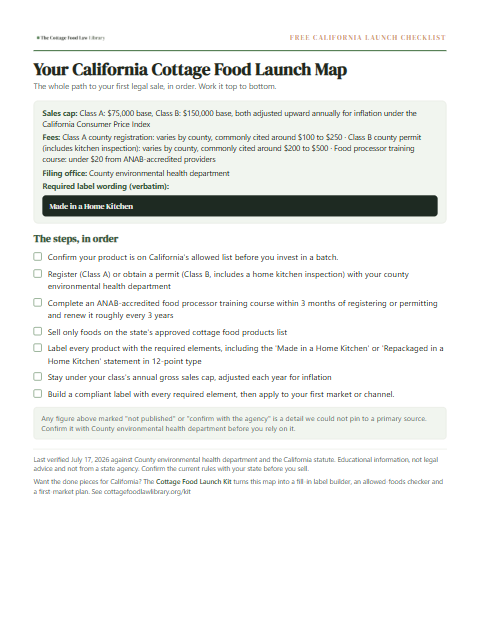
Get the free California cottage food checklist
The one-page map of the steps, in order, so you can see the whole path at a glance.
Instant download, plus California law-change alerts. Unsubscribe anytime.
Where can you sell in California?
The venues and channels California cottage food operators may use.
| Channel | Allowed in California? |
|---|---|
| Direct to consumer in person (home, farmers markets, events) | Yes. Class A and Class B |
| Online direct-to-consumer sales | Yes. Class A and Class B |
| Indirect sales through stores and restaurants | With conditions. Class B permit only, which requires a home kitchen inspection |
| Third-party shipping/delivery service | Yes. Permitted per current CDPH guidance for cottage food sales |
Registration, training and inspection
Registration and permits. Class A cottage food operations register with their county environmental health department (no kitchen inspection). Class B cottage food operations obtain a permit from the same office, which includes a home kitchen inspection.
Food safety training. All cottage food operators must complete an ANAB-accredited food processor training course within 3 months of registering or permitting and renew it periodically (commonly cited as every 3 years).
Kitchen inspection. Class A operations do not require a home kitchen inspection. Class B operations do require one as part of the county permitting process.
The fees a California cottage food seller can expect.
| Item | Cost |
|---|---|
| Class A county registration | varies by county, commonly cited around $100 to $250 |
| Class B county permit (includes kitchen inspection) | varies by county, commonly cited around $200 to $500 |
| Food processor training course | under $20 from ANAB-accredited providers |
Not published centrally. Confirm the current amount with County environmental health department.