Arizona Cottage Food Law (2026): Rules, Limits and How to Start
Do you need a license to sell homemade food in Arizona?
Arizona requires you to register with the Department of Health Services and complete an accredited food handler course before you sell homemade cottage food. House Bill 2042 (2024) expanded the law well beyond shelf-stable goods to cover many foods that need refrigeration. The state sets no dollar cap on sales. Your home kitchen, registration and labels all have to meet the state's specific rules.
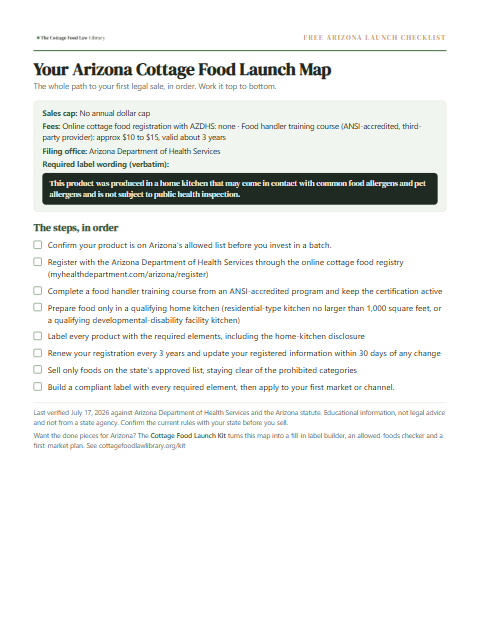
To sell homemade food in Arizona you first register with Arizona Department of Health Services. The kitchen stays your own. Foods like baked goods and candies and chocolates are on the table once the registration and the label are done, in the order the page below lays out.
Arizona sets no dollar limit on cottage food sales, so the ceiling on your growth is your own kitchen and time rather than a statutory cap. The other rules that matter, the label, the allowed foods and where you can sell, are in the tables below.
The parts new Arizona sellers most often get wrong are the exact label disclosure wording, the food safety course and the registration step. Each one has its own row below, with the official source beside it.

How much can you sell? The Arizona sales cap
The annual sales limit for an Arizona cottage food operation.
| Item | Arizona rule |
|---|---|
| Annual sales cap | No annual dollar cap in Arizona |
| How it works | No dollar or volume sales cap was found in Arizona's cottage food statute or Department of Health Services guidance. |
What foods can you sell in Arizona?
Allowed and prohibited categories under current Arizona law.
| Allowed (examples) | Prohibited |
|---|---|
| Baked goods (breads, cakes, cookies, pastries); Candies and chocolates; Dry pasta and dry spice mixes; Fruit jams and jellies; Granola and honey; Popcorn; Roasted coffee beans and roasted nuts; Tortillas; Certain foods requiring time or temperature control for safety, expanded under HB 2042 (2024), subject to department rules. | Alcoholic beverages and foods containing alcoholic beverages; Unpasteurized (raw) milk and unpasteurized milk products; Fish and shellfish products, meat, meat by-products, poultry and poultry by-products, except from sources federal law permits: poultry under the 1,000-bird exemption (9 CFR 381.10(c)), poultry from inspected sources (9 CFR 381.10(d)) and meat from inspected sources (9 CFR 303.1(d)); Marijuana and marijuana products; Any cottage food sold as an ingredient for another retail product. |
Arizona cottage food label requirements
Every package you sell needs a label with the elements below in legible print.
- Preparer name and AZDHS registration number
- Complete ingredient list
- Production date
- The disclosure statement above
- The department-provided website address carrying foodborne-illness reporting information, how to verify a preparer's active registration and how to report registration issues. This is required on EVERY label, not only online listings (A.R.S. 36-932(A))
- A tamper-evident seal on the package (A.A.C. R9-8-101.02)
- A developmental-disability facility statement if the kitchen is such a facility
Arizona requires this disclosure statement, word for word:
This product was produced in a home kitchen that may come in contact with common food allergens and pet allergens and is not subject to public health inspection.
Reproduced from Arizona's cottage food labeling requirements. Confirm the current wording with Arizona Department of Health Services before you print a run of labels.
From the team behind this library
The Cottage Food Launch Kit
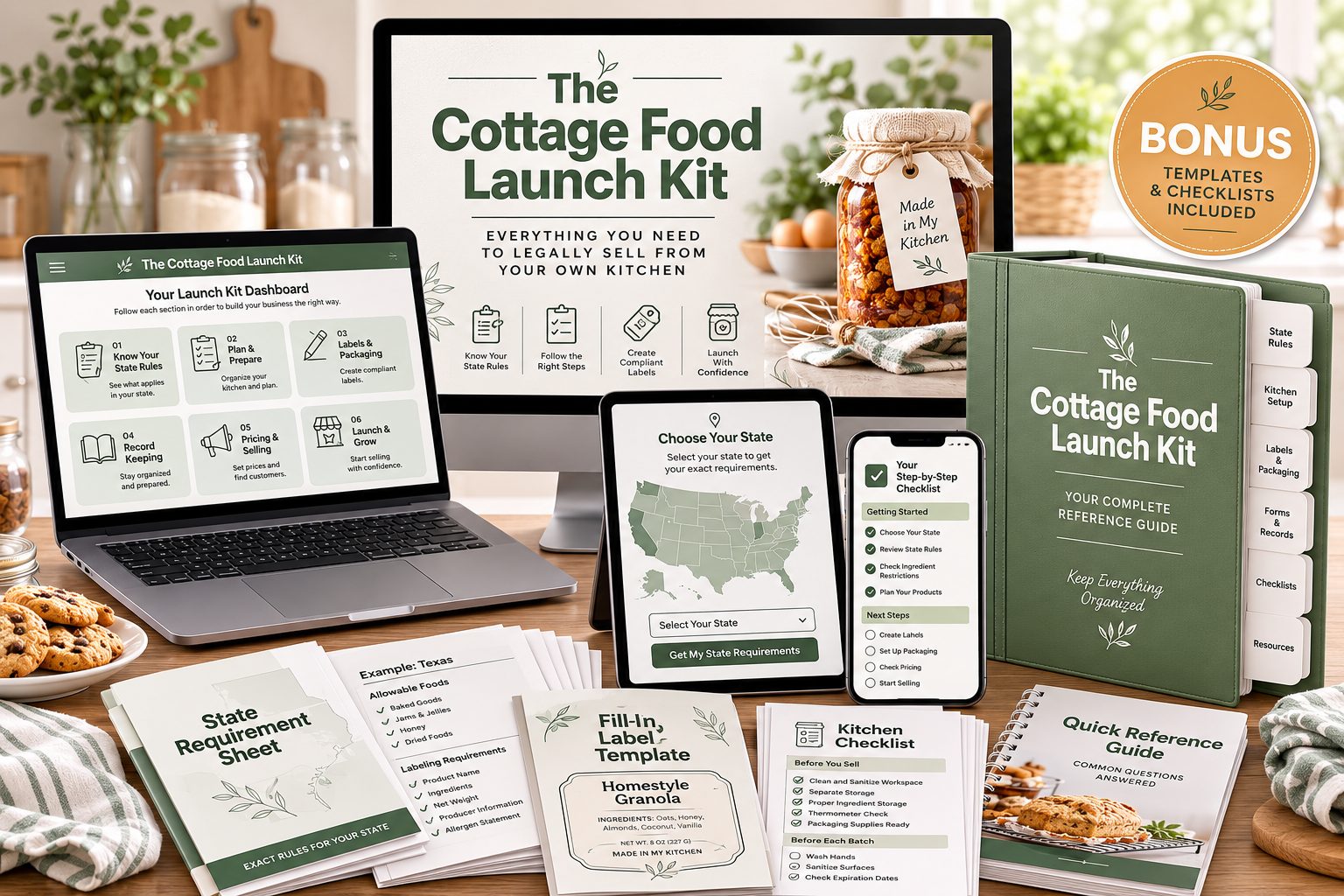
Want the whole path in one place? The kit turns everything on this page into one ordered walkthrough for Arizona: your state requirement sheet, a fill-in label template with the exact required wording, the allowed-foods checker, the ordered checklist and your first-market plan. Follow it in an evening.
Where can you sell in Arizona?
The venues and channels Arizona cottage food operators may use.
| Channel | Allowed in Arizona? |
|---|---|
| Direct to consumer in person (home, farmers markets, farm stands, street sales) | Yes. Local zoning and municipal codes may still restrict where food can be sold; the cottage food law does not override them |
| Online sales | With conditions. Must carry a prominent notification statement per AZDHS requirements. Dairy products and foods containing meat or poultry may be sold remotely including over the internet but NOT through a third-party food delivery platform and must be delivered to the consumer in person (A.R.S. 36-932(E)(2)) |
| Stores and restaurants (consignment/resale) | With conditions. Requires a separate section, a separate display case from non-homemade food and a sign disclosing the product is homemade and exempt from licensing and inspection; cannot be used as an ingredient in other food prepared there |
| As a base (commissary) for a licensed mobile food unit | No. A home kitchen used for cottage food products may not operate as a commissary for a mobile food business under A.R.S. 36-1761 |
| Dairy products and foods containing meat or poultry (any channel) | With conditions. Sold by the preparer in person or remotely including over the internet, but excluding third-party food delivery platforms and delivered to the consumer in person (A.R.S. 36-932(E)(2)) |
| Time/temperature-control (TCS) products, delivery | With conditions. Delivered in person directly to the consumer, in a single delivery run no longer than two hours, to one destination only. Products and equipment may not be stored outside the home (A.A.C. R9-8-101.02) |
Registration, training and inspection
Registration and permits. Register with the Arizona Department of Health Services through its online cottage food registry before preparing food for commercial sale. Renew every 3 years and update information within 30 days of any change.
Food safety training. The person preparing or supervising the cottage food must complete a food handler training course from an ANSI-accredited program and maintain active certification.
Kitchen inspection. Cottage food operations are exempt from state food service licensing and inspection. Stores and restaurants that sell cottage food on consignment must display a sign disclosing that it is exempt from state licensing and inspection.
The fees an Arizona cottage food seller can expect.
| Item | Cost |
|---|---|
| Online cottage food registration with AZDHS | No state fee |
| Food handler training course (ANSI-accredited, third-party provider) | approx $10 to $15, valid about 3 years |
Wondering how Arizona compares? See what a cottage food license costs in every state, from the no-fee states to the priciest permits.