Illinois Cottage Food Law (2026): Rules, Limits and How to Start
Do you need a license to sell homemade food in Illinois?
Illinois lets you sell most homemade foods direct to consumers with no sales cap, but the bar to start is higher than most states. You must register with your local health department and every operator has to hold an ANSI-accredited Certified Food Protection Manager certificate before registering, not just a basic food handler card.
To sell homemade food in Illinois you first register with Local health department where the operator resides, under Illinois Department of Public Health. The kitchen stays your own. Foods like baked goods and candies and confections are on the table once the registration and the label are done, in the order the page below lays out.
Illinois sets no dollar limit on cottage food sales, so the ceiling on your growth is your own kitchen and time rather than a statutory cap. The other rules that matter, the label, the allowed foods and where you can sell, are in the tables below.
The parts new Illinois sellers most often get wrong are the exact label disclosure wording, the food safety course and the registration step. Each one has its own row below, with the official source beside it.
How much can you sell? The Illinois sales cap
The annual sales limit for a Illinois cottage food operation.
| Item | Illinois rule |
|---|---|
| Annual sales cap | No annual dollar cap in Illinois |
| How it works | Illinois removed its sales cap through the 2018 and 2022 amendments (Public Act 102-0633 among them). There is no revenue limit on a registered cottage food operation today. |
What foods can you sell in Illinois?
Allowed and prohibited categories under current Illinois law.
| Allowed (examples) | Prohibited |
|---|---|
| Baked goods (most non-potentially hazardous items); Candies and confections; Condiments (honey, ketchup, mustards, nut butters, oils, pickles, salsas, sauces, syrups, vinegars); Dry goods, pastries, preserves, snacks; Carbonated drinks and extracts; Frozen produce, hardboiled eggs, juices; Canned tomato products meeting the state's acidified/pH requirements. | Meat, poultry, fish, seafood and shellfish; Dairy, except as an ingredient in a qualifying non-potentially hazardous baked good, candy or frosting; Eggs, except as an ingredient in a qualifying baked good, dry noodles, or non-raw frosting; Pumpkin, sweet potato and custard or cream pies, plus cheesecakes; Garlic in oil or oil infused with garlic, unless the garlic oil is acidified; Low-acid canned foods, sprouts, cut leafy greens (except dehydrated, acidified, or blanched and frozen); Cut or puréed fresh tomato or melon, dehydrated tomato or melon, frozen cut melon; Wild-harvested, non-cultivated mushrooms; Alcoholic beverages and kombucha. |
Illinois cottage food label requirements
Every package you sell needs a label with the elements below in legible print.
- Cottage food operation name and the county, township, city or village of registration
- Registration number and the municipality or county where registered
- Common or usual name of the food product
- Ingredients in descending order by weight, including colors, artificial flavors and preservatives
- Net weight, excluding packaging
- Production date
- Allergen statement for any of the nine major allergens
- The disclosure statement above
Illinois requires this disclosure statement, word for word:
This product was produced in a home kitchen not inspected by a health department that may also process common food allergens. If you have safety concerns, contact your local health department.
Reproduced from Illinois's cottage food labeling requirements. Confirm the current wording with Local health department where the operator resides, under Illinois Department of Public Health before you print a run of labels.
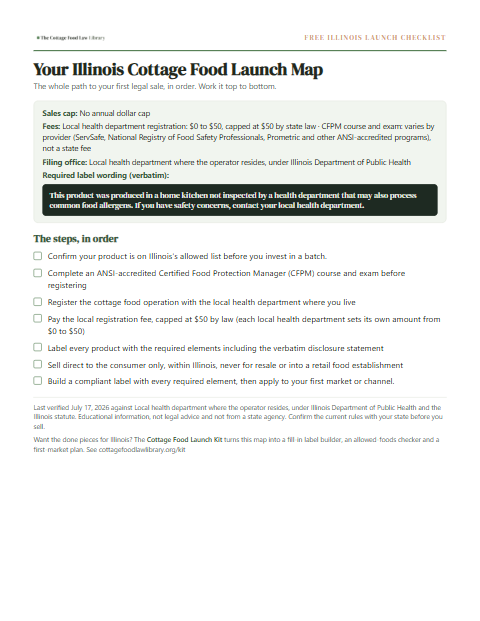
Get the free Illinois cottage food checklist
The one-page map of the steps, in order, so you can see the whole path at a glance.
Instant download, plus Illinois law-change alerts. Unsubscribe anytime.
Where can you sell in Illinois?
The venues and channels Illinois cottage food operators may use.
| Channel | Allowed in Illinois? |
|---|---|
| Direct to consumer in person (home, farmers markets, pop-ups, events) | Yes |
| Online sales with in-state fulfillment | Yes. The online sales interface must show the point-of-sale disclosure notice. |
| Resale through a retail food establishment | No |
| Shipping or delivery out of state | No |
Registration, training and inspection
Registration and permits. Every cottage food operation must register with the local health department where the operator resides before selling.
Food safety training. All cottage food operators and anyone else preparing or packaging the products must complete an ANSI-accredited Certified Food Protection Manager (CFPM) course and exam before registering.
Kitchen inspection. No inspection happens at registration. The local health department may inspect the home kitchen if it has cause to believe the products are unsafe or the operation is out of compliance.
The fees a Illinois cottage food seller can expect.
| Item | Cost |
|---|---|
| Local health department registration | $0 to $50, capped at $50 by state law |
| CFPM course and exam | varies by provider (ServSafe, National Registry of Food Safety Professionals, Prometric and other ANSI-accredited programs), not a state fee |