Maine Cottage Food Law (2026): Rules, Limits and How to Start
Do you need a license to sell homemade food in Maine?
Maine requires a Home Food Processor license and a kitchen inspection before you sell shelf-stable homemade food, with no state sales cap. Maine also recognizes local Food Sovereignty ordinances under Title 7, which let a municipality legalize direct producer-to-consumer sales of homemade food without the state license, so your actual requirements depend on whether your town has adopted one.
Maine asks more of a home food seller than most states. You work through Maine Department of Agriculture, Conservation and Forestry before your first sale. The page below lays out the registration, the training and the inspection in the order they come. It is a real process, so knowing the steps up front is what keeps it from stalling.
Maine sets no dollar limit on cottage food sales, so the ceiling on your growth is your own kitchen and time rather than a statutory cap. The other rules that matter, the label, the allowed foods and where you can sell, are in the tables below.
The parts new Maine sellers most often get wrong are the label elements, the kitchen inspection and the registration step. Each one has its own row below, with the official source beside it.
How much can you sell? The Maine sales cap
The annual sales limit for a Maine cottage food operation.
| Item | Maine rule |
|---|---|
| Annual sales cap | No annual dollar cap in Maine |
| How it works | Maine's Home Food Processor license carries no state revenue cap. |
What foods can you sell in Maine?
Allowed and prohibited categories under current Maine law.
| Allowed (examples) | Prohibited |
|---|---|
| Baked goods (breads, cookies, cakes without cream or custard, pies); Jams, jellies, fruit butters; Dried fruits and vegetables; Hard candy, fudge, caramel corn; Granola, trail mix, roasted nuts; Honey, ketchup, fruit leather; Acidified foods (salsas, pickles, sauces) with University of Maine approval; Low-sugar preserves with pH testing. | Home-canned foods that require pressure cooking to seal (confirmed verbatim against the official Chapter 345 rule text); Potentially hazardous foods requiring refrigeration at 45°F or below (confirmed against the official Chapter 345 rule text, which frames this as a general PHF restriction rather than a named-food list); Dairy products, meat, poultry, seafood; Kombucha and other fermented beverages; Cannabis-infused products; Pet treats. |
These lists follow Maine Department of Agriculture, Conservation and Forestry's published guidance. Confirm your own product against Maine Department of Agriculture, Conservation and Forestry before you commit to a batch.
Maine cottage food label requirements
Every package you sell needs a label with the elements below in legible print.
- The common or usual name of the product
- Ingredients in order of predominance
- Net weight or numerical count
- The name and address of the producer, manufacturer or distributor and zip code
No single statewide disclosure sentence. Maine does not set one required disclosure line in the sources we checked. Put the required elements above on every label. Confirm the current wording with Maine Department of Agriculture, Conservation and Forestry before you print a run.
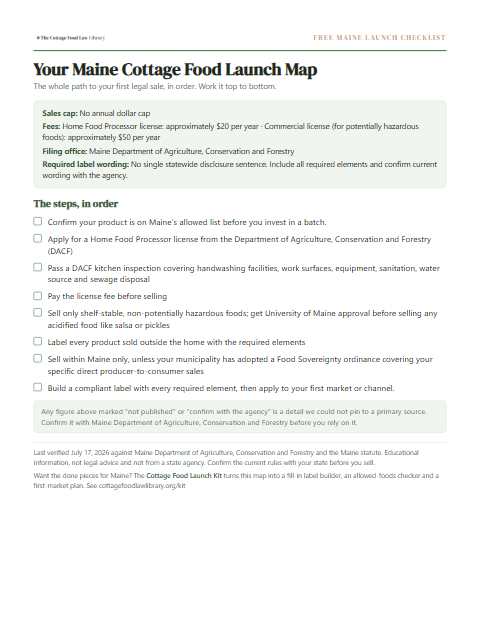
Get the free Maine cottage food checklist
The one-page map of the steps, in order, so you can see the whole path at a glance.
Instant download, plus Maine law-change alerts. Unsubscribe anytime.
Where can you sell in Maine?
The venues and channels Maine cottage food operators may use.
| Channel | Allowed in Maine? |
|---|---|
| Direct sale from the home, farmers markets, online, mail order within Maine | Yes. Confirmed: the home-direct sale channel does not even require a label per Chapter 345 (see labelRequirements note). |
| Retail and wholesale (sale to stores) | Yes. Verification correction 2026-07-17: was "conditional" resting on one secondary source. Confirmed directly against the official Chapter 345 rule text (Code of Maine Rules 001-c345, fetched from maine.gov/sos), which states products "may be offered for sale directly to the consumer or through other distribution methods, including sales to stores and wholesale distribution," with a separate label requirement (see labelRequirements) triggered specifically by store/wholesale/public sale. |
| Sale across state lines | No. Unless separately compliant with applicable federal rules. Not directly re-confirmed against Chapter 345 text this pass; carried forward from prior research. |
| Direct producer-to-consumer sale within a municipality that has adopted a Food Sovereignty ordinance | Yes. State licensing is not enforced against sales covered by a validly adopted local ordinance. Confirmed against the official Maine Legislature's Title 7, Chapter 8-F text: direct producer-to-consumer transactions include on-premises sale, roadside stands, farmers' markets, community social events, buying clubs, deliveries, CSAs and herd-share agreements, but wholesale or retail distribution OUTSIDE the adopting municipality still must comply with all applicable state and federal food safety law without exception. |
Registration, training and inspection
Registration and permits. A Home Food Processor license from DACF is required to sell shelf-stable homemade food in most of Maine, unless your municipality has adopted a Food Sovereignty ordinance covering the specific sale.
Food safety training. No training course is legally required to obtain the Home Food Processor license. Confirmed directly against the official Chapter 345 rule text, which contains no training or certification requirement.
Kitchen inspection. DACF inspects the home kitchen (handwashing, work surfaces, equipment, sanitation, water source, sewage disposal) before issuing the license.
The fees a Maine cottage food seller can expect.
| Item | Cost |
|---|---|
| Home Food Processor license | approximately $20 per year |
| Commercial license (for potentially hazardous foods) | approximately $50 per year |
Not published centrally. Confirm the current amount with Maine Department of Agriculture, Conservation and Forestry. Confirm the inspection step that applies to your product with Maine Department of Agriculture, Conservation and Forestry.