New Hampshire Cottage Food Law (2026): Rules, Limits and How to Start
Do you need a license to sell homemade food in New Hampshire?
New Hampshire lets you sell most homemade foods straight from your home, a farm stand or a farmers market with no license and no sales cap. You only need a $150 Class H Homestead Food License if you want to sell online, by mail order, to restaurants or through wholesalers. There is no state training requirement either way.
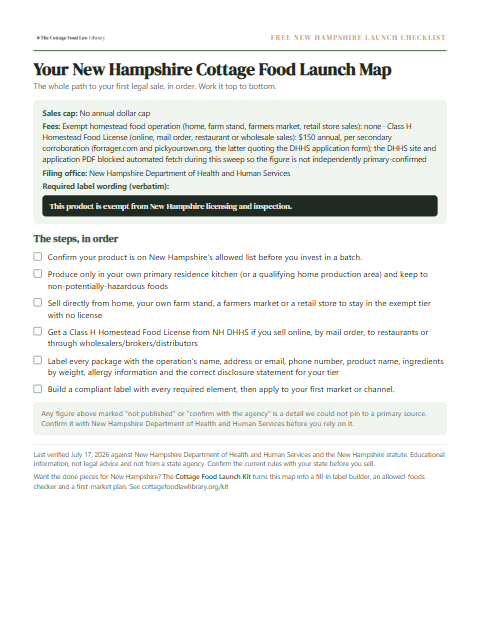
New Hampshire lets most home food sellers start without a state license, with a permit or registration reserved for certain foods or sales channels. Foods like baked goods and jams, jellies and fruit butters are the common starting point. The page below shows exactly which step applies to your product.
New Hampshire sets no dollar limit on cottage food sales, so the ceiling on your growth is your own kitchen and time rather than a statutory cap. The other rules that matter, the label, the allowed foods and where you can sell, are in the tables below.
The parts new New Hampshire sellers most often get wrong are the exact label disclosure wording. Each one has its own row below, with the official source beside it.
How much can you sell? The New Hampshire sales cap
The annual sales limit for a New Hampshire cottage food operation.
| Item | New Hampshire rule |
|---|---|
| Annual sales cap | No annual dollar cap in New Hampshire |
| How it works | New Hampshire had a $35,000 unlicensed sales cap (previously raised from $20,000), removed entirely by House Bill 119, signed August 4, 2023 and effective October 3, 2023. House Bill 304 (2025) cleaned up remaining statute language tied to the old cap. Neither the exempt tier nor the licensed tier carries a revenue limit today. |
What foods can you sell in New Hampshire?
Allowed and prohibited categories under current New Hampshire law.
| Allowed (examples) | Prohibited |
|---|---|
| Baked goods (breads, cookies, cakes, muffins); Jams, jellies and fruit butters; Candy and chocolate-covered items; Granola, nuts, seeds and popcorn; Dried herbs, spices, coffee and tea; Processed acidified foods such as pickled vegetables and salsa made from safe, tested recipes (allowed since House Bill 1565, effective August 13, 2024); Other non-potentially-hazardous, shelf-stable homestead food products not otherwise restricted by rule. | Potentially hazardous (TCS) foods that need temperature control for safety, including most items requiring refrigeration; Raw dairy and most meat, poultry or seafood products, which fall under separate licensing chapters; Acidified or fermented foods made without a safe, tested recipe or without the required process review. |
New Hampshire cottage food label requirements
Every package you sell needs a label with the elements below in legible print.
- Homestead food operation name
- Physical or e-mail address
- Phone number
- Product name
- Ingredients in descending order of predominance by weight, or (since House Bill 304, 2025) a QR code or website link to the ingredient list plus a physical sign at the point of sale, for exempt sales from home or a farm stand
- Allergy information
- The exempt-tier disclosure in at least 10-point type: "This product is exempt from New Hampshire licensing and inspection."
- For the licensed tier, the disclosure reads instead: "This product is made in a residential food production area licensed by the New Hampshire Department of Health and Human Services."
New Hampshire requires this disclosure statement, word for word:
This product is exempt from New Hampshire licensing and inspection.
Reproduced from New Hampshire's cottage food labeling requirements. Confirm the current wording with New Hampshire Department of Health and Human Services before you print a run of labels.
From the team behind this library
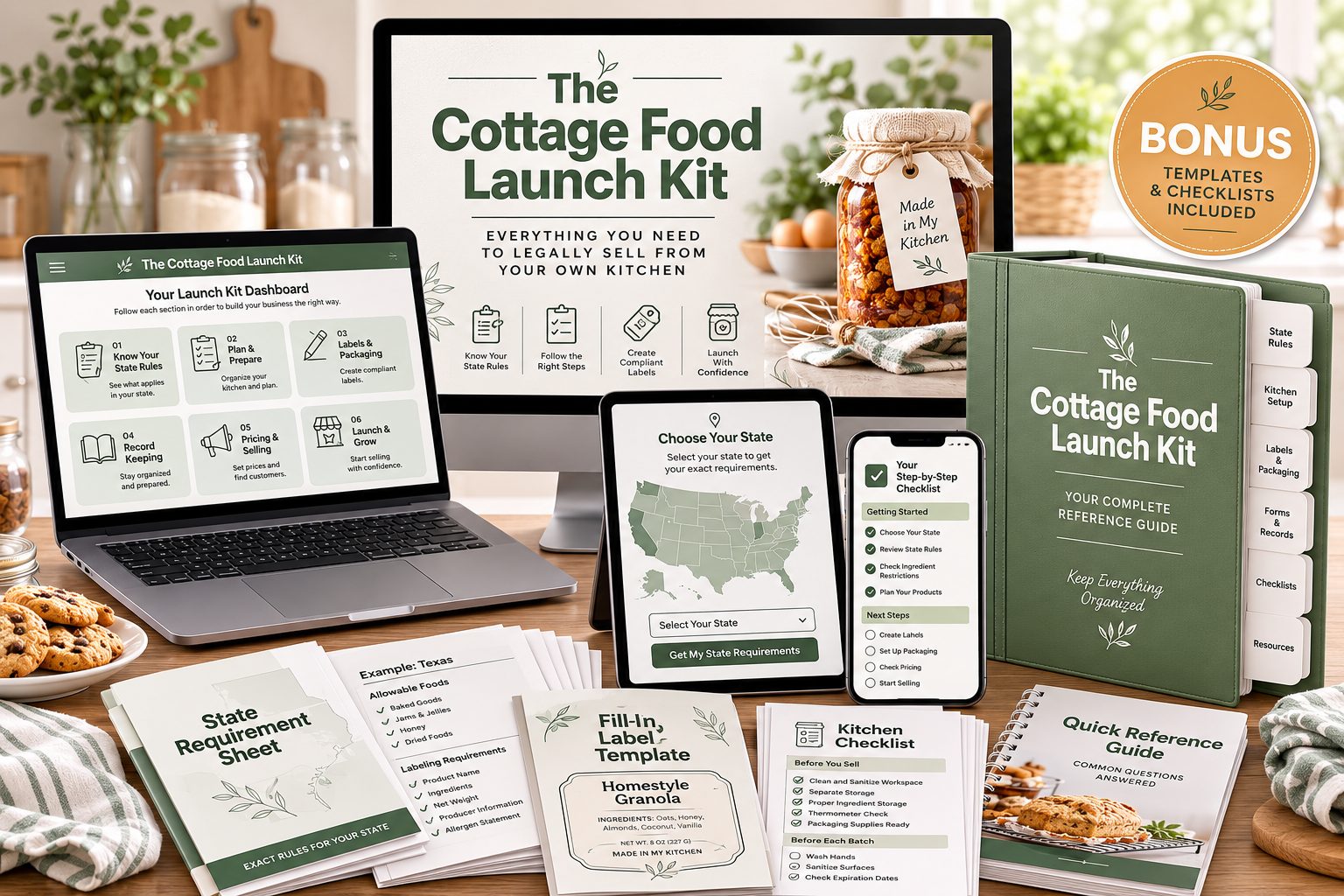
The Cottage Food Launch Kit
Want the whole path in one place? The kit turns everything on this page into one ordered walkthrough for New Hampshire: your state requirement sheet, a fill-in label template with the exact required wording, the allowed-foods checker, the ordered checklist and your first-market plan. Follow it in an evening.
Where can you sell in New Hampshire?
The venues and channels New Hampshire cottage food operators may use.
| Channel | Allowed in New Hampshire? |
|---|---|
| Direct from home | Yes. Exempt tier, no license needed |
| Own farm stand | Yes. Exempt tier, no license needed |
| Farmers markets | Yes. Exempt tier, no license needed |
| Retail food stores | Yes. Exempt tier, no license needed |
| Online orders and mail order | With conditions. Requires the Class H Homestead Food License |
| Sales to restaurants or other retail food establishments for resale | With conditions. Requires the Class H Homestead Food License |
| Wholesale through brokers or distributors | With conditions. Requires the Class H Homestead Food License |
Registration, training and inspection
Registration and permits. No registration or license for the exempt tier (direct sales from home, a farm stand, a farmers market or a retail store). A Class H Homestead Food License from NH DHHS is required only to sell online, by mail order, to restaurants, or through wholesalers, brokers or distributors.
Food safety training. New Hampshire has no state food safety training or food handler card requirement for either the exempt or the licensed homestead food tier.
Kitchen inspection. The exempt tier is not inspected except when DHHS has reason to suspect an imminent health hazard under RSA 143-A:3, IV-b. The Class H licensed tier operates under He-P 2300 as a licensed food production area, which secondary sources describe as subject to routine inspection consistent with other NH food licenses; this specific point was not independently confirmed on a primary source during this sweep.
The fees a New Hampshire cottage food seller can expect.
| Item | Cost |
|---|---|
| Exempt homestead food operation (home, farm stand, farmers market, retail store sales) | No state fee |
| Class H Homestead Food License (online, mail order, restaurant or wholesale sales) | $150 per year |
Confirm the inspection step that applies to your product with New Hampshire Department of Health and Human Services.
Wondering how New Hampshire compares? See what a cottage food license costs in every state, from the no-fee states to the priciest permits.