Mississippi Cottage Food Law (2026): Rules, Limits and How to Start
Do you need a license to sell homemade food in Mississippi?
Mississippi does not require a permit, registration or fee to sell homemade cottage foods, as long as annual gross sales stay at or under $35,000. You must sell face to face inside Mississippi only: no internet sales, no mail order and no wholesale or retail placement. Every label needs the state's exact disclosure statement. Training is encouraged but not required by law.
In Mississippi the path depends on what you make and how you sell it. Many home producers of foods like baked goods without cream, custard or meat fillings, such as breads, biscuits, cookies, pastries and tortillas and candy need no state license at all, while some foods or channels trigger a registration. The rules below sort out which one is yours.
Mississippi caps annual cottage food sales at $35,000 gross annual sales. House Bill 326 (2020 Regular Session, effective July 1, 2020) raised the cap from $20,000 to $35,000 and added internet advertising as permitted while keeping actual sales in person only.
The parts new Mississippi sellers most often get wrong are the exact label disclosure wording. Each one has its own row below, with the official source beside it.
How much can you sell? The Mississippi sales cap
The annual sales limit for a Mississippi cottage food operation.
| Item | Mississippi rule |
|---|---|
| Annual sales cap | $35,000 gross annual sales |
| How it works | House Bill 326 (2020 Regular Session, effective July 1, 2020) raised the cap from $20,000 to $35,000 and added internet advertising as permitted while keeping actual sales in person only. The cap applies to all sales of cottage food products at any location, regardless of product type or how many people are involved in the operation. Reform bills to raise the cap further, including proposals in 2024, 2025 and 2026 to remove it entirely or raise it to $50,000, $120,000 or $200,000, have all failed to pass as of this sweep. |
What foods can you sell in Mississippi?
Allowed and prohibited categories under current Mississippi law.
| Allowed (examples) | Prohibited |
|---|---|
| Baked goods without cream, custard or meat fillings, such as breads, biscuits, cookies, pastries and tortillas; Candy; Chocolate-covered nonperishable foods such as pretzels, nuts and whole uncut fruit except melons (no stick or skewer may puncture the coated fruit before sale); Dried fruit except melons; Dried pasta; Dried spices; Dry baking mixes; Granola, cereal and trail mixes; Dry rubs; Fruit pies; Jams, jellies and preserves that meet 21 CFR Part 150 and contain real sugar, not sugar substitutes; Nut mixes; Popcorn; Vinegar and mustard; Waffle cones; Acidified plant-based products meeting the 21 CFR Part 114 definition, with a water activity above 0.85 and a finished equilibrium pH of 4.6 or below. | Meat, fish and poultry; Dairy products, including custard pies; Eggs, other than air-dried hard-cooked eggs with an intact shell; Cooked vegetables, cooked potatoes, legumes and beans; Raw seed sprouts and sliced melons; Garlic and other fresh herbs held in oil; Nut butters; Fruit and vegetable juices; Rice; Low-acid canned foods with a pH above 4.6, including canned vegetables, meats and seafood; Smoked fish and pasteurized or pre-cooked foods; Beverages and other liquid foods (the water source cannot be verified as potable in an uninspected kitchen); Sugar-free or reduced-sugar jams and jellies made with sugar substitutes. |
Mississippi cottage food label requirements
Every package you sell needs a label with the elements below in legible print.
- The name and address of the cottage food operation
- The name of the cottage food product
- The ingredients in descending order of predominance by weight
- The net weight or volume of the product
- Allergen information for milk, eggs, wheat, peanuts, soybeans, fish, shellfish, tree nuts and sesame, either in the ingredient list or a separate Contains statement
- Nutritional information, only if a nutritional claim is made
- The disclosure statement in at least ten-point type in a color that clearly contrasts the label background
Mississippi requires this disclosure statement, word for word:
Made in a cottage food operation that is not subject to Mississippi's food safety regulations.
Reproduced from Mississippi's cottage food labeling requirements. Confirm the current wording with Mississippi State Department of Health before you print a run of labels.
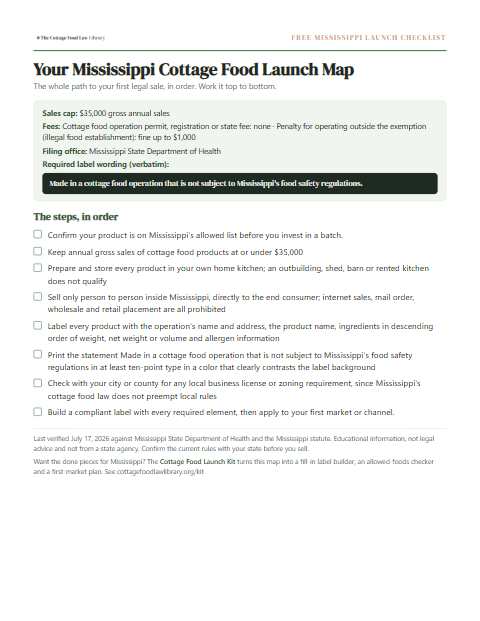
Get the free Mississippi cottage food checklist
The one-page map of the steps, in order, so you can see the whole path at a glance.
Instant download, plus Mississippi law-change alerts. Unsubscribe anytime.
Where can you sell in Mississippi?
The venues and channels Mississippi cottage food operators may use.
| Channel | Allowed in Mississippi? |
|---|---|
| Direct sale from home, farmers markets, roadside stands and special events | Yes. Producer must be present and sell person to person |
| Internet or mail-order sales | No. Online advertising, including social media, is allowed since HB 326 (2020); completing a sale online or by mail order is not |
| Wholesale or sale to a retail food establishment | No. Prohibited outright, including consignment placement in a store or restaurant |
| Catering | No. A retail permit is required to operate as a caterer; cottage food status does not cover it |
| Out-of-state sales or sales of out-of-state cottage foods in Mississippi | No. Cottage food products may be sold only within Mississippi. Cottage foods made in other states may not be sold in Mississippi |
Registration, training and inspection
Registration and permits. No state registration, permit or license is required to operate a compliant cottage food operation. A local city or county business license or zoning permit may apply separately and is not addressed by the state exemption.
Food safety training. No food safety training or certification is required by law. MSDH strongly encourages a food safety course, especially a course on safe acidification, for anyone making acidified or pickled products because improper acidification risks botulism.
Kitchen inspection. A cottage food kitchen is not subject to routine inspection. MSDH may enter and inspect only after receiving a complaint that the operation produced adulterated or unsafe food. Laboratory confirmation of an ingredient list may also be required if a complaint raises serious doubt about label accuracy.
The fees a Mississippi cottage food seller can expect.
| Item | Cost |
|---|---|
| Cottage food operation permit, registration or state fee | No state fee |
| Penalty for operating outside the exemption (illegal food establishment) | fine up to $1,000 |