Arkansas Cottage Food Law (2026): Rules, Limits and How to Start
Do you need a license to sell homemade food in Arkansas?
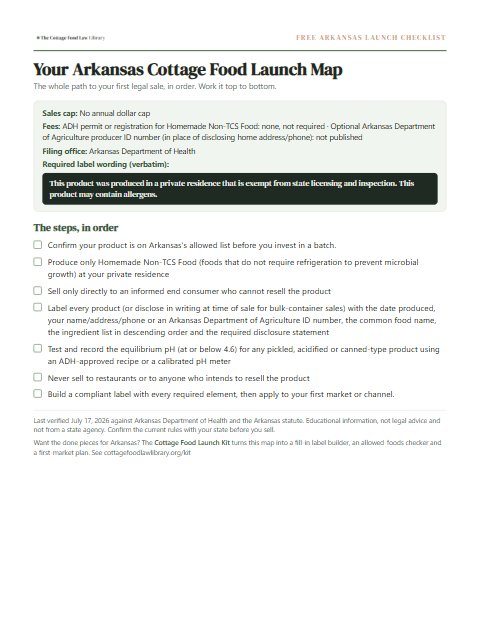
Arkansas's Food Freedom Act lets you sell homemade non-refrigerated food directly to an informed consumer with no permit, no license and no state sales cap. You do need to disclose specific information on every label, including the exact statutory disclosure statement. Stick to shelf-stable foods since anything needing refrigeration, plus dairy and meat, falls outside the exemption.
Arkansas keeps the path to selling short. There is no state permit and no annual sales cap, so foods like baked goods with a final ph at or below 4.6 and water activity at or below 0.85 and candy and confections can go to market once your label carries what the state asks for. The rules below are the whole picture.
Arkansas sets no dollar limit on cottage food sales, so the ceiling on your growth is your own kitchen and time rather than a statutory cap. The other rules that matter, the label, the allowed foods and where you can sell, are in the tables below.
The parts new Arkansas sellers most often get wrong are the exact label disclosure wording. Each one has its own row below, with the official source beside it.
How much can you sell? The Arkansas sales cap
The annual sales limit for an Arkansas cottage food operation.
| Item | Arkansas rule |
|---|---|
| Annual sales cap | No annual dollar cap in Arkansas |
| How it works | The Arkansas Homemade Food Production Guidelines (Arkansas Department of Health, May 21, 2026 update) do not state any dollar or volume sales cap for Homemade Non-TCS Food. |
What foods can you sell in Arkansas?
Allowed and prohibited categories under current Arkansas law.
| Allowed (examples) | Prohibited |
|---|---|
| Baked goods with a final pH at or below 4.6 and water activity at or below 0.85 (breads, cakes, cookies, pastries, fruit-filled pies; excludes custard, cream fillings, cheesecake and non-baked dairy items); Candy and confections (brittle, caramels, chocolate, fudge, hard candy, chocolate-covered non-TCS foods); Pickled and acidified fruits and vegetables with an equilibrium pH at or below 4.6, using an ADH-approved recipe or a calibrated pH meter; Jams, jellies, preserves, marmalades and fruit butters at or below pH 4.6; Dried, dehydrated and roasted products (baking mixes, dried fruit, granola, nut mixes, popcorn, roasted coffee, dry pasta without eggs); Frozen fruit-based treats at or below pH 4.6 (popsicles, sorbet, freezer jams); Maple syrup, sorghum and honey (including creamed honey and honey flavored with dry non-TCS ingredients); Hemp foods made only from hulled hemp seed, hemp seed protein powder or hemp seed oil; Icings, fillings, frostings, sugar art and toppings at or below pH 4.6 or water activity 0.85, when not egg, cream, milk or cream-cheese based; Whole, uncut raw fresh fruits and vegetables. | Any Time/Temperature Control for Safety (TCS) food, including raw or cooked meat, poultry, seafood, wild game and dairy products (dairy excluded under Act 698 of 2025); Cut leafy greens, cut or sliced fresh tomatoes, cut or sliced melons; Garlic-in-oil mixtures; Raw seed sprouts (microgreens harvested and cut only once at harvest are allowed); Canned low-acid foods (finished pH above 4.6), including canned beans, corn, meat, fish, poultry, broth and eggs; Smoked, cured or dried meats; Ready-to-eat food prepared on-site or unpackaged commercially prepared food; Products flavored with alcohol at or above 5% ABV; Any product with a final pH above 4.6 or water activity above 0.85 in a category that requires those limits. |
Arkansas cottage food label requirements
Every package you sell needs a label with the elements below in legible print.
- Date the food was manufactured, produced or processed
- Producer's name, address and telephone number, or an Arkansas Department of Agriculture-issued identification number in place of that information
- Common or usual name of the food
- Ingredients in descending order of predominance
- The verbatim disclosure statement (above)
- For bulk-container sales, a separate written document with all required disclosures given to the buyer at time of sale
- For online sales, the same information posted on the website in addition to the physical package label
Arkansas requires this disclosure statement, word for word:
This product was produced in a private residence that is exempt from state licensing and inspection. This product may contain allergens.
Reproduced from Arkansas's cottage food labeling requirements. Confirm the current wording with Arkansas Department of Health before you print a run of labels.
From the team behind this library
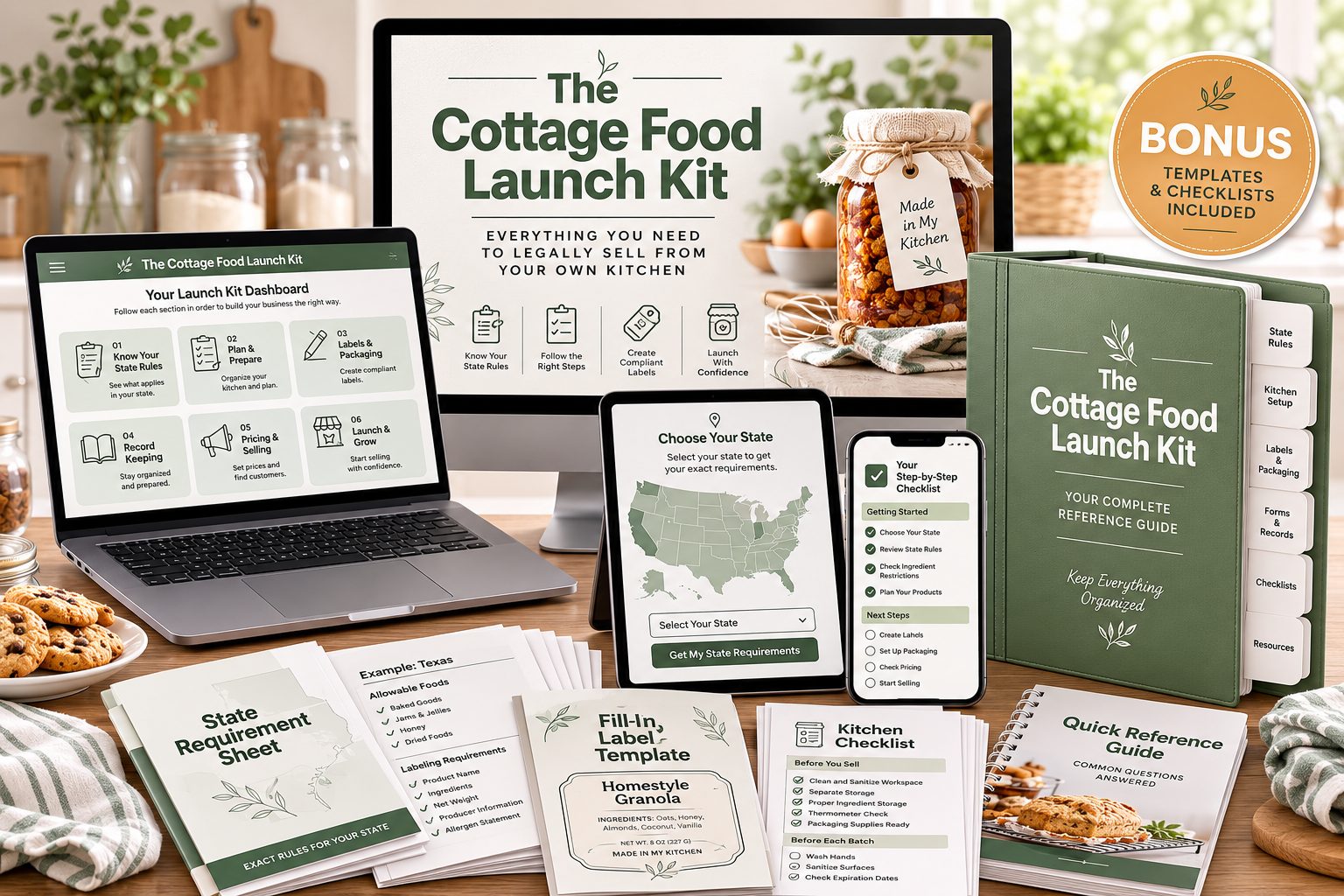
The Cottage Food Launch Kit
Want the whole path in one place? The kit turns everything on this page into one ordered walkthrough for Arkansas: your state requirement sheet, a fill-in label template with the exact required wording, the allowed-foods checker, the ordered checklist and your first-market plan. Follow it in an evening.
Where can you sell in Arkansas?
The venues and channels Arkansas cottage food operators may use.
| Channel | Allowed in Arkansas? |
|---|---|
| Direct to consumer in person, by phone or online | Yes |
| Farmers markets | Yes |
| From the producer's home, ranch, farm or office | Yes |
| Third-party vendor, including a retail shop or grocery store | Yes. The homemade product must be kept physically separate from state- or federally-inspected products at that vendor's location |
| Interstate sales | With conditions. Allowed if the seller also complies with the other state's laws and applicable federal law; producers should check with the FDA and the destination state's health authority first |
| Shipped via commercial carrier (mail, parcel post) | Yes |
| Sold to restaurants for use within the restaurant | No. Homemade Non-TCS Foods are not from an ADH-approved source for restaurant use |
| Resale by the buyer to a further purchaser | No. Must be sold to an informed end consumer who cannot resell the product |
Registration, training and inspection
Registration and permits. No registration or permit is required from the Arkansas Department of Health to produce and sell Homemade Non-TCS Food. Producers may optionally request an identification number from the Arkansas Department of Agriculture to use on labels instead of their home address and phone number.
Food safety training. The Arkansas Department of Health's Homemade Food Production Guidelines (May 2026 update) do not state a food safety training or certification requirement for Homemade Non-TCS Food producers.
Kitchen inspection. Homemade Non-TCS Food produced at a private residence is exempt from ADH permitting and inspection requirements. ADH retains general authority to act against adulterated or misbranded food.
The fees an Arkansas cottage food seller can expect.
| Item | Cost |
|---|---|
| ADH permit or registration for Homemade Non-TCS Food | none, not required |
| Optional Arkansas Department of Agriculture producer ID number (in place of disclosing home address/phone) | Not published; confirm with Arkansas Department of Health |
Wondering how Arkansas compares? See what a cottage food license costs in every state, from the no-fee states to the priciest permits.