Alabama Cottage Food Law (2026): Rules, Limits and How to Start
Do you need a license to sell homemade food in Alabama?
Alabama does not require a license or food service permit to sell homemade cottage foods. You register your operation with your county health department, complete an approved food safety course and get your label approved before you sell. There is no cap on how much you can earn.
To sell homemade food in Alabama you first register with Local county health department. The kitchen stays your own. Foods like cakes, breads, danish pastries, donuts, pastries and pies and fermented or preserved vegetables or fruit that do not produce alcohol and fall within the department's allowed acidity level are on the table once the registration and the label are done, in the order the page below lays out.
Alabama sets no dollar limit on cottage food sales, so the ceiling on your growth is your own kitchen and time rather than a statutory cap. The other rules that matter, the label, the allowed foods and where you can sell, are in the tables below.
The parts new Alabama sellers most often get wrong are the label elements, the food safety course and the registration step. Each one has its own row below, with the official source beside it.
How much can you sell? The Alabama sales cap
The annual sales limit for a Alabama cottage food operation.
| Item | Alabama rule |
|---|---|
| Annual sales cap | No annual dollar cap in Alabama |
| How it works | Act 2021-456 removed the prior $20,000 annual gross sales cap effective August 1, 2021. Alabama cottage food operators now have no state sales limit. |
What foods can you sell in Alabama?
Allowed and prohibited categories under current Alabama law.
| Allowed (examples) | Prohibited |
|---|---|
| Cakes, breads, Danish pastries, donuts, pastries and pies; Fermented or preserved vegetables or fruit that do not produce alcohol and fall within the department's allowed acidity level; Other non-potentially hazardous foods that do not require time or temperature control for safety. | Meat, poultry or fish products; Potentially hazardous foods requiring time or temperature control for safety; Fermented products that produce alcohol; Foods outside the department's allowed acidity level for preserved products. |
Alabama cottage food label requirements
Every package you sell needs a label with the elements below in legible print.
- Common or usual name of the food
- Name and home or P.O. Box address of the cottage food production operation
- A statement that the food is not inspected by the state or local health department
- Ingredient list in descending order of predominance
- Allergen disclaimer
- Minimum 10-point font
No single statewide disclosure sentence. Alabama does not set one required disclosure line in the sources we checked. Put the required elements above on every label. Confirm the current wording with Local county health department before you print a run.
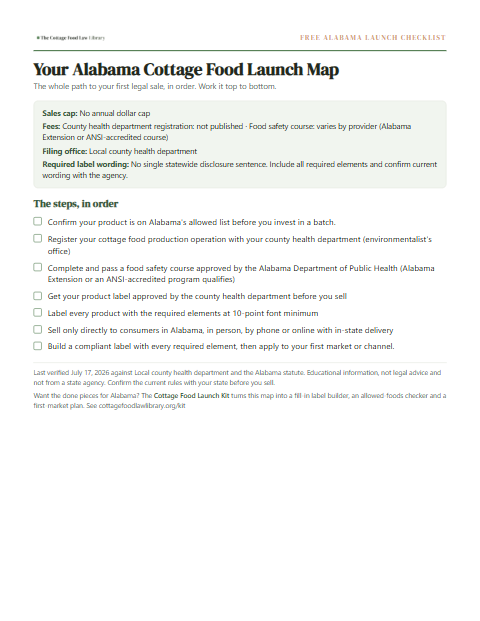
Get the free Alabama cottage food checklist
The one-page map of the steps, in order, so you can see the whole path at a glance.
Instant download, plus Alabama law-change alerts. Unsubscribe anytime.
Where can you sell in Alabama?
The venues and channels Alabama cottage food operators may use.
| Channel | Allowed in Alabama? |
|---|---|
| Direct to consumer in person (home, farmers markets, farm stands) | Yes |
| Direct to consumer by phone or online | Yes. Order may be taken remotely; delivery still direct to the Alabama consumer |
| Delivery within Alabama by mail or through an agent | Yes. Intrastate delivery only per Alabama Cooperative Extension System guidance |
| Restaurants, grocery stores or novelty shops for resale | No. Not permitted under the cottage food exemption |
| Interstate mail or carrier shipping | Not clearly authorized. Not addressed in the sources reviewed; treat as unconfirmed |
Registration, training and inspection
Registration and permits. Register the cottage food production operation with the county health department's environmentalist office. No food service permit is required, but registration and label approval are.
Food safety training. Complete and pass a food safety course approved by the Alabama Department of Public Health (Alabama Extension course or an ANSI-accredited program satisfies it).
Kitchen inspection. Neither the State Department of Public Health nor a county health department may regulate or inspect a cottage food production operation except that the department retains stop-sale, seizure or hold authority for food suspected of causing a foodborne illness.
The fees a Alabama cottage food seller can expect.
| Item | Cost |
|---|---|
| County health department registration | Not published; confirm with Local county health department |
| Food safety course | varies by provider (Alabama Extension or ANSI-accredited course) |