Georgia Cottage Food Law (2026): Rules, Limits and How to Start
Do you need a license to sell homemade food in Georgia?
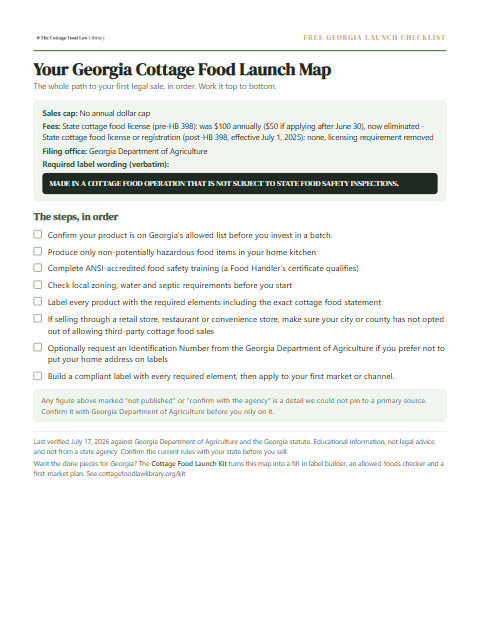
Georgia removed its cottage food license and licensing fee effective July 1, 2025 under House Bill 398. You can now sell to grocery stores, convenience stores and restaurants in addition to selling direct to consumers. You still need Food Handler-level training and a compliant label. A city or county can opt out of allowing retail sales in its jurisdiction.
Georgia keeps the path to selling short. There is no state permit and no annual sales cap, so foods like the statutory list is non-exhaustive: o.c.g.a. 26-2-470 and loaf breads, rolls, biscuits and cakes, except those whose fillings require refrigeration or have high moisture content can go to market once your label carries what the state asks for. The rules below are the whole picture.
Georgia sets no dollar limit on cottage food sales, so the ceiling on your growth is your own kitchen and time rather than a statutory cap. The other rules that matter, the label, the allowed foods and where you can sell, are in the tables below.
House Bill 398 took effect July 1, 2025. Georgia dropped the requirement to hold a cottage food license and now lets home producers sell through retail stores, alongside the direct-to-consumer sales the law already allowed. This page reflects the rule in force today; the full history sits in the law-updates log.

How much can you sell? The Georgia sales cap
The annual sales limit for a Georgia cottage food operation.
| Item | Georgia rule |
|---|---|
| Annual sales cap | No annual dollar cap in Georgia |
| How it works | No annual sales cap. HB 398 (effective July 1, 2025) removed Georgia's cottage food licensing requirement. Correction 2026-08-15: this file previously said HB 398 also eliminated a prior $5,000 sales limit. No primary source supports that. GDA's own cottage food FAQ, which is demonstrably pre-HB-398 content, states "The Georgia Department of Agriculture does not have any limits on gross sales or the number of units that can be produced", so there was no gross-sales limit before HB 398 either. The full enrolled HB 398 text contains no dollar figure of any kind and Rule 40-7-19-.05 sets no dollar cap. |
What foods can you sell in Georgia?
Allowed and prohibited categories under current Georgia law.
| Allowed (examples) | Prohibited |
|---|---|
| The statutory list is NON-EXHAUSTIVE: O.C.G.A. 26-2-470(7) reads "includes, but is not limited to"; Loaf breads, rolls, biscuits and cakes, except those whose fillings require refrigeration or have high moisture content; Pastries and cookies; Candies and confections; Fudge; Fruit pies; Jams, jellies and preserves, except fruit butters when their commercial sterility may be affected by reduced sugar or pectin levels; Uncut fruits and vegetables; Dill pickles; Dried fruits; Dry herbs, seasonings and mixtures; Dry soup mixes; Dry pasta; Cereals, trail mixes and granola; Coated and uncoated nuts; Roasted coffee beans; Vinegar and flavored vinegars; Popcorn, popcorn balls and cotton candy; Nonalcoholic beverages: a "cottage food item" is now defined as a non-potentially hazardous food OR nonalcoholic beverage (O.C.G.A. 26-2-470(2)). | Alcoholic beverages (excluded from the definition of "cottage food item"); Foods containing cannabis; Raw milk; Any potentially hazardous food requiring refrigeration or temperature control; Baked goods whose fillings require refrigeration or have high moisture content; Fruit butters, but only where their commercial sterility may be affected by reduced sugar or pectin levels. The exclusion is conditional rather than absolute; Meat, poultry, seafood and eggs as standalone products; Dairy products; Cooked vegetables and mushrooms; Raw sprouts; Pet food and treats (require separate feed licensing). |
Georgia cottage food label requirements
Every package you sell needs a label with the elements below in legible print.
- The business name, address AND telephone number of the cottage food operator, or a department-issued identification number in place of the address (O.C.G.A. 26-2-473(a)(1))
- The disclosure statement above, in at least 10 point font. The statute specifies no typeface
- The information may be provided on a package label, on a bulk-container label, on a placard at the point of sale, or on the webpage on which the item is offered for sale (26-2-473(b))
- Telephone and custom orders may substitute an oral or written disclosure
- Items sold through a third-party vendor must additionally be displayed in a separate section of the store or in a separate display case from non-cottage food items (26-2-473(d))
- The statute imposes no ingredient-list, net-weight, allergen-declaration or nutritional-claim requirement and no typeface rule. Those came from the pre-HB-398 Rule 40-7-19-.09, which is still unamended. Where the rule and the statute conflict the statute governs
Georgia requires this disclosure statement, word for word:
This product was produced at a residential property that is exempt from state inspection. This product may contain allergens.
Reproduced from Georgia's cottage food labeling requirements. Confirm the current wording with Georgia Department of Agriculture before you print a run of labels.
From the team behind this library
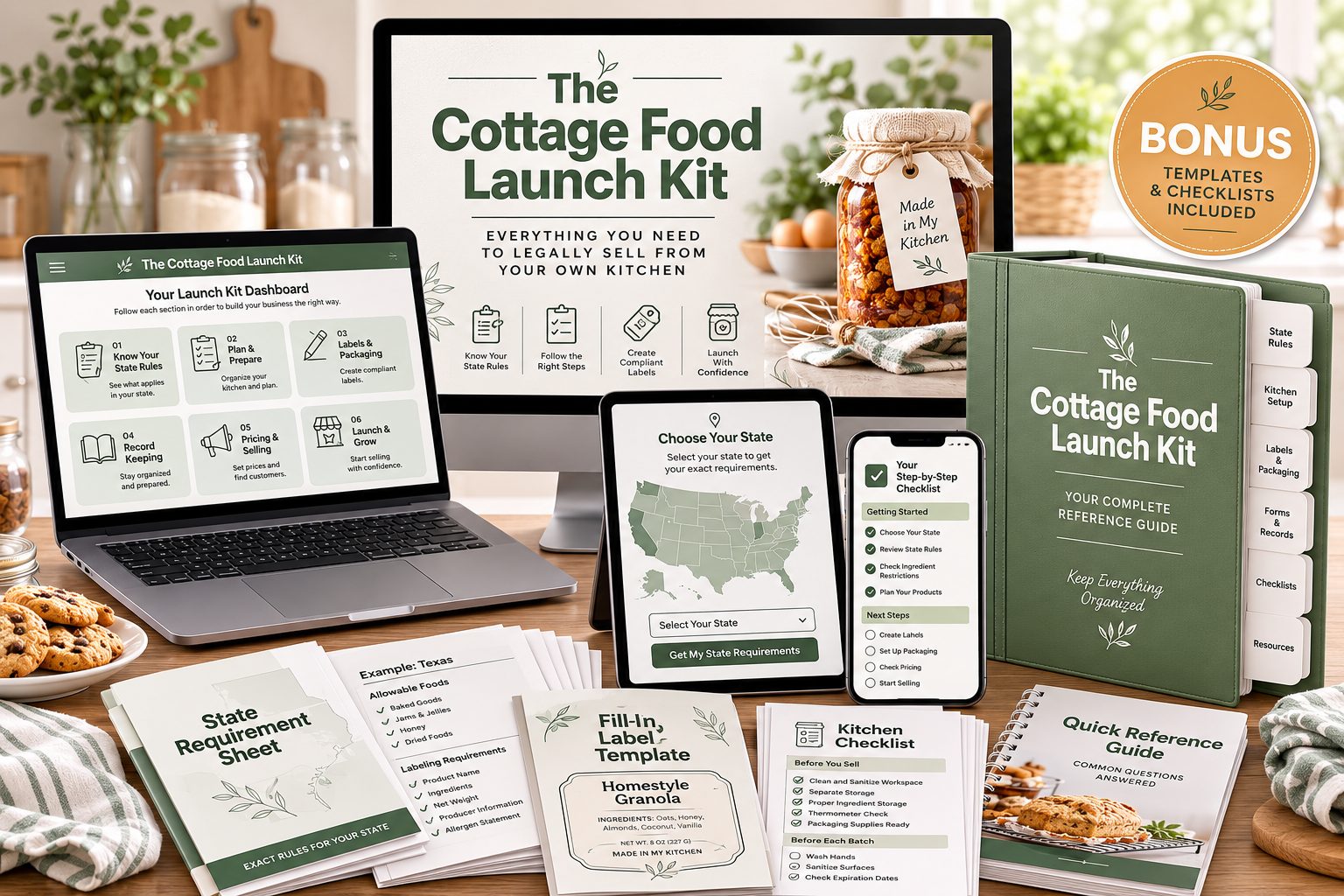
The Cottage Food Launch Kit
Want the whole path in one place? The kit turns everything on this page into one ordered walkthrough for Georgia: your state requirement sheet, a fill-in label template with the exact required wording, the allowed-foods checker, the ordered checklist and your first-market plan. Follow it in an evening.
Where can you sell in Georgia?
The venues and channels Georgia cottage food operators may use.
| Channel | Allowed in Georgia? |
|---|---|
| Direct to consumer in person, at non-profit and for-profit events | Yes |
| Online internet sales | Yes |
| Retail food sales establishments (grocery stores, convenience stores, restaurants) | With conditions. Newly allowed under HB 398 effective July 1, 2025; a city or county may pass an ordinance opting out of allowing this within its jurisdiction, so confirm local rules first |
| Commercial delivery of cottage food items | Yes. HB 398 specifically bars cities or counties from prohibiting commercial delivery companies from delivering cottage food |
| Interstate shipping / distribution across state lines | With conditions. Not prohibited by Georgia law. The new article imposes no in-state-only limit; O.C.G.A. 26-2-477 only preserves federal law "including, but not limited to, any federal law prohibiting the sale of certain food items in interstate commerce" and the law of other states. The old flat ban came from the pre-HB-398 GDA FAQ |
| Wholesale distribution generally | With conditions. Prior guidance barred wholesale/distribution outright; HB 398 specifically carves out retail food sales establishments as a new allowed channel, subject to local opt-out |
Georgia Department of Agriculture has not settled every channel in one published place. Confirm your specific channel, for example online or out-of-state shipping, with Georgia Department of Agriculture.
Registration, training and inspection
Registration and permits. Georgia removed its cottage food license requirement effective July 1, 2025 under House Bill 398. An optional Identification Number is available from GDA for operators who prefer not to disclose their home address on labels, but it is not a licensing or registration requirement to operate.
Food safety training. Confirmed current and unchanged: GDA's own live cottage-food page (agr.georgia.gov/cottage-food), fetched directly at verification, states cottage food operators must complete an ANSI-accredited food safety training program, with a Food Handler's certificate sufficient.
Kitchen inspection. With the licensing requirement gone, GDA no longer conducts pre-licensing inspections at a cottage food operator's residence. GDA still investigates consumer complaints, foodborne illness reports and public health emergencies.
The fees a Georgia cottage food seller can expect.
| Item | Cost |
|---|---|
| State cottage food license (pre-HB 398) | was $100 annually ($50 if applying after June 30), now eliminated |
| State cottage food license or registration (post-HB 398, effective July 1, 2025) | none, licensing requirement removed |
Confirm the exact course or certificate Georgia Department of Agriculture accepts before you enroll.
Wondering how Georgia compares? See what a cottage food license costs in every state, from the no-fee states to the priciest permits.
Georgia has two cottage food rulebooks in print. Only one is in force
Search for Georgia cottage food rules and you will land on Rule 40-7-19 at the Secretary of State, which describes annual registration with the Department of Agriculture, a $100 license fee halved for applications after June 30, pre-license inspections, plus a sales rule reading "Sale of cottage food products must be to the end consumer. No distribution or wholesale is allowed, including to hotels, restaurants, or institutions." None of that survived House Bill 398. The Department says so itself: the prior regulations "will be amended, including by repealing portions inconsistent with HB 398" and it will use enforcement discretion in the meantime. The rewrite had not landed when we checked, so both texts are still published.
What the statute in force actually says
HB 398 added Article 19 to Title 26 Chapter 2 of the Official Code of Georgia Annotated, Sections 26-2-470 to 26-2-478, in force since July 1, 2025. A cottage food item is a non-potentially hazardous food or nonalcoholic beverage produced at the producer's residential property. Where the item is packaged, the packaging happens there too. Alcoholic beverages, foods containing cannabis and raw milk are named out of it. The statute's own examples of non-potentially hazardous food widen the older brochure list: dill pickles, dry pasta, fudge, dry soup mixes, roasted coffee beans, uncut fruits and vegetables, alongside the breads, cakes, jams, dried fruits, seasonings, granola, nuts, vinegars, confections and popcorn people expect.
Section 26-2-472 sets the routes. You may sell directly to a person, including online and by mail order, or to retail food sales establishments including grocery stores and restaurants. Cottage food that complies with the article is to be considered as coming from an approved source, which is the technical hurdle that used to keep homemade product off a licensed shelf. Any store selling it has to post signage, specified by the Department, saying cottage food products are not subject to commercial food regulations or inspection. A third-party vendor carries one more duty: the items go in a separate section of the store or a separate display case, conspicuously labeled as containing cottage food items that are exempt from state inspection.
The disclosure sentence and where it has to appear
Section 26-2-473 asks for your business name, address and telephone number, with an identification number from the Department available in place of the address on written request, plus this statement in at least 10 point font: "This product was produced at a residential property that is exempt from state inspection. This product may contain allergens." Where that goes depends on how the food reaches the buyer. On a label affixed to the package where it is packaged. On a label affixed to the container where it sells from bulk. On a placard at the point of sale where it is neither. On the webpage where the item is offered for sale online. Sell by telephone or custom order and you may skip the display entirely, provided you tell the customer both facts, that the item was produced at a residential property exempt from state inspection and that it may contain allergens, then keep the rest of the information ready to hand over on request.
Your city can close the shop route through one procedure
Section 26-2-478 lets a county or municipality prohibit cottage food operators from selling through third-party vendors inside its boundaries. The ordinance has to be adopted at a hearing held at least 15 and no more than 45 days after notice is published in a newspaper of general circulation locally. It does not take effect until the local government notifies the Commissioner. Local government cannot otherwise regulate cottage food under the article, nor stop commercial delivery companies from delivering it. Ordinary business licensing and zoning still apply. Check the opt-out before you pitch a grocery buyer rather than after.
Enforcement is a warning first, then $75
Under Section 26-2-475 a person who willfully fails to comply gets a written warning, then a civil penalty of not more than $75.00 per violation on a second or later one. The Department may inspect the residence to investigate a consumer complaint, a report of foodborne illness or another public health emergency. That inspection is limited to the areas you use for the operation, it gets scheduled with you in advance except in emergencies. You may ask for an administrative warrant before it happens.
Sources for this section, read during this pass: the Department's own copy of HB 398 as passed, its HB 398 FAQ, the live cottage food page and the still-published Rule 40-7-19.