Florida Cottage Food Law (2026): Rules, Limits and How to Start
Do you need a license to sell homemade food in Florida?
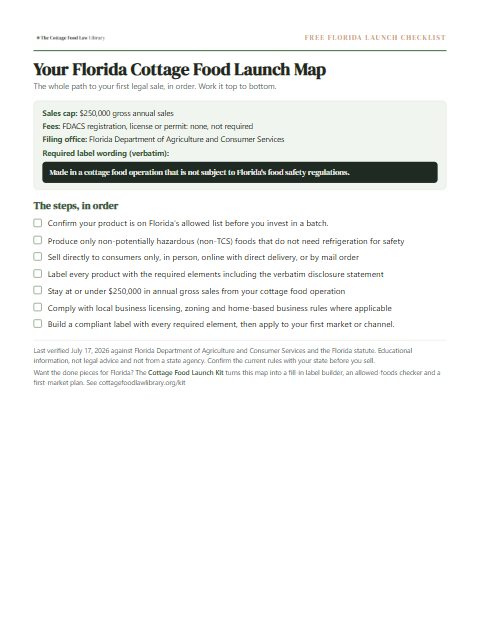
Florida does not require a license, permit or inspection to sell homemade cottage food. The state's $250,000 annual gross sales cap is the highest in the country. You can sell directly to consumers in person, online and by mail order, but not wholesale. Every product needs a compliant label with the state's exact disclosure statement.
Florida lets most home food sellers start without a state license, with a permit or registration reserved for certain foods or sales channels. Foods like loaf breads, rolls, biscuits and cakes, pastries and cookies are the common starting point. The page below shows exactly which step applies to your product.
Florida caps annual cottage food sales at $250,000 gross annual sales. House Bill 663, the 2021 'Home Sweet Home Act,' raised the cap from $50,000 to $250,000 effective July 1, 2021.
The parts new Florida sellers most often get wrong are the exact label disclosure wording. Each one has its own row below, with the official source beside it.
How much can you sell? The Florida sales cap
The annual sales limit for a Florida cottage food operation.
| Item | Florida rule |
|---|---|
| Annual sales cap | $250,000 gross annual sales |
| How it works | House Bill 663, the 2021 'Home Sweet Home Act,' raised the cap from $50,000 to $250,000 effective July 1, 2021. This is the highest cottage food sales cap of any US state found in this sweep. |
What foods can you sell in Florida?
Allowed and prohibited categories under current Florida law.
| Allowed (examples) | Prohibited |
|---|---|
| Loaf breads, rolls, biscuits; Cakes, pastries and cookies; Candies and confections; Honey; Jams, jellies and preserves; Fruit pies and dried fruits; Dry herbs, seasonings and mixtures; Homemade pasta; Cereals, trail mixes and granola; Coated or uncoated nuts; Vinegar and flavored vinegars; Popcorn and popcorn balls. | Any Time/Temperature Control for Safety (TCS) food requiring refrigeration; Dairy products and cheesecakes; Baked goods with cream, custard or meat fillings; Cream cheese and buttercream icings; Meat, poultry and seafood, including dehydrated meats and jerky; Canned vegetables and soups; Cooked vegetable products such as salsas and tomato sauces; Pumpkin and sweet potato pies, plus vegetable butters; Low-acid or acidified canned goods (most pickled products). |
Florida cottage food label requirements
Every package you sell needs a label with the elements below in legible print.
- Cottage food operation name and address
- Product name
- Ingredients listed in descending order by weight
- Net weight or volume
- Federal allergen information
- Nutritional claims, if any are made
- The disclosure statement above, at least 10-point type, contrasting color
Florida requires this disclosure statement, word for word:
Made in a cottage food operation that is not subject to Florida's food safety regulations.
Reproduced from Florida's cottage food labeling requirements. Confirm the current wording with Florida Department of Agriculture and Consumer Services before you print a run of labels.
From the team behind this library
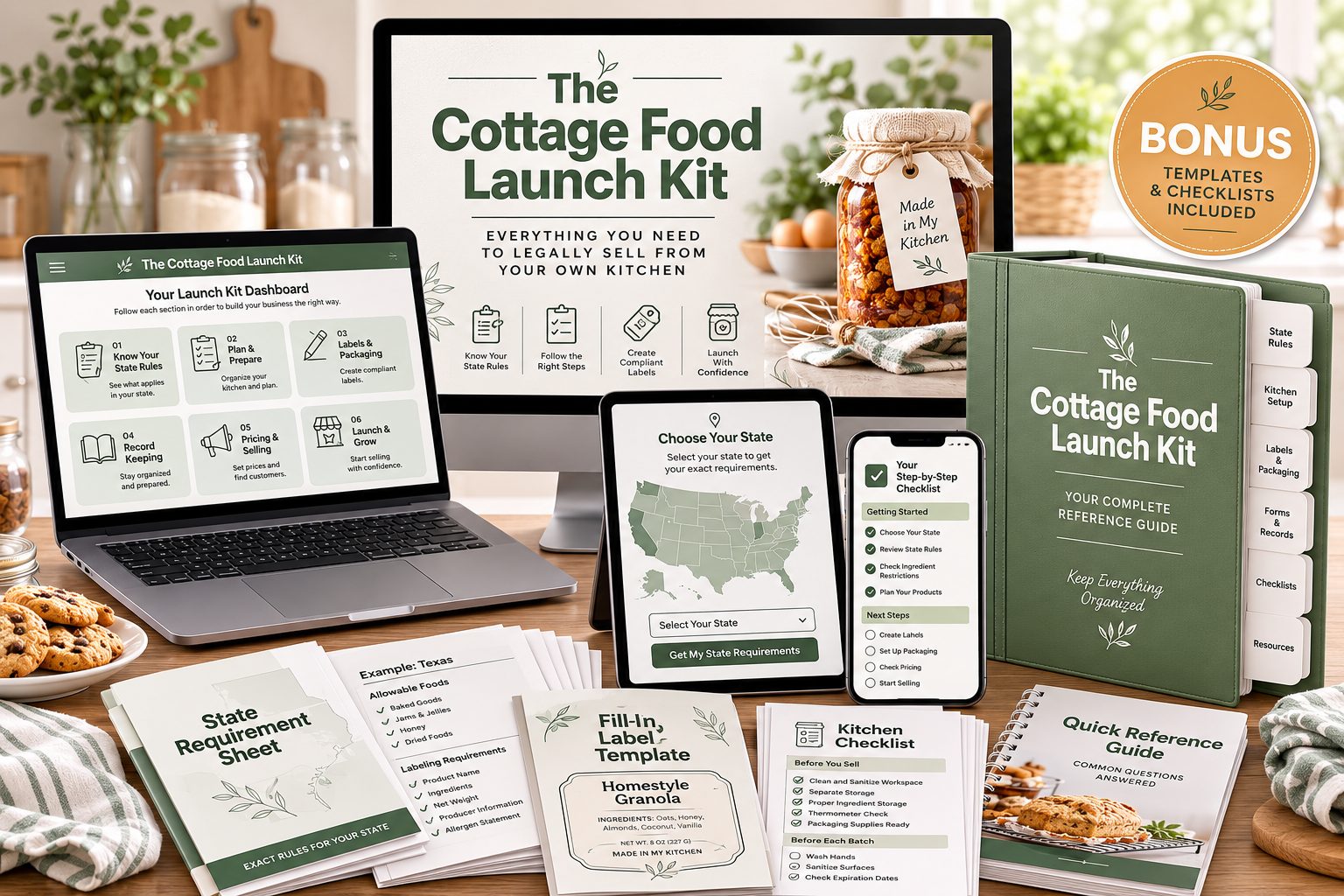
The Cottage Food Launch Kit
Want the whole path in one place? The kit turns everything on this page into one ordered walkthrough for Florida: your state requirement sheet, a fill-in label template with the exact required wording, the allowed-foods checker, the ordered checklist and your first-market plan. Follow it in an evening.
Where can you sell in Florida?
The venues and channels Florida cottage food operators may use.
| Channel | Allowed in Florida? |
|---|---|
| Direct to consumer in person | Yes |
| Website and online orders | Yes |
| Mail order / shipping by mail | Yes |
| Delivery to a consumer's private event venue (wedding, birthday party) | Yes |
| Wholesale sales | No. Not permitted under the cottage food exemption |
Registration, training and inspection
Registration and permits. No registration, license or permit is required from FDACS to operate a cottage food operation meeting the statutory conditions.
Food safety training. Florida Statute 500.80 and FDACS guidance do not impose a food safety training or certification requirement on cottage food operators.
Kitchen inspection. Cottage food operations are not subject to state food safety inspection; the required label disclosure states this directly.
The fees a Florida cottage food seller can expect.
| Item | Cost |
|---|---|
| FDACS registration, license or permit | none, not required |
Wondering how Florida compares? See what a cottage food license costs in every state, from the no-fee states to the priciest permits.
Which icings and fillings Florida allows, plus the order to start in
The short answer: a cream cheese icing and a real butter icing are both out. Margarine, shortening and vegan butter are in. That answer is not in the statute. It is written in the Department of Agriculture and Consumer Services' own cottage food guidance document, which is why searching Florida Statutes section 500.80 for the word icing returns nothing. The list on the FDACS cottage food page names "Cakes, pastries and cookies" then stops, so a decorator has to go one level deeper to get an answer.
What the law actually decides an icing on
Florida never sets out a frosting rule. It sets out a food-safety test, then lets the test decide. Section 500.03(1)(j) defines a cottage food product as "food that is not time or temperature controlled for safety or a potentially hazardous food as defined by department rule". The department rule is 5K-4.0010, whose subsection (9) reads "Potentially Hazardous Food/Time/Temperature Control for Safety Food (PHF/TCS) means food that requires time/temperature control for safety (TCS) to limit pathogenic microorganism growth or toxin formation." That is a functional test rather than a list, which is exactly why FDACS answers the frosting question in guidance instead of in the rule.
The numbers behind the test come from further along the same chapter. Rule 5K-4.002(4), effective April 22, 2026, adopts Chapters 1 through 7 of the 2022 FDA Food Code plus Annexes 3 to 7 as Florida rules. It excludes only three of the Food Code's definitions from that adoption, none of them the TCS one, so the Food Code's definition at 1-201.10(B) is Florida rule text. It decides a finished food on the interaction of its water activity and its pH. In its Table B, the one covering food that is not heat-treated after packaging, anything at a water activity below 0.88 is non-TCS at every pH, as is anything below pH 4.2 at every water activity. Cells in between are marked Product Assessment Required, meaning somebody has to demonstrate that pathogens will not grow, using intrinsic factors such as "preservatives, antimicrobials, humectants, acidulants, or nutrients" or extrinsic ones such as packaging or shelf life. Sugar is a humectant. A stiff, sugar-heavy icing is shelf stable for that reason rather than by tradition.
What FDACS says, variant by variant
The Department's guidance document answers the frosting question in one paragraph. It answers it on the fat rather than on a measurement: "Cream cheese and butter icings are not allowed to be produced under cottage food. These items require refrigeration due to the high-water content (made from cow's milk) and are considered a TCS food. Margarine (vegetable oils), Shortening (solidified fat), vegan butter/margarine (made with vegetable oils) would be considered permissible."
| What you are making it with | FDACS guidance | What the rule is deciding it on |
|---|---|---|
| Cream cheese | Not allowed under cottage food | Guidance treats the water carried in a cow's milk product as putting the finished icing into TCS territory |
| Real butter | Not allowed under cottage food | Same reasoning, stated in the same sentence. This is stricter than a Table B reading of a stiff buttercream would suggest, so treat the guidance as the operating answer in Florida |
| Margarine | Permissible | Named as a vegetable oil rather than a dairy product |
| Shortening | Permissible | Named as solidified fat |
| Vegan butter or vegan margarine | Permissible | Named as made with vegetable oils |
| Meringue powder, royal icing, fondant, ganache | Not addressed | The guidance does not name them either way. Put the question to the Division of Food Safety before you build a menu on one |
Fillings run on the same guidance rather than on a separate rule. Cake pops are allowed "provided the cake pops do not have a filling that is not allowed or inedible decorations (e.g. disco dust)". Meat fillings are out. Pumpkin and sweet potato pies are out, while fruit pies are in. Fruit butters made from fresh fruit are in, vegetable butters such as pumpkin butter are out. Commercially canned fillings such as canned pumpkin or cherry pie filling may be used; home-canned ones may not. Fresh or frozen fruit and vegetables may go into the batter, never onto the finished item as decoration or garnish.
Where the law stops and recipe testing starts
No Florida document ranks recipes. FDACS answers on ingredients, the adopted Food Code answers on the finished product's water activity and pH. A cottage food operation has no inspector reviewing the difference, because Florida issues no permit and runs no routine inspection. That gap is worth naming. If a variant sits in a Product Assessment cell of Table B, the assessment is a laboratory exercise you commission, not a form FDACS reviews. The practical position for a Florida decorator is to stay inside what the guidance names as permissible, or to make the item in a facility permitted under section 500.12 instead. For contrast, California publishes an entire approved category for frostings, icings, fondants and gum pastes that contain no eggs, cream or cream cheese, which allows a butter buttercream that Florida's guidance does not; the rules on that are set out on our California page.
The order to start in
- Settle the product first. Work out whether every finished item, icing and filling included, is outside the TCS definition above. This is the decision that everything else depends on, so it comes before packaging, pricing or a business name.
- Confirm the kitchen. It has to be the kitchen in the residence. The guidance rules out a rented kitchen, a commissary and a motor home kitchen. Water has to be potable, from a municipal supply or a properly constructed on-site well. The guidance points people with septic systems at the local health department, since a food business adds wastewater load a house was not sized for.
- Sort the home-business side. Section 500.80(6) preempts local regulation of cottage food operations to the state, so a city cannot ban you or regulate how you prepare, process, store or sell. It then routes you to section 559.955, which keeps a home-based business subject to "applicable business taxes under chapter 205" in its county and municipality. Read subsection (5)(a) before you celebrate: section 559.955 does not override a condominium declaration, a cooperative document or an HOA covenant. A deed restriction can still stop you where a city cannot.
- Build the label before the first batch. Section 500.80(3) lists the seven elements, set out in the label section higher up this page. Two details live only in the guidance: the address has to be the physical address of the home kitchen rather than a PO box. A cake that cannot carry a label is labeled on the invoice delivered with it, or on the box if it is boxed.
- Set up the sales channel you are actually allowed to use. Website orders, mail order and in-person direct sales are open under section 500.80(2). Wholesale is closed. The guidance closes the near-misses with it: no consignment, no third party collecting or distributing for you, no selling alongside a permitted food business, no selling out of a shop you lease. A farmers market may still impose its own vendor licence, which is the market's rule rather than the state's.
- Package the samples at home. Free tasting samples are allowed. The guidance requires that they be pre-packaged in the home kitchen, so bread is sliced and wrapped at home rather than cut at the stall, with a properly labeled package of the same product on display beside them.
- Keep the sales record. The $250,000 ceiling counts gross sales of cottage food products at any location, whatever the product or the number of people involved. Section 500.80(1)(b) requires you to give FDACS written documentation verifying it on request. Storage is part of the same discipline: section 500.80(4) lets you sell only products stored on the premises, which the guidance reads as the residence itself rather than a garage, shed, barn or other outbuilding.
- Know what a complaint triggers. Under section 500.80(7) the department may investigate a complaint. Only on a complaint may an authorized officer enter and inspect. Refusing that entry is itself grounds for disciplinary action under section 500.121.
Sources for this section: Florida Statutes section 500.80, the definitions at section 500.03, the home-based business section at 559.955, Florida Administrative Code rules 5K-4.0010 and 5K-4.002, the FDACS cottage foods page and the FDACS cottage food guidance document named above.