Alaska Cottage Food Law (2026): Rules, Limits and How to Start
Do you need a license to sell homemade food in Alaska?
Alaska's homemade food exemption, created by HB 251 in 2024, lets you make and sell most homemade foods, including many that need refrigeration, without a state permit, inspection or sales cap. You still need a standard Alaska business license, a compliant label on every package and you must stay clear of the specific prohibited categories like dairy, seafood and game meat.
In Alaska the path depends on what you make and how you sell it. Many home producers of foods like baked goods and other non-potentially hazardous shelf-stable foods and many potentially hazardous need no state license at all, while some foods or channels trigger a registration. The rules below sort out which one is yours.
Alaska sets no dollar limit on cottage food sales, so the ceiling on your growth is your own kitchen and time rather than a statutory cap. The other rules that matter, the label, the allowed foods and where you can sell, are in the tables below.
The parts new Alaska sellers most often get wrong are the exact label disclosure wording. Each one has its own row below, with the official source beside it.
How much can you sell? The Alaska sales cap
The annual sales limit for a Alaska cottage food operation.
| Item | Alaska rule |
|---|---|
| Annual sales cap | No annual dollar cap in Alaska |
| How it works | HB 251 (2024) removed the prior $25,000 annual sales cap that existed under Alaska's older cottage food rule. No state dollar limit currently applies to homemade food sales. |
What foods can you sell in Alaska?
Allowed and prohibited categories under current Alaska law.
| Allowed (examples) | Prohibited |
|---|---|
| Baked goods and other non-potentially hazardous shelf-stable foods; Many potentially hazardous (refrigeration-requiring) foods, expanded under the 2024 rule; Processed foods using Grade A milk or milk products (e.g. ice cream, cheesecake, custards), as distinct from raw milk products; Meat from cattle, goats, sheep, swine or catfish only if produced under USDA inspection. | Homemade dairy products made directly from animal milk (milk, cheese, butter, kefir, yogurt), regulated separately under 18 AAC 32; Seafood (salt-water and freshwater fish, amphibians, crustaceans, mollusks and other aquatic animals or byproducts); Game meat (bears, caribou, deer, elk, moose, waterfowl and other game animals); Oil rendered from animal fat; Alcohol; Cannabis. |
Alaska cottage food label requirements
Every package you sell needs a label with the elements below in legible print.
- Producer's name
- Current address
- Telephone number
- Business license number
- The disclosure statement above
Alaska requires this disclosure statement, word for word:
This food was made in a home kitchen, is not regulated or inspected, and may contain allergens.
Reproduced from Alaska's cottage food labeling requirements. Confirm the current wording with Alaska Department of Environmental Conservation, Division of Environmental Health, Food Safety and Sanitation Program before you print a run of labels.
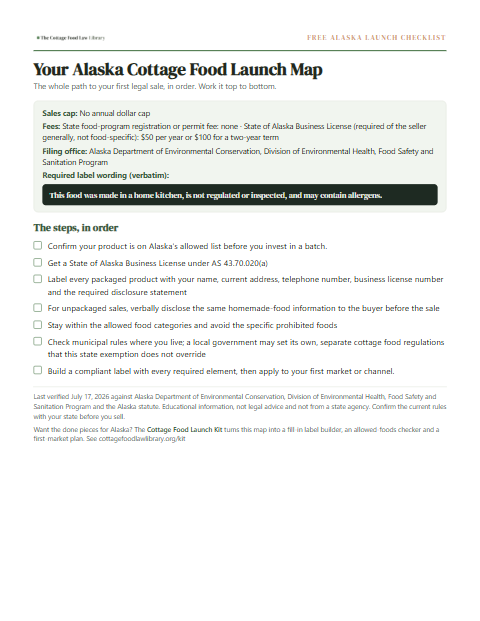
Get the free Alaska cottage food checklist
The one-page map of the steps, in order, so you can see the whole path at a glance.
Instant download, plus Alaska law-change alerts. Unsubscribe anytime.
Where can you sell in Alaska?
The venues and channels Alaska cottage food operators may use.
| Channel | Allowed in Alaska? |
|---|---|
| Direct to consumer, packaged with a compliant label | Yes |
| Direct to consumer, unpackaged with verbal disclosure before sale | Yes. Applies to sales where the item is not pre-packaged |
| Retail space selling homemade food on a producer's behalf | With conditions. A retail space selling homemade food must prominently display a sign disclosing it was made in a home kitchen, may contain allergens and is not regulated or inspected |
| Sales within a municipality with its own separate cottage food ordinance (e.g. Anchorage) | With conditions. The state exemption does not supersede stricter local rules where they exist |
Registration, training and inspection
Registration and permits. No state food-specific permit, registration or inspection is required under the homemade food exemption. A general State of Alaska Business License is required to operate as a business, which is a standard requirement unrelated to the food exemption itself.
Food safety training. No food safety training or certification requirement was found in the sources reviewed for Alaska's homemade food exemption.
Kitchen inspection. Production and sale of a homemade food in compliance with the statute is exempt from state licensing, packaging, permitting and inspection requirements.
The fees a Alaska cottage food seller can expect.
| Item | Cost |
|---|---|
| State food-program registration or permit fee | No state fee |
| State of Alaska Business License (required of the seller generally, not food-specific) | $50 per year or $100 for a two-year term |