Hawaii Cottage Food Law (2026): Rules, Limits and How to Start
Do you need a license to sell homemade food in Hawaii?
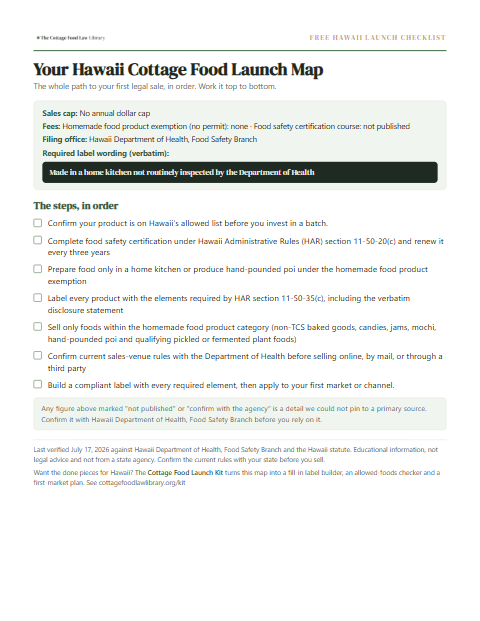
Hawaii lets you sell homemade food products from your home kitchen without a permit or a sales cap. You do need a food safety certification renewed every three years and a compliant label on every product. The rules were rewritten in 2024 and 2025 and DOH now confirms in its own current guidance that you may sell online. Mail order and shipping out of state are the two channels DOH still does not address.
Hawaii runs one of the more permissive cottage food laws in the country. You can start selling foods like baked goods and candies from your own kitchen with no state permit to file and no dollar ceiling on your sales. Once you meet the labeling step below you are clear to sell.
Hawaii sets no dollar limit on cottage food sales, so the ceiling on your growth is your own kitchen and time rather than a statutory cap. The other rules that matter, the label, the allowed foods and where you can sell, are in the tables below.
The parts new Hawaii sellers most often get wrong are the exact label disclosure wording and the food safety course. Each one has its own row below, with the official source beside it.
How much can you sell? The Hawaii sales cap
The annual sales limit for a Hawaii cottage food operation.
| Item | Hawaii rule |
|---|---|
| Annual sales cap | No annual dollar cap in Hawaii |
| How it works | Hawaii sets no dollar or unit sales cap on homemade food product operations. |
What foods can you sell in Hawaii?
Allowed and prohibited categories under current Hawaii law.
| Allowed (examples) | Prohibited |
|---|---|
| Baked goods; Candies; Jams and jellies; Mochi; Hand-pounded poi; Plant foods that are pickled, fermented or acidified, qualifying at a pH at or below 4.2 OR a water activity at or below 0.88; Products containing cut tomatoes, such as salsa, held at 41F or below; Kimchi; Juice sold direct to the consumer. | Dried meats such as beef jerky; Dried aku and other dried seafood; Fruits from the melon family, including dried melons; Dried tomatoes; Vacuum packaging, as a process; Canning of anything other than jams and jellies, as a process; Potentially hazardous (TCS) foods requiring refrigeration, excluded by definition. |
Hawaii cottage food label requirements
Every package you sell needs a label with the elements below in legible print.
- The disclosure statement above
- The food's common name
- Ingredients in descending order, with sub-ingredients listed
- Major allergen notification, including sesame
- Your name and contact information
Hawaii requires this disclosure statement, word for word:
Made in a home kitchen not routinely inspected by the Department of Health
Reproduced from Hawaii's cottage food labeling requirements. Confirm the current wording with Hawaii Department of Health, Food Safety Branch before you print a run of labels.
From the team behind this library
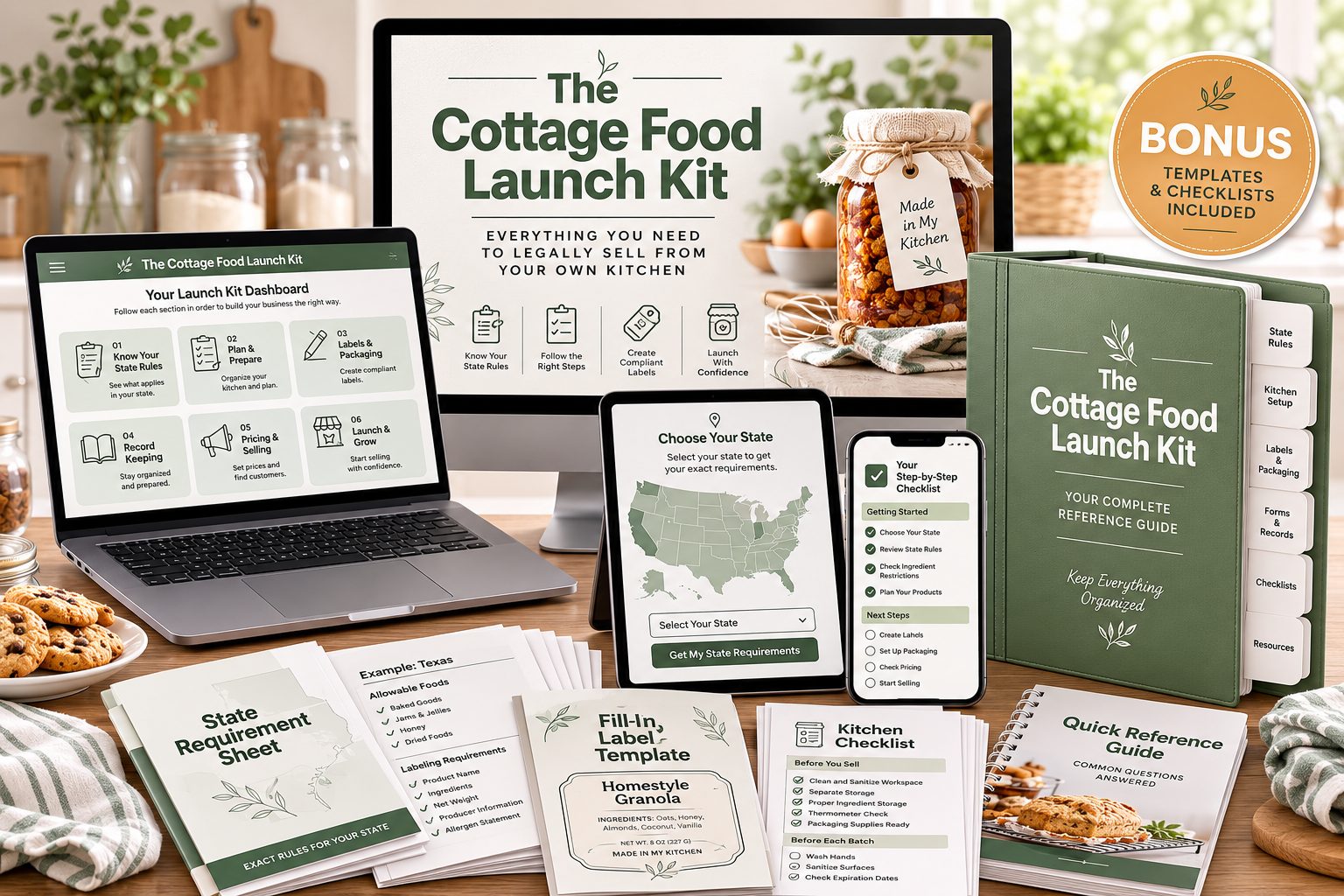
The Cottage Food Launch Kit
Want the whole path in one place? The kit turns everything on this page into one ordered walkthrough for Hawaii: your state requirement sheet, a fill-in label template with the exact required wording, the allowed-foods checker, the ordered checklist and your first-market plan. Follow it in an evening.
Where can you sell in Hawaii?
The venues and channels Hawaii cottage food operators may use.
| Channel | Allowed in Hawaii? |
|---|---|
| Direct to consumer in person (home, farmers markets) | Yes |
| Third-party sales and wholesale of non-TCS homemade food products | Yes. Confirmed directly against the Hawaii DOH's own August 2025 newsroom press release: "Allowing producers of certain Homemade food products to sell to third parties and wholesale their non-Time/Temperature Controlled for Safety products." Does not apply to home-based honey producers, who stay under HRS 328-79. |
| Online sales | Yes. Confirmed directly by the DOH Food Safety Branch's own "Homemade Food Products" fact sheet, revision-dated 01.29.2026. Under "Where can I sell my homemade food product?" it lists non-profit and for-profit events such as fundraisers, craft fairs and farmers markets, then adds: "You may also sell your product online." |
| Mail order and out-of-state shipping | Not confirmed. Split out from the online channel on 2026-08-15. DOH's fact sheet names in-person events, farmers markets, online sales and wholesale to permitted food establishments and says nothing about mail order or interstate shipping. The amended HAR 11-50-3 text that would settle it sits inside an image-only scan with no text layer |
Hawaii Department of Health, Food Safety Branch has not settled every channel in one published place. Confirm your specific channel, for example online or out-of-state shipping, with Hawaii Department of Health, Food Safety Branch.
Registration, training and inspection
Registration and permits. No permit or registration is required to operate under the homemade food product exemption. A separate permit path exists for operations that fall outside the exemption.
Food safety training. Operators must obtain food safety certification under HAR section 11-50-20(c), renewed every three years.
Kitchen inspection. No permit-triggered routine inspection applies to the homemade food product exemption, but HAR section 11-50-3 cross-references the Department of Health's general inspection sections (11-50-8, 11-50-10, 11-50-11, 11-50-14). Treat the kitchen as inspectable on complaint or cause.
The fees a Hawaii cottage food seller can expect.
| Item | Cost |
|---|---|
| Homemade food product exemption (no permit) | No state fee |
| Food safety certification course | Not published; confirm with Hawaii Department of Health, Food Safety Branch |
Not published centrally. Confirm the current amount with Hawaii Department of Health, Food Safety Branch. Confirm the exact course or certificate Hawaii Department of Health, Food Safety Branch accepts before you enroll. Confirm the inspection step that applies to your product with Hawaii Department of Health, Food Safety Branch.
Wondering how Hawaii compares? See what a cottage food license costs in every state, from the no-fee states to the priciest permits.