California Cottage Food Law (2026): Rules, Limits and How to Start
Do you need a license to sell homemade food in California?
California lets you sell homemade food under two tiers. Class A covers direct-to-consumer sales only and needs just a county registration, while Class B adds indirect sales through stores and restaurants and needs a county permit with a kitchen inspection. Both classes require an approved food processor training course, an approved-foods-list product and a compliant label. Both carry an annual gross sales cap that adjusts for inflation each year.
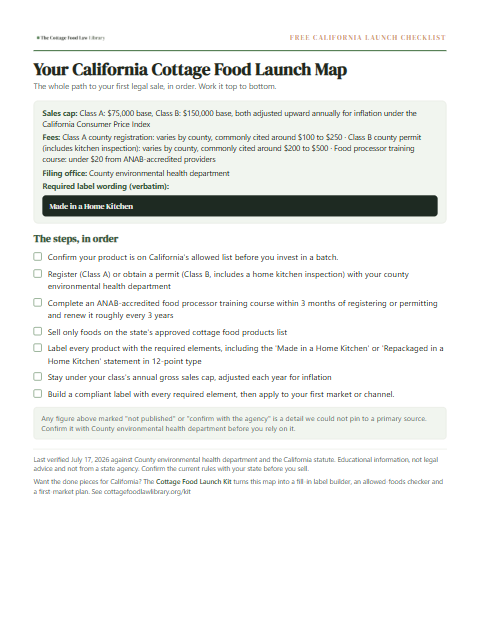
To sell homemade food in California you first register with County environmental health department. The kitchen stays your own. Foods like baked goods without cream, custard or meat fillings and candy such as brittle and toffee are on the table once the registration and the label are done, in the order the page below lays out.
California caps annual cottage food sales at Class A: $88,878, Class B: $177,756. AB 1144 (2021) replaced the original flat $50,000 cap with this two-tier, inflation-indexed structure written into Health and Safety Code Section 113758(a).
The parts new California sellers most often get wrong are the exact label disclosure wording, the food safety course and the registration step. Each one has its own row below, with the official source beside it.

How much can you sell? The California sales cap
The annual sales limit for a California cottage food operation.
| Item | California rule |
|---|---|
| Annual sales cap | Class A: $88,878, Class B: $177,756; effective January 1, 2026. Statutory bases are $75,000 and $150,000, adjusted upward each year for inflation under the California Consumer Price Index |
| How it works | AB 1144 (2021) replaced the original flat $50,000 cap with this two-tier, inflation-indexed structure written into Health and Safety Code Section 113758(a). The cap counts gross sales, meaning product price plus any shipping charged, not net profit. It excludes sales tax collected. Correction 2026-08-14: the current-year figures are now confirmed against CDPH's own hosted PDF, 'Cottage Food Operation Adjusted Gross Annual Sales Limit', fetched and read directly as the 2026 file in the CDPH Document Library. Effective January 1, 2026 the limits are Class A $88,878 and Class B $177,756, a 3.1 percent adjustment on the 2024-2025 CPI average. The same sheet prints the full history: $75,000/$150,000 from January 1, 2022, then $80,475/$160,950 for 2023, $83,614/$167,227 for 2024 and $86,206/$172,411 for 2025. The July 2026 pass could not locate a CDPH-hosted 2026 figure and this file said so; that gap is now closed. One re-verification note for whoever checks next: the 2025 filename carries a space where the 2026 filename does not, so pattern-matching the older URL returns a 404. The sheet also lists 3.1 percent for both 2025 and 2026, so identify the year by the effective-date row rather than by the percentage. |
What foods can you sell in California?
Allowed and prohibited categories under current California law.
| Allowed (examples) | Prohibited |
|---|---|
| Baked goods without cream, custard or meat fillings (breads, biscuits, churros, cookies, pastries, tortillas); Candy such as brittle and toffee; Chocolate-covered nonperishable foods (nuts, dried fruit); Dried fruit; Dried pasta; Dry baking mixes; Fruit pies, fruit empanadas and fruit tamales; Granola, cereals and trail mixes; Herb blends and dried mole paste; Honey and sweet sorghum syrup; Jams, jellies, preserves and fruit butter meeting the federal standard of identity; Nut mixes and nut butters; Popcorn; Vinegar and mustard; Roasted coffee and dried tea; Waffle cones and pizelles. | Any food not on the state's approved cottage food products list; Foods with cream, custard or meat fillings; Potentially hazardous foods requiring time or temperature control for safety, outside the approved list. |
California cottage food label requirements
Every package you sell needs a label with the elements below in legible print.
- "Made in a Home Kitchen" or "Repackaged in a Home Kitchen" in at least 12-point type on the primary display panel
- Common or adequately descriptive name of the food product
- Name of the cottage food operation
- Registration or permit number and the name of the issuing county
- Ingredient list in descending order of predominance by weight, if two or more ingredients
- Compliance with federal labeling law including allergen disclosure, to the extent required
- When the operation advertises publicly (website, social media, print, catalogue or newsletter), the advertisement must display the county of approval, the permit or registration number and "Made in a Home Kitchen" or "Repackaged in a Home Kitchen" as applicable (HSC 114365.2(f))
California requires this disclosure statement, word for word:
Made in a Home Kitchen
Reproduced from California's cottage food labeling requirements. Confirm the current wording with County environmental health department before you print a run of labels.
From the team behind this library
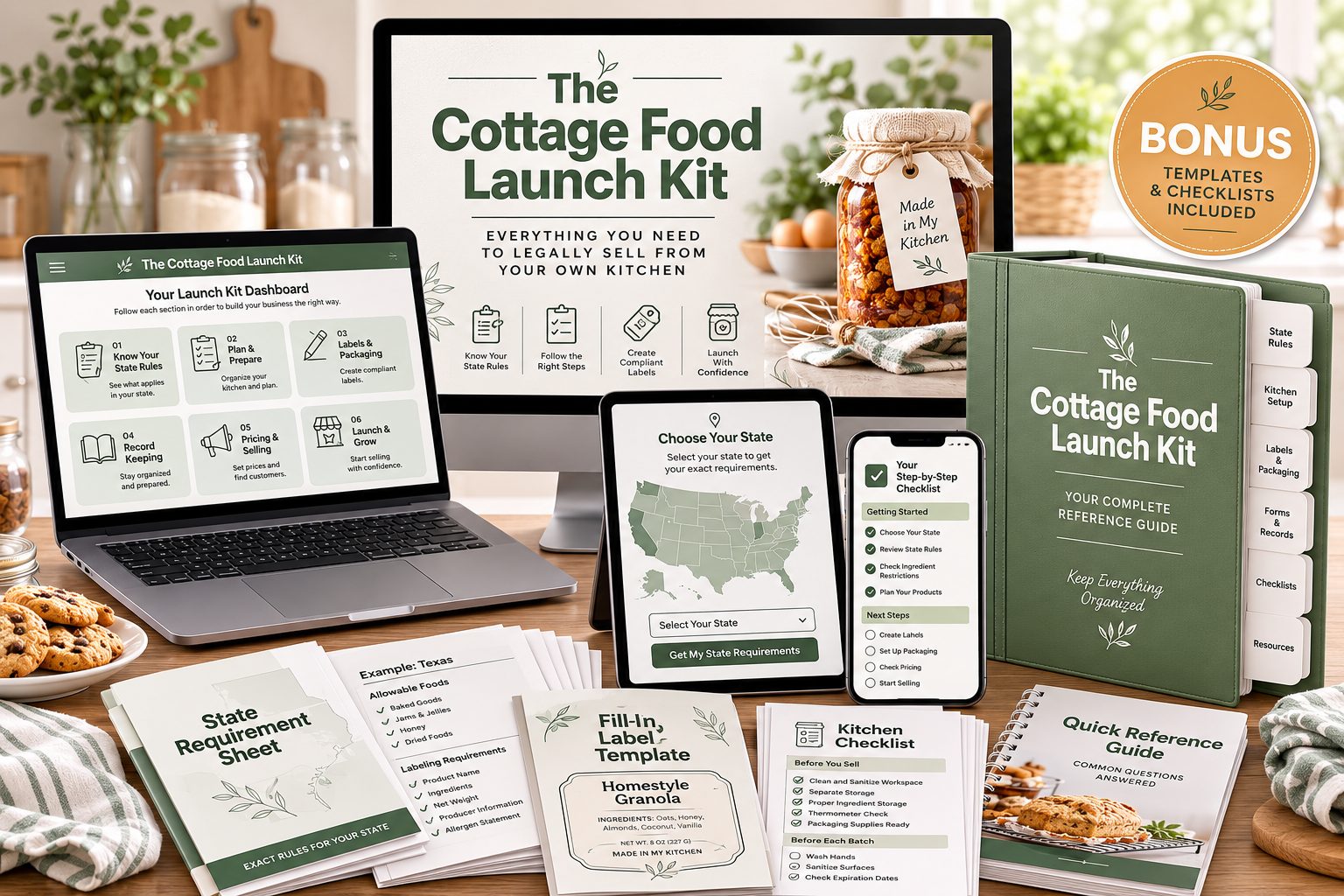
The Cottage Food Launch Kit
Want the whole path in one place? The kit turns everything on this page into one ordered walkthrough for California: your state requirement sheet, a fill-in label template with the exact required wording, the allowed-foods checker, the ordered checklist and your first-market plan. Follow it in an evening.
Where can you sell in California?
The venues and channels California cottage food operators may use.
| Channel | Allowed in California? |
|---|---|
| Direct to consumer in person (home, farmers markets, events) | Yes. Class A and Class B |
| Online direct-to-consumer sales | Yes. Class A and Class B |
| Indirect sales through stores and restaurants | With conditions. Class B permit only, which requires a home kitchen inspection |
| Third-party shipping/delivery service | Yes. Permitted, but only within California. "Direct sale" and "indirect sale" are both defined as a transaction within the state and either may be fulfilled in person, by mail delivery or through any third-party delivery service, in-state only (HSC 113758) |
Registration, training and inspection
Registration and permits. Class A cottage food operations register with their county environmental health department (no kitchen inspection). Class B cottage food operations obtain a permit from the same office, which includes a home kitchen inspection.
Food safety training. All cottage food operators must complete an ANAB-accredited food processor training course within 3 months of registering or permitting and renew it periodically (commonly cited as every 3 years).
Kitchen inspection. Class A operations do not require a home kitchen inspection. Class B operations do require one as part of the county permitting process.
The fees a California cottage food seller can expect.
| Item | Cost |
|---|---|
| Class A county registration | varies by county, commonly cited around $100 to $250 |
| Class B county permit (includes kitchen inspection) | varies by county, commonly cited around $200 to $500 |
| Food processor training course | under $20 from ANAB-accredited providers |
Not published centrally. Confirm the current amount with County environmental health department.
Wondering how California compares? See what a cottage food license costs in every state, from the no-fee states to the priciest permits.
How California's two cottage food classes actually work
California splits home food sellers into two classes, Class A and Class B. The class you choose decides who you may sell to and whether anybody inspects your kitchen. Both classes are county business even though the rules are written statewide, which is the single biggest source of confusion for new operators.
Class A: registration, a checklist, no inspection
A Class A cottage food operation registers with the local enforcement agency, which in practice is your county environmental health department, then submits a completed self-certification checklist. Health and Safety Code section 114365 then keeps Class A operations out of initial and routine inspections altogether. An inspector comes only where a consumer complaint suggests the food is being produced unsafely. Class A sells direct to the consumer: in person, at farmers markets, at events and online.
Class B: a permit, one inspection, then stores and restaurants
A Class B operation applies for a permit from the same county office and passes an initial inspection before it issues. After that the statute caps routine inspection at not more than one per year. What the permit buys is reach: Class B may do direct sales and indirect sales, which means selling through third-party retailers that hold their own valid permits.
Why the price differs from county to county
CDPH writes the statewide framework and maintains the approved cottage food products list, but you never file with CDPH. Registration, permitting, inspection and every fee happen at county level, which is why quoted figures swing so widely across the 58 counties. AB 1144 did settle the question people ask most about that: a registration or permit issued by one county is enough to operate statewide, so you do not repeat the process every time you cross a county line.
The caps and where this year's figure comes from
AB 1144 was approved on September 16, 2021 as Chapter 178 and wrote the two figures into Health and Safety Code section 113758(a): no more than "seventy-five thousand dollars ($75,000) in verifiable gross annual sales" for Class A and "one hundred fifty thousand dollars ($150,000)" for Class B, each "annually adjusted for inflation based on the California Consumer Price Index." Those bases have moved every January since. CDPH publishes the running figure on one sheet called the Cottage Food Operation Adjusted Gross Annual Sales Limit. The sheet effective January 1, 2026 sets Class A at $88,878 and Class B at $177,756, a 3.1 percent adjustment on the 2024-2025 average. The same sheet prints the history behind it: $80,475 and $160,950 in 2023, $83,614 and $167,227 in 2024, then $86,206 and $172,411 in 2025. Check the sheet again each January, because the number changes on the first of the year rather than when the statute does.
The training clock
Section 114365.2(d) gives you three months from registering to complete a department-approved food processor course, then a repeat every three years. The statute caps the course at four hours, so it is an evening rather than a project.
The California label fields the statute never lists
Health and Safety Code section 114365.2(e) names five things a cottage food label carries, all of them in the label section higher up this page. Then it hands the rest of the job to somebody else: a cottage food operation "shall properly label all cottage food products in compliance with the Federal Food, Drug, and Cosmetic Act (21 U.S.C. Sec. 343 et seq.)". Your address, your net quantity and your Nutrition Facts panel all live on that federal side of the sentence, which is why they are missing from the state list. CDPH writes them down in its own labeling document instead.
Your address: city and ZIP, or the whole street line
The state list asks for the name of the cottage food operation. It never asks for an address at all. CDPH's Labeling Requirements for Cottage Food Products, revised January 2025, asks for the operation name plus the city plus the ZIP code, then adds one condition: "If the CFO is not listed in a current telephone directory, then a street address must also be included on the label." Most home operators are not in a directory, so most of them print the street address.
The federal rule underneath it is 21 CFR 101.5(d), which starts from the opposite end: it requires the street address, the city, the state and the ZIP code, then says "the street address may be omitted if it is shown in a current city directory or telephone directory". Same outcome, opposite framing. The practical version is that city plus ZIP is the floor, the street address is what you add when nothing public already carries it. A PO box is not one of the options in either text.
Net quantity in both systems of measure
Net quantity is another field the state list leaves out. CDPH puts it back: "The net quantity (count, weight, or volume) of the food product, stated in both English (pound) units and metric units (grams)." Its own example label prints it as Net Wt. 3 oz. (85.049g), so the dual statement is one line rather than two.
Worth knowing which rule is doing the work, because the two federal texts read differently. FDA's food labeling regulation at 21 CFR 101.7(p) is permissive, saying a metric statement "may also appear on the principal display panel or on other panels". The requirement to give both traces to the Fair Packaging and Labeling Act at 15 U.S.C. 1453(a)(2), which asks for the net quantity in the most appropriate units of both the customary inch and pound system and the SI metric system. CDPH's document is where a California operator is told to do it, so treat the dual statement as the published instruction you follow rather than as an optional flourish.
The Nutrition Facts exception, plus the eleven words that end it
CDPH states the exception in one line: "Nutrition Facts panels will generally not be required for CFOs." The word doing the work is generally. The federal exemption at 21 CFR 101.9(j)(1)(i) covers food sold by a person making direct sales to consumers with annual gross sales of not more than $500,000, or annual gross food sales to consumers of not more than $50,000, on one condition: "Provided, That the food bears no nutrition claims or other nutrition information in any context on the label or in labeling or advertising." Paragraph (j)(1)(ii) computes those figures on the most recent two-year average of business activity.
CDPH lists the eleven words it treats as nutrient content claims: free, low, reduced, fewer, high, less, more, lean, extra lean, good source, light. A health claim, which links a food component to a disease or health condition, does the same thing under 21 CFR 101.14 and 101.70. Use any of them and the exemption is gone. The panel becomes mandatory. Read the phrase "in labeling or advertising" literally: a caption calling a granola high in fiber costs you the exemption for that product just as surely as printing it on the bag.
What goes on the advertisement rather than on the jar
California asks for a second disclosure that never touches the package. Section 114365.2(f) reaches an operation "that advertises to the public, including through an internet website, social media platform, newspaper, newsletter, or other public announcement" and requires three things on the advertisement itself: the county of approval, the permit or registration number, plus a statement that the food is Made in a Home Kitchen or Repackaged in a Home Kitchen as applicable. Assembly Bill 831 added it with effect from January 1, 2022, which is recent enough that plenty of shop pages and Instagram bios have never carried it.
Keep the certificate where the sale happens
Section 114365(b) sets four rules for the paper itself. The registration or permit is nontransferable, valid only for the person, location, type of food sales and distribution activity written on it. It is renewed annually. One county's registration or permit is enough to operate throughout the state. Then the one that catches people at a market stall: "The registration or permit or an accurate copy thereof shall be retained by the operator onsite at the time of either direct or indirect cottage food sale." A copy in the tote counts. Nothing in the car does not.
The published food list runs well past the statute
Section 114365.5(b) lists sixteen categories. The page's own allowed-foods table above follows it. The statute calls that list a floor rather than a ceiling. Subsection (c) lets the State Public Health Officer add or delete categories, effective 30 days after notice on the program website, outside the usual rulemaking process. So the live list is the one CDPH publishes. Its current Approved Cottage Foods list, last reviewed April 2026, runs ten numbered categories with named examples, several of which the statute never mentions:
- A whole category for icings. Category 5 covers frostings, icings, fondants and gum pastes that contain no eggs, cream or cream cheese. It names buttercream made with butter, in traditional, vegan and chocolate versions, plus flat icing, regular and chocolate fondant, sugar glazes, edible images and gum paste made with pasteurized eggs only. Frostings made with meringue powder, powdered eggs or pasteurized eggs are allowed.
- Named confections the statute skips. Freeze-dried candies, cotton candy, edible dessert sprinkles, marshmallows without eggs, salted caramels, popcorn balls.
- Extracts, with a fixed flavour list. Extracts of at least 70 proof, limited to the fruits and flavours the document names.
- Dried and freeze-dried foods. Fruit powders, fruit roll-ups, hot chocolate mix, vegetable chips, soup mixes, spice rubs. Powdered beverage bases are their own category.
- The limits inside the categories. Only roasted or pasteurized nuts. Fruit pies only, with pumpkin named as excluded. Jams and preserves only from fruits listed in 21 CFR Part 150, where the document says additional fruits or vegetables will not be approved. Honey and sorghum syrup pure, with no added ingredients.
One field note from the same source. The figures in the caps section higher up this page were read off CDPH's Adjusted Gross Annual Sales Limit sheet during this pass, fetched as a PDF rather than through the page that links it. Two things will trip up anyone re-checking them. The sheet lists the same 3.1 percent adjustment for 2025 as for 2026, so the effective-date row is the only reliable way to tell which year you are reading. The 2026 filename also drops a space the 2025 filename carries, so guessing the URL from the older one returns a 404.
Sources for this section: Health and Safety Code sections 114365 to 114365.6, CDPH's Labeling Requirements for Cottage Food Products (Rev. 1/2025), its Approved Cottage Foods list (reviewed April 2026), its Cottage Food Operation Adjusted Gross Annual Sales Limit sheet, plus 21 CFR 101.5, 101.7 and 101.9 and 15 U.S.C. 1453.