How to Label Homemade Food (2026): the Required Elements and Wording
The elements are similar everywhere. The disclosure sentence is the part your state writes word for word.
A cottage food label does two jobs. It tells your buyer what is in the package. It also carries the disclosure your state requires so a market manager or an inspector can see the food is a legal home-kitchen product. Get the elements and the exact wording right and your product stays on the table. Miss the disclosure sentence and it can be pulled, even when the food is fine.
The elements almost every state asks for
- Your business name. The name of your cottage food operation.
- Your address or a state ID number. Some states let you swap your home address for a registration or permit number so you do not print your address.
- The product name. A common or descriptive name for the food.
- The ingredient list. In descending order by weight where the product has two or more ingredients.
- Allergen declarations. The major allergens present, called out clearly.
- Net weight or quantity. Required in many states.
- The state disclosure statement. The line that names the food as a home-kitchen product, in the exact words your state sets.
The disclosure sentence is the part states write word for word
Most states mandate a specific disclosure sentence and expect it verbatim. The wording is not the same from one state to the next. Three real examples from the library:
- Texas: "THIS PRODUCT WAS PRODUCED IN A PRIVATE RESIDENCE THAT IS NOT SUBJECT TO GOVERNMENTAL LICENSING OR INSPECTION." Texas wants it in capital letters.
- California: the words "Made in a Home Kitchen" or "Repackaged in a Home Kitchen" in at least 12-point type, plus the operation name and the registration or permit number and issuing county.
- Alaska: "This food was made in a home kitchen, is not regulated or inspected, and may contain allergens." Alaska's wording comes straight from its enacted bill text.
Copy your state's sentence from your state page, not from a forum thread. A disclosure line that is close but not exact is one of the most common reasons a home product gets flagged.
Refrigerated and acidified foods carry extra lines
Where a state allows refrigerated (time and temperature controlled) foods, the label usually adds a production date and a safe-handling line. Pickled, fermented and acidified products often need a batch or lot number. Your state page notes these where they apply.
Build your label once, correctly
From the team behind this library
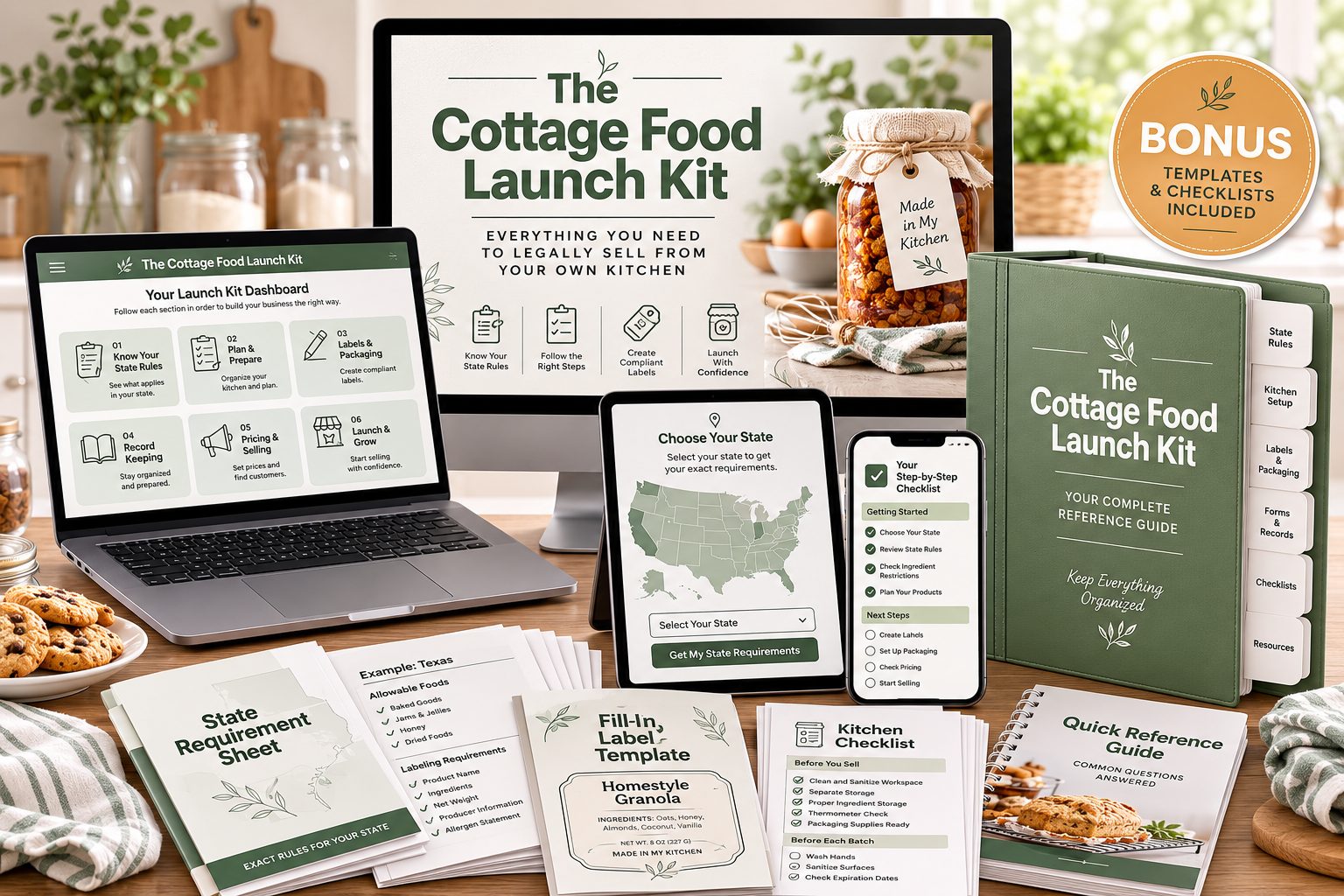
The Cottage Food Launch Kit
Want the whole path in one place? The Cottage Food Launch Kit turns the rules for your state into one ordered walkthrough: your requirement sheet, a fill-in label template with the exact required wording, the allowed-foods checker, the ordered checklist and your first-market plan.
This guide is educational information, not legal advice. Label rules change and vary by product. Confirm the current wording with your state agency before you print.
Labeling FAQ
Do all states require the same cottage food label?
No. The required elements are similar across states, but the exact disclosure sentence differs and some states do not mandate one at all. Texas, California and many others require specific wording word for word. Always use your own state page for the exact text.
What is the cottage food disclosure statement?
It is a short sentence, required by most states, that tells the buyer the food was made in a home kitchen that is not licensed or inspected. The exact words are set by each state. Reproduce them exactly; do not paraphrase.
Do I need to list allergens on a homemade food label?
Yes in almost every state. Declare the major allergens present (milk, eggs, wheat, soy, peanuts, tree nuts, fish, shellfish and sesame). Several states point to the federal allergen rules for the wording.
What does a cottage food label look like?
A typical label shows your business name, the product name, the ingredient list in descending order by weight, the allergens, the net weight and your state's home-kitchen disclosure line. For example, a cookie label might read "Maple Street Bakes, Oatmeal Cookies, 8 oz" with the ingredients and allergens below and the state disclosure sentence at the bottom. You can assemble one for your own state with the free label builder tool on this site.
How do I make or print cottage food labels?
Lay out the required elements and your state's exact disclosure wording, then print onto plain label stock or sticker sheets from any office supplier. A word processor or a free label template works for a first run; many sellers move to printed rolls once they settle on a design. The wording is what has to be right. The print method is up to you.
What is legally required on a food label?
Two layers apply. General US food-labeling rules cover the product name, the ingredient list, allergen declarations, the net quantity and the maker's name and address. Cottage food law then adds the home-kitchen disclosure line that tells the buyer the food was not made in a licensed facility. For a home seller, the disclosure sentence is the part specific to cottage food. It is the one your state most often sets word for word.