Texas Cottage Food Law (2026): Rules, Limits and How to Start
Do you need a license to sell homemade food in Texas?
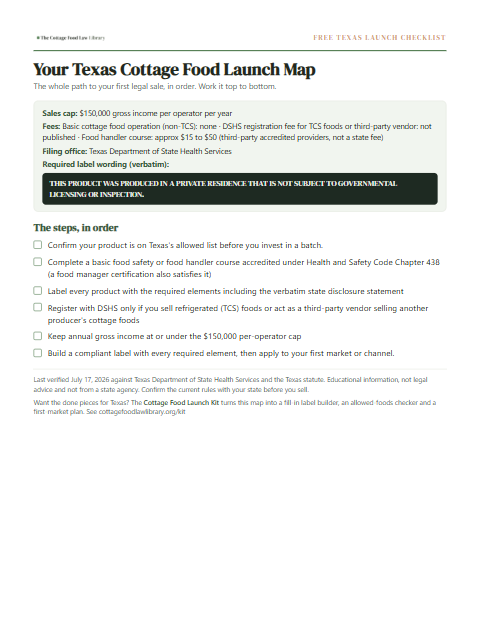
Texas does not require a permit or license to sell most homemade foods from your own kitchen. You register with the Department of State Health Services only if you sell refrigerated (TCS) foods or you act as a third-party vendor. You must finish an accredited food handler course and put a compliant label on every product.
Texas lets most home food sellers start without a state license, with a permit or registration reserved for certain foods or sales channels. Foods like baked goods and candy are the common starting point. The page below shows exactly which step applies to your product.
Texas caps annual cottage food sales at $150,000 gross income per operator per year. Tripled from $50,000 by Senate Bill 541 effective September 1, 2025.
Senate Bill 541 took effect September 1, 2025. Senate Bill 541 raised the annual gross income cap from $50,000 to $150,000, set it to adjust for inflation and let cottage producers sell most foods not on the prohibited list, including refrigerated foods once registered with DSHS. This page reflects the rule in force today; the full history sits in the law-updates log.
How much can you sell? The Texas sales cap
The annual sales limit for a Texas cottage food operation.
| Item | Texas rule |
|---|---|
| Annual sales cap | $150,000 gross income per operator per year |
| How it works | Tripled from $50,000 by Senate Bill 541 effective September 1, 2025. The $150,000 figure adjusts for inflation going forward. Counts gross income from cottage food sales, not net profit. |
What foods can you sell in Texas?
Allowed and prohibited categories under current Texas law.
| Allowed (examples) | Prohibited |
|---|---|
| Baked goods; Candy; Granola; Dried herb and spice mixes; Jams and jellies; Pickled and fermented vegetables; Roasted coffee; Dry baking mixes; Most other non-prohibited foods (SB 541 expanded to allow foods not specifically prohibited); Refrigerated (TCS) foods once registered with DSHS. | Meat and poultry; Seafood and fish; Ice or ice products, including shaved ice, ice cream, frozen custard, popsicles and gelato; Low-acid canned goods; Raw milk and raw milk products; Any product containing CBD or THC. |
Texas cottage food label requirements
Every package you sell needs a label with the elements below in legible print.
- Cottage food operation name
- Your address, or your DSHS ID number in its place
- The product name
- Major allergen declarations (eggs, tree nuts, soy, peanuts, milk, wheat, sesame) if present
- Batch or lot number (pickled, fermented or acidified products)
- Production date and safe-handling line (refrigerated TCS foods)
- The state disclosure statement in capital letters (verbatim above)
Texas requires this disclosure statement, word for word:
THIS PRODUCT WAS PRODUCED IN A PRIVATE RESIDENCE THAT IS NOT SUBJECT TO GOVERNMENTAL LICENSING OR INSPECTION.
Reproduced from Texas's cottage food labeling requirements. Confirm the current wording with Texas Department of State Health Services before you print a run of labels.
From the team behind this library
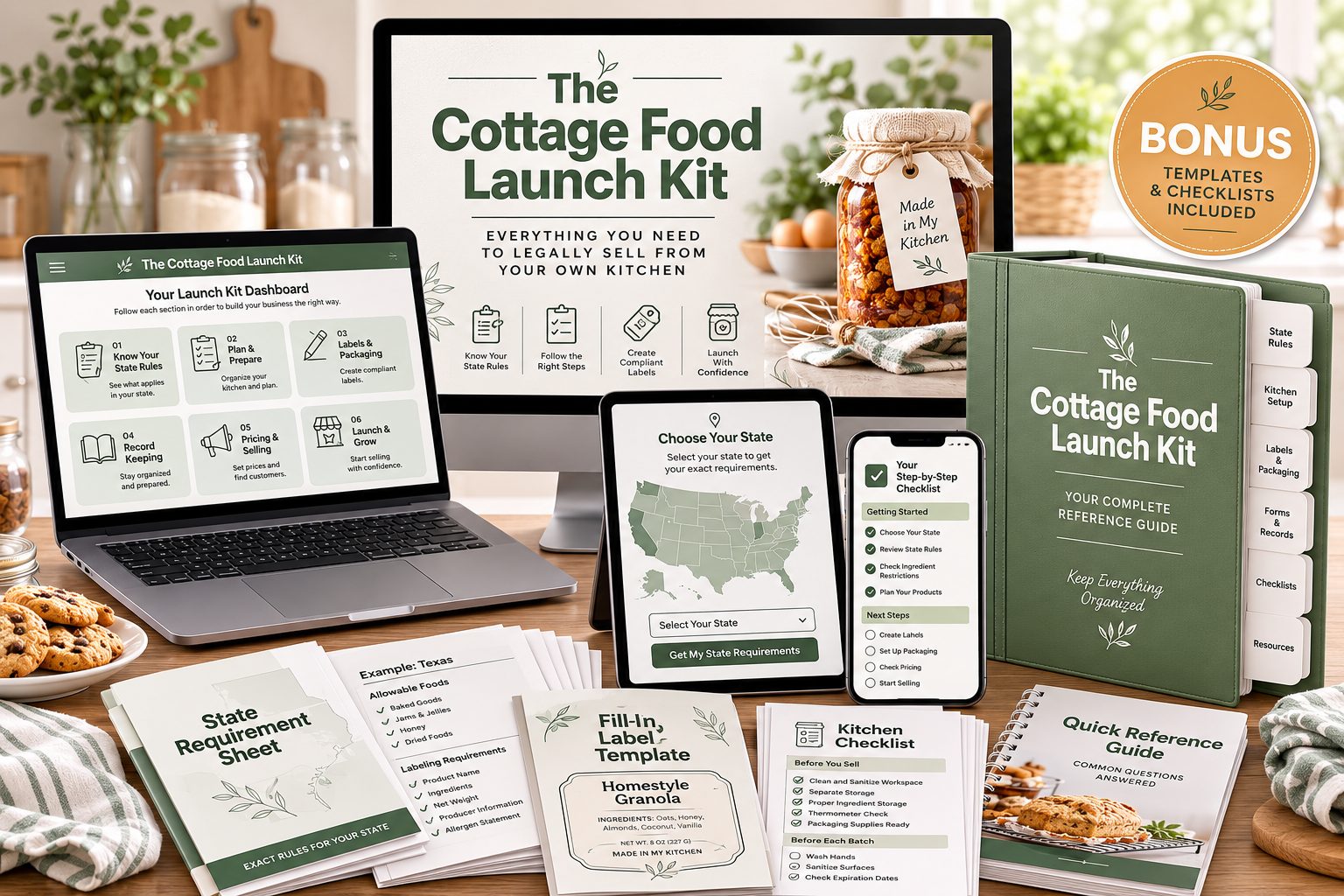
The Cottage Food Launch Kit
Want the whole path in one place? The kit turns everything on this page into one ordered walkthrough for Texas: your state requirement sheet, a fill-in label template with the exact required wording, the allowed-foods checker, the ordered checklist and your first-market plan. Follow it in an evening.
Where can you sell in Texas?
The venues and channels Texas cottage food operators may use.
| Channel | Allowed in Texas? |
|---|---|
| Direct to consumer in person (home, farmers markets, farm stands) | Yes |
| Retail stores and food service establishments | Yes. Non-refrigerated foods only. A store, food service establishment, farmers market or farm stand selling on the operation's behalf is a "cottage food vendor" under new Section 437.01965: a person with a contractual relationship with the operation who sells directly to consumers in Texas. The vendor must display a prominent sign at the point of sale reading THIS PRODUCT WAS PRODUCED IN A PRIVATE RESIDENCE THAT IS NOT SUBJECT TO GOVERNMENTAL LICENSING OR INSPECTION, the food must carry the date it was made on the label and vendors may not handle TCS foods |
| Online orders with personal delivery | With conditions. Buyer may order through the internet, but the operator, the operator's employee or a household member must personally deliver; label info must reach the buyer before payment. SB 541 struck "or by mail order" from the provision, so the internet is now the only remote ordering channel named in the statute |
| Wholesale through a registered third-party vendor | With conditions. Non-TCS foods only. A cottage food vendor that buys from the operation at wholesale must register with DSHS (Section 437.01965(d)) and Section 437.0194(a-1) permits wholesale only to a cottage food vendor and only for non-TCS, non-excluded foods |
| Refrigerated (TCS) foods sold wholesale | No. Direct to consumer only |
| Mail or carrier shipping across state lines | Not clearly authorized. Texas sources do not clearly authorize interstate carrier shipping; treat as unconfirmed and check with DSHS |
Registration, training and inspection
Registration and permits. No registration for the basic non-TCS path. Registration with DSHS is required only for refrigerated (TCS) foods or for third-party vendors selling another producer's cottage foods.
Food safety training. Operators must complete a basic food safety or food handler course accredited under Health and Safety Code Chapter 438. A food manager certification also satisfies the requirement.
Kitchen inspection. Texas law bars local governments and health departments from inspecting cottage food operations, requiring a permit or charging a fee. Health authorities keep only emergency powers for an immediate and serious threat to health.
The fees a Texas cottage food seller can expect.
| Item | Cost |
|---|---|
| Basic cottage food operation (non-TCS) | No state fee |
| DSHS registration fee for TCS foods or third-party vendor | Not published; confirm with Texas Department of State Health Services |
| Food handler course | approx $15 to $50 (third-party accredited providers, not a state fee) |
Wondering how Texas compares? See what a cottage food license costs in every state, from the no-fee states to the priciest permits.
The Texas detail: SB 541, the DSHS registration and the no-permit rule
Texas has no cottage food license to buy. The Department of State Health Services calls you a cottage food production operation. For most foods you simply start once your food handler course and your label are done. Two things are worth knowing in detail: what Senate Bill 541 actually changed and the narrow set of people who do have to register.
What SB 541 changed on September 1, 2025
DSHS summarizes the bill as one that "expands the types of allowable foods; sets conditions for the wholesale of cottage foods; changes labeling requirements; and clarifies the regulation of cottage foods." Alongside that it lifted the annual gross income threshold to $150,000 and widened the definition of a cottage food production operation to include nonprofit organizations. Public health entities across Texas had to be compliant with the new law from September 1, 2025, so guidance published before that date can be out of step.
Who actually has to register with DSHS
Only two groups, neither of them the ordinary home baker:
- Operations selling TCS foods. Time and temperature control for safety items, the refrigerated end of the list such as cheesecake, cream pies, flan or cut fruit, need a DSHS registration before you may sell them.
- Cottage food vendors. If you buy another producer's cottage foods and resell them direct to consumers, you register as a vendor.
Registration runs through the DSHS Online Licensing Registry. There is a second reason people register voluntarily: a registered operation may print a DSHS-issued unique identification number on its label in place of a home address, which keeps a residential address off every package.
The extra label line for refrigerated foods
A TCS product carries the standard disclosure statement plus a safe-handling line: "SAFE HANDLING INSTRUCTIONS: To prevent illness from bacteria, keep this food refrigerated or frozen until the food is prepared for consumption."
No city or county may permit you
This is the part Texas writes more forcefully than any other state. DSHS states that local public health entities may not regulate production at a cottage food operation, may not require any type of license or permit and may not charge a fee to produce or to sell direct to a consumer or a cottage food vendor. A local government authority may not even employ someone who knowingly requires a cottage food operation to apply for a permit. Health authorities keep only their emergency powers, for an immediate and serious threat to human life or health. Your training requirement sits in Health and Safety Code Chapter 438, which accredits the food handler programs. The rest of the framework sits in Chapter 437.
What happens if you sell food without a license in Texas
Texas sets no penalty for running a cottage food production operation, because it does not license one. Health and Safety Code section 437.0191(a) says a cottage food production operation "is not a food service establishment for purposes of this chapter", then section 437.0192(a) bars a local government authority, a local health department included, from requiring any type of license or permit or charging any fee. The penalties people search for sit on the other side of that line. They are the ordinary Texas food licensing penalties, which start applying at the point where what somebody sells stops being cottage food.
Where the line sits after the 2025 rewrite
Senate Bill 541 turned the definition around. Section 437.001(2-b) now describes a cottage food production operation as an individual working out of their own home, or a nonprofit, producing at home any food other than six excluded categories, which are meat, seafood and fish, ice cream and other frozen desserts, low-acid canned goods, raw milk and raw milk products, with an annual gross income of $150,000 or less as the department adjusts it for inflation. The exemption stops covering you at the point where you sell an excluded food, pass the cap, or sell through a channel Chapter 437 does not allow.
What applies on the licensed side of the line
- Operating without a DSHS permit is a Class A misdemeanor. Section 437.0055(a) requires a department permit to operate a food service establishment or a retail food store in an area where the county does not require one. Section 437.0165 makes operating without it an offense, a Class A misdemeanor, with each day of violation a separate offense.
- Operating without a county permit is a Class C misdemeanor. Where the commissioners court requires the permit under section 437.003, section 437.016 makes operating without it a Class C misdemeanor, again with each day counted separately.
- A court can be asked to stop it. Section 437.015 lets a city attorney, a county attorney or a district attorney sue in district court to enjoin an establishment from operating without a required permit. Section 437.0155(a) gives the department its own route to injunctive relief.
- Manufacturing food without the state license is the expensive one. A food manufacturer needs a license from the department every two years under section 431.222 of the Texas Food, Drug and Cosmetic Act. Manufacturing without it is a prohibited act under section 431.021(y). The civil penalty may not exceed $25,000 a day for each violation under section 431.0585(b). A first criminal offense is a Class A misdemeanor under section 431.059(a). Senate Bill 541 added one carve-out here: section 437.0191(c) exempts a cottage food production operation that manufactures and distributes cottage food at wholesale for resale from Chapter 431 licensing.
One figure worth handling carefully. Chapter 437 carries an administrative penalty of up to $10,000 a day at section 437.018(b), which gets quoted around as if it were a cottage food penalty. That section reaches "a person who holds a permit or who is regulated under this chapter", while 437.0191(a) puts a cottage food production operation outside the chapter's establishment definition. Treat it as belonging to the licensed side of the line rather than as your exposure while you are inside the exemption.
What a complaint against a cottage operation actually does
It gets recorded. Section 437.0192(b) requires each local health department and the department to keep a record of a complaint made against a cottage food production operation, which is a filing duty rather than an inspection trigger. DSHS states the position plainly on its own cottage food page: health departments do not have regulatory authority to conduct inspections of a cottage food production operation. What survives is the emergency power. Section 437.0191(b) preserves the authority of the department or a local health authority under sections 431.045, 431.0495 and 431.247 to act against an immediate and serious threat to human life or health, which DSHS describes as emergency orders, recall orders and delegation of powers.
Two practical notes if you are the one making a complaint or answering one. DSHS asks people to work out which department has jurisdiction over an establishment before filing, since a complaint about a locally regulated business goes to that local jurisdiction rather than to the state. And on what follows a complaint, the department's own enforcement page declines to promise a sequence: different kinds of actions may be taken depending on the severity of the offense, the history of previous violations, the efforts made to correct the violation and other matters particular to the case. Nobody can tell you a warning comes first.
The same question for every other state, with the statutes that answer it, sits in the guide on what happens if you sell without a license.
Where Texas cottage food may be sold and what goes on the package
Two questions follow the license question in Texas. Who may I sell to. What has to be on the label. Senate Bill 541 rewrote the first answer on September 1, 2025 and left the second one close to where it was. Both live in Health and Safety Code Chapter 437, in sections short enough to read over a coffee.
TCS or not: the line that decides your paperwork
Texas sorts cottage foods by whether the finished product needs a fridge. DSHS describes time and temperature control for safety foods as the ones held at "41ºF or below for cold items and 135ºF or above for hot items". Everything shelf stable runs in the ordinary lane: finish the food handler course that section 437.0195 requires, label the product, start selling. A TCS product moves you into section 437.01953, which asks three things: register with the department in the form and manner it prescribes, store and deliver the food at the air temperature needed to prevent the growth of bacteria that may cause human illness, then label it under section 437.0193.
Six categories sit outside cottage food at any temperature. No registration opens them: meat, meat products, poultry and poultry products; seafood, fish and shellfish; ice and ice products, which the statute spells out as shaved ice, ice cream, frozen custard, popsicles and gelato; low-acid canned goods; products containing cannabidiol or tetrahydrocannabinol; raw milk and raw milk products. Everything else that is not on that list is fair game, which is the reversal SB 541 made: the law now names what you may not make rather than what you may.
Who you may sell to now
Direct sales stay the backbone. The definition has you selling directly to consumers or to a cottage food vendor, delivering at the point of sale or at another location the buyer designates. The vendor route is the new one. Section 437.0194(a-1) lets you sell at wholesale to a cottage food vendor any cottage food other than a time and temperature control for safety food. A cottage food vendor is a person in Texas who has a contractual relationship with your operation and sells your food directly to Texas consumers on your behalf. Section 437.01965(a) lets that vendor sell it "at a farmers' market, a farm stand, a food service establishment, or any retail store." DSHS states the limit on the other side of that in one line: TCS foods are not eligible for wholesale. Section 437.01955 adds two smaller freedoms most operators never hear about. You may hand out samples to consumers at any location. You may also donate food other than a TCS food for sale or service at an event.
Online orders yes, carrier shipping no
Texas writes its internet rule as a delivery rule. Under section 437.0194(b) a buyer may order from you online on two conditions. You or your employee or a member of your household personally delivers the food to that buyer. The labeling information reaches the buyer before you take payment. The statute names posting a legible statement on the operation's website as the way to do the second part. Personal delivery is the catch that decides everything else. Neither the DSHS cottage food page nor the sections we read name mail or a carrier as a route for cottage food, which is why the sales table above marks carrier shipping unconfirmed rather than allowed. If shipping is the whole plan for your business, ask DSHS about the food manufacturer license before you buy boxes.
The $150,000 ceiling and what it counts
The definition at section 437.001(2-b) caps the operation at an annual gross income of $150,000 or less from the sale of food it produces, a figure the department adjusts annually for inflation using the Consumer Price Index. Gross income is the phrase to read twice. Your flour, your jars, your booth fees and your fuel do not come off before you measure yourself against it. Two honest notes. The $150,000 is the base written into SB 541. We did not find a published adjusted figure for the current year on a DSHS page during this pass, so plan against the base and ask DSHS for this year's number if you are anywhere near it. And the ceiling attaches to the operation as the statute defines it, which is an individual working out of their own home or a nonprofit organization, rather than to each person who helps in the kitchen.
The packaging rules people miss
Section 437.0193 asks for the food to be packaged in a way that prevents contamination, with an exception for items too large or bulky for conventional packaging. Where a product is not packaged, the label information goes to the buyer on an invoice or a receipt instead. A TCS product adds the date the food was made, plus the safe handling line in at least 12-point font, on the label or on that invoice or receipt. Pickled and fermented products carry a batch or lot number. The labeling guide works through the elements in order. The exact Texas disclosure sentence sits in the label section higher up this page.
If the question underneath all of this is what happens to somebody who sells outside these lines, the guide on penalties for selling food without a license answers it state by state, with Texas first.