Kansas Cottage Food Law (2026): Rules, Limits and How to Start
Do you need a license to sell homemade food in Kansas?
Kansas is one of the most open cottage food states. The Cottage Food Act needs no license, no registration, no training and no inspection to sell qualifying non-TCS foods direct to consumers. It sets no sales cap either. Multiple secondary sources describe Kansas as also allowing interstate shipping, an unusual feature worth confirming before you build a shipping-dependent product.
Kansas keeps the path to selling short. There is no state permit and no annual sales cap, so foods like baked goods and jams, jellies, fruit butters can go to market once your label carries what the state asks for. The rules below are the whole picture.
Kansas sets no dollar limit on cottage food sales, so the ceiling on your growth is your own kitchen and time rather than a statutory cap. The other rules that matter, the label, the allowed foods and where you can sell, are in the tables below.
The parts new Kansas sellers most often get wrong are the label elements. Each one has its own row below, with the official source beside it.
How much can you sell? The Kansas sales cap
The annual sales limit for a Kansas cottage food operation.
| Item | Kansas rule |
|---|---|
| Annual sales cap | No annual dollar cap in Kansas |
| How it works | Kansas sets no dollar or unit sales cap on Cottage Food Act sales. |
What foods can you sell in Kansas?
Allowed and prohibited categories under current Kansas law.
| Allowed (examples) | Prohibited |
|---|---|
| Baked goods (breads, cookies, cakes without cream or custard filling); Jams, jellies, fruit butters; Candy and fudge; Granola, trail mix, nuts and nut butters; Honey; Herb-infused oils (shelf-stable only). | Dairy products; Meat, poultry and seafood; Pickled and fermented foods; Cream or custard fillings; Anything requiring refrigeration. |
These lists follow Kansas Department of Agriculture's published guidance. Confirm your own product against Kansas Department of Agriculture before you commit to a batch.
Kansas cottage food label requirements
Every package you sell needs a label with the elements below in legible print.
- Product name
- Your name and address
- Ingredients in descending order
- Net quantity
- Federal major allergen disclosures
No single statewide disclosure sentence. Kansas does not set one required disclosure line in the sources we checked. Put the required elements above on every label. Confirm the current wording with Kansas Department of Agriculture before you print a run.
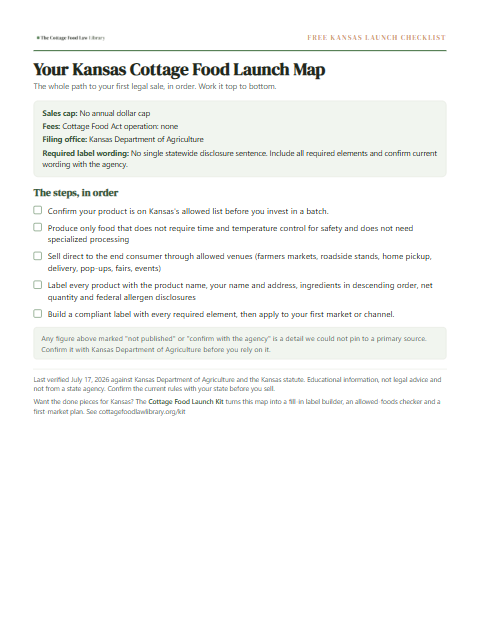
Get the free Kansas cottage food checklist
The one-page map of the steps, in order, so you can see the whole path at a glance.
Instant download, plus Kansas law-change alerts. Unsubscribe anytime.
Where can you sell in Kansas?
The venues and channels Kansas cottage food operators may use.
| Channel | Allowed in Kansas? |
|---|---|
| Farmers markets, roadside stands, home pickup, delivery, pop-ups, fairs and events | Yes |
| Interstate shipping | With conditions. Reported by multiple secondary sources as allowed; not confirmed against primary statute text during this research pass. |
Kansas Department of Agriculture has not settled every channel in one published place. Confirm your specific channel, for example online or out-of-state shipping, with Kansas Department of Agriculture.
Registration, training and inspection
Registration and permits. No government license, registration or permit is required to operate under K.S.A. 65-689(d)(4)'s direct-to-consumer producer exemption. Confirmed directly against the official Kansas Revisor of Statutes text: a person producing food for distribution directly to the end consumer, where the food does not require time and temperature control for safety or specialized processing, does not require a license.
Food safety training. No food safety training or certification requirement appears in K.S.A. 65-689(d)(4)'s text as confirmed against the official Revisor of Statutes site.
Kitchen inspection. K.S.A. 65-689(d)(4) exempts qualifying direct-to-consumer producers from routine licensing, but the statute text confirmed against ksrevisor.gov states the exemption "shall not be exempt from inspection or regulation when a violation is observed or reported to the secretary." This corrects the prior blanket "false" to a complaint-driven "conditional," matching the pattern in most other cottage food states.
The fees a Kansas cottage food seller can expect.
| Item | Cost |
|---|---|
| Cottage Food Act operation | No state fee |
Not published centrally. Confirm the current amount with Kansas Department of Agriculture.