Colorado Cottage Food Law (2026): Rules, Limits and How to Start
Do you need a license to sell homemade food in Colorado?
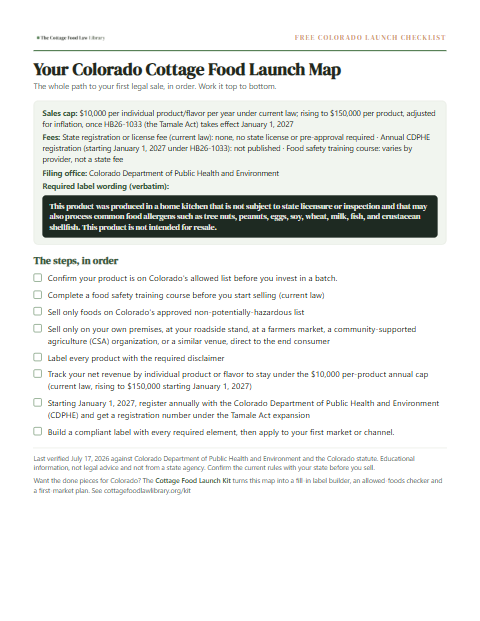
Under Colorado's current Cottage Foods Act you can sell a limited list of non-refrigerated foods directly to consumers at your home, a roadside stand, a farmers market or a similar venue, capped at $10,000 per individual product per year, after completing a food safety training course. No state license or inspection is required today, but a newly signed expansion, the Tamale Act, raises the cap to $150,000 per product and adds refrigerated and meat-containing foods starting January 1, 2027.
In Colorado the path depends on what you make and how you sell it. Many home producers of foods like spices and teas and dehydrated produce, nuts and seeds need no state license at all, while some foods or channels trigger a registration. The rules below sort out which one is yours.
Colorado caps annual cottage food sales at $10,000 per individual product/flavor per year under current law. The cap is per distinct product or flavor, not a single total across the whole operation, so a producer can exceed $10,000 in total sales by offering multiple distinct products under current law.
House Bill 26-1033 was passed and takes effect January 1, 2027. Colorado will lift the annual limit from $10,000 per product to $150,000 and let producers sell refrigerated and meat products for the first time, with a new registration and food-safety step for temperature-controlled foods. This page reflects the rule in force today; the full history sits in the law-updates log.

How much can you sell? The Colorado sales cap
The annual sales limit for a Colorado cottage food operation.
| Item | Colorado rule |
|---|---|
| Annual sales cap | $10,000 per individual product/flavor per year under current law; rising to $150,000 per product, adjusted for inflation, once HB26-1033 (the Tamale Act) takes effect January 1, 2027 |
| How it works | The cap is per distinct product or flavor, not a single total across the whole operation, so a producer can exceed $10,000 in total sales by offering multiple distinct products under current law. HB26-1033 was signed June 4, 2026 and raises this to $150,000 per product; the Cottage Foods Act provisions of that bill (CRS 25-4-1614 and CRS 35-36-102) take effect January 1, 2027, after this file's verification date, so the $10,000 figure is what currently governs. |
What foods can you sell in Colorado?
Allowed and prohibited categories under current Colorado law.
| Allowed (examples) | Prohibited |
|---|---|
| Spices and teas; Dehydrated produce, nuts and seeds; Freeze-dried produce; Honey; Jams, jellies, preserves and fruit butter; Flour; Baked goods (non-potentially-hazardous only; some pies, cheesecakes and custard pastries are excluded as potentially hazardous); Fruit empanadas and tortillas; Candies; Roasted coffee beans; Buttercream made with ghee or vegetable oil; Pickled fruits and vegetables at or below pH 4.6; Up to 250 dozen whole eggs per month (subject to separate Colorado Department of Agriculture approved-source rules); Other non-potentially-hazardous foods: the statutory list ends "and other nonpotentially hazardous foods", so it is illustrative rather than closed; Starting January 1, 2027 under HB26-1033: one type of time/temperature-control food (such as tamales, burritos or tortas) with up to 5 variations, including certain meat products using already USDA-inspected meat. | All meat products such as bacon, jerky or chicharron, plus poultry, fish and shellfish products, including as an ingredient or topping in another cottage food; Cream-filled, custard-filled or meringue-filled baked goods; Pumpkin, sweet potato and cream pies and cheesecakes, unless lab-verified as non-potentially-hazardous; Buttercream frosting made with butter; Sauces, beverages and condiments; Fresh-cut produce or juices; Pepper jelly made with fresh or dehydrated peppers; CBD and THC products; Refrigerated and time/temperature-control foods generally, under current law (allowed in a limited way only after the January 1, 2027 HB26-1033 provisions take effect). |
Colorado cottage food label requirements
Every package you sell needs a label with the elements below in legible print.
- The disclosure statement above, affixed to the product label
- A separate point-of-sale placard, sign or card displaying: "This product was produced in a home kitchen that is not subject to state licensure or inspection. This product is not intended for resale."
Colorado requires this disclosure statement, word for word:
This product was produced in a home kitchen that is not subject to state licensure or inspection and that may also process common food allergens such as tree nuts, peanuts, eggs, soy, wheat, milk, fish, and crustacean shellfish. This product is not intended for resale.
Reproduced from Colorado's cottage food labeling requirements. Confirm the current wording with Colorado Department of Public Health and Environment before you print a run of labels.
From the team behind this library
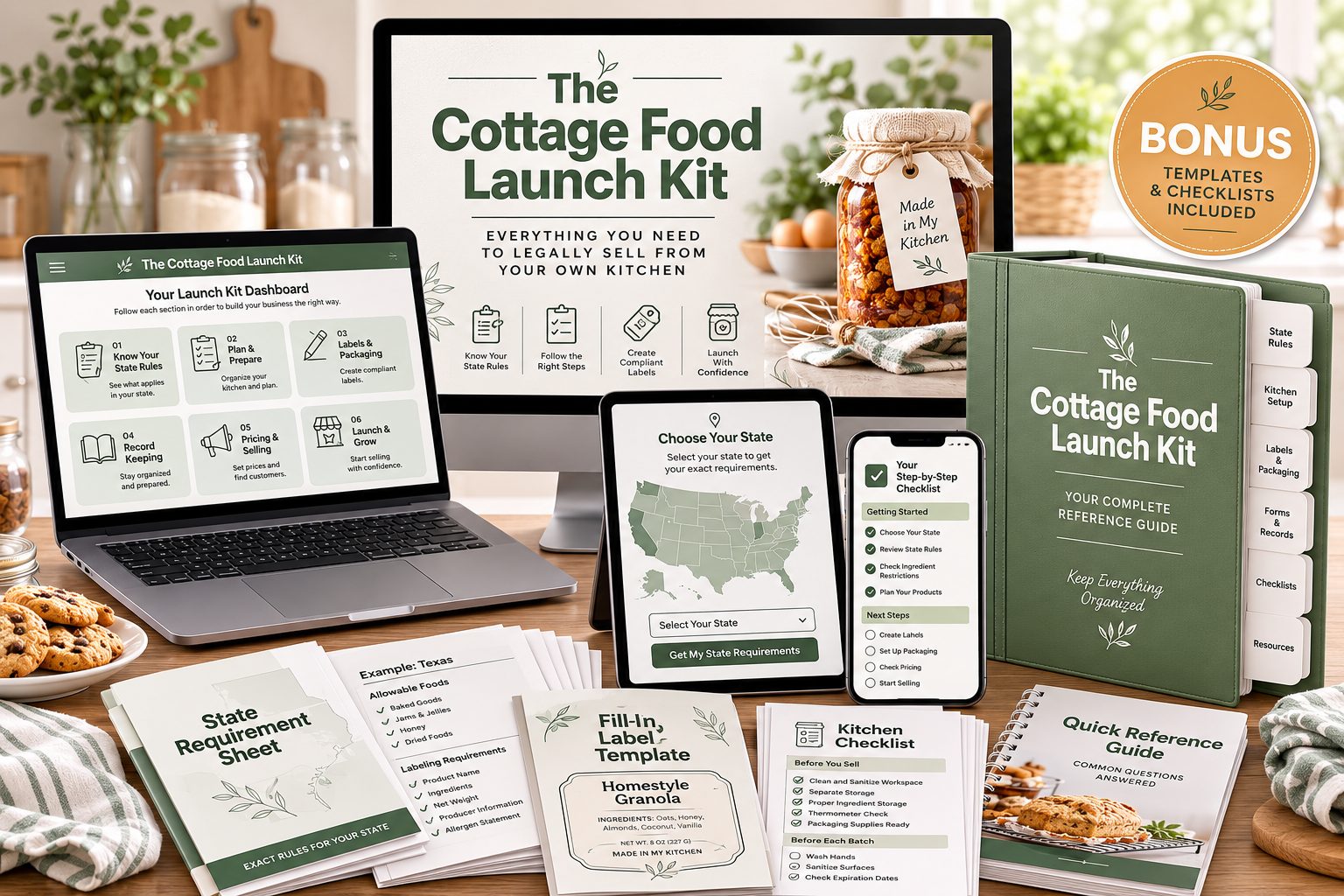
The Cottage Food Launch Kit
Want the whole path in one place? The kit turns everything on this page into one ordered walkthrough for Colorado: your state requirement sheet, a fill-in label template with the exact required wording, the allowed-foods checker, the ordered checklist and your first-market plan. Follow it in an evening.
Where can you sell in Colorado?
The venues and channels Colorado cottage food operators may use.
| Channel | Allowed in Colorado? |
|---|---|
| Producer's own premises | Yes |
| Producer's roadside stand | Yes |
| Farmers markets, CSAs and similar small-scale venues | Yes. Products must be packaged and labeled to be sold at these venues |
| Grocery stores or other retail food establishments (wholesale) | No. Prohibited under current law; selling or distributing further than the end consumer is not allowed |
| Online sales | Yes. CDPHE answers this directly: internet sales are allowed and the delivery method is for the producer and the informed end consumer to agree, so long as no interstate commerce is involved |
Registration, training and inspection
Registration and permits. No state registration or license is required under current law; a local public health agency may offer a voluntary registry. Starting January 1, 2027, HB26-1033 requires every cottage food producer to register annually with CDPHE and obtain a registration number in a public online registry.
Food safety training. Producers must complete a food safety training course before starting a cottage foods business under current law. HB26-1033 adds a specific time-and-temperature-control food safety course requirement for producers selling refrigerated foods once that provision takes effect January 1, 2027.
Kitchen inspection. Colorado's Cottage Foods Act specifically excludes a qualifying home kitchen from the definition of a retail food establishment, so no state licensing inspection applies under current law.
The fees a Colorado cottage food seller can expect.
| Item | Cost |
|---|---|
| State registration or license fee (current law) | none, no state license or pre-approval required |
| Annual CDPHE registration (starting January 1, 2027 under HB26-1033) | Not published; confirm with Colorado Department of Public Health and Environment |
| Food safety training course | varies by provider, not a state fee |
Wondering how Colorado compares? See what a cottage food license costs in every state, from the no-fee states to the priciest permits.