Oklahoma Cottage Food Law (2026): Rules, Limits and How to Start
Do you need a license to sell homemade food in Oklahoma?
Oklahoma's Homemade Food Freedom Act lets you sell homemade food from your home with no license and no inspection, up to $75,000 in gross annual sales. Starting November 1, 2026, the law is renamed the Local Food Freedom Act and that cap rises to $250,000 under House Bill 3720, signed May 5, 2026.
In Oklahoma the path depends on what you make and how you sell it. Many home producers of foods like breads, cookies and cakes without cream fillings and candies and chocolate confections need no state license at all, while some foods or channels trigger a registration. The rules below sort out which one is yours.
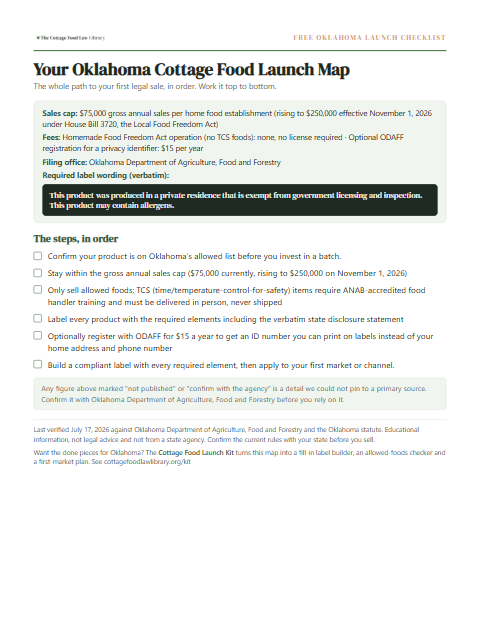
Oklahoma caps annual cottage food sales at $75,000 gross annual sales per home food establishment. The cap is gross sales, not net profit, per home food establishment.
House Bill 3720 was passed and takes effect November 1, 2026. Oklahoma renames its law the Local Food Freedom Act and raises the annual sales cap from $75,000 to $250,000, one of the highest ceilings in the country, while keeping the labeling and food-safety training rules. This page reflects the rule in force today; the full history sits in the law-updates log.
How much can you sell? The Oklahoma sales cap
The annual sales limit for an Oklahoma cottage food operation.
| Item | Oklahoma rule |
|---|---|
| Annual sales cap | $75,000 gross annual sales per home food establishment (rising to $250,000 effective November 1, 2026 under House Bill 3720, the Local Food Freedom Act) |
| How it works | The cap is gross sales, not net profit, per home food establishment. HB 3720 also expands the definition of a qualifying establishment beyond just a residence and updates delivery/sale provisions; it does not take effect until November 1, 2026, so $75,000 remains the operative cap as of this sweep. |
What foods can you sell in Oklahoma?
Allowed and prohibited categories under current Oklahoma law.
| Allowed (examples) | Prohibited |
|---|---|
| Breads, cookies and cakes without cream fillings; Candies and chocolate confections; Jams, jellies and preserves; Dry mixes, spices and seasoning blends; Granola, popcorn and roasted nuts; TCS (time/temperature-control-for-safety) items with required training and in-person delivery only. | Meat, poultry and meat by-products; Seafood; Unpasteurized (raw) milk; Cannabis or marijuana products; Alcoholic beverages. |
Oklahoma cottage food label requirements
Every package you sell needs a label with the elements below in legible print.
- Business name and address, or the ODAFF-issued identifier if registered for label privacy
- Product name and a description of the product
- Producer telephone number
- Ingredient list
- Allergen declarations
- The disclosure statement (verbatim above) in 10-point minimum font with contrasting print
- THIRD-PARTY VENDORS ONLY: the vendor displays a placard where homemade food products are displayed for sale reading "This product was produced in a private residence that is exempt from government licensing and inspection. This product may contain allergens." The allergen sentence belongs on that placard, not on the producer's own label
Oklahoma requires this disclosure statement, word for word:
This product was produced in a private residence that is exempt from government licensing and inspection.
Reproduced from Oklahoma's cottage food labeling requirements. Confirm the current wording with Oklahoma Department of Agriculture, Food and Forestry before you print a run of labels.
From the team behind this library
The Cottage Food Launch Kit
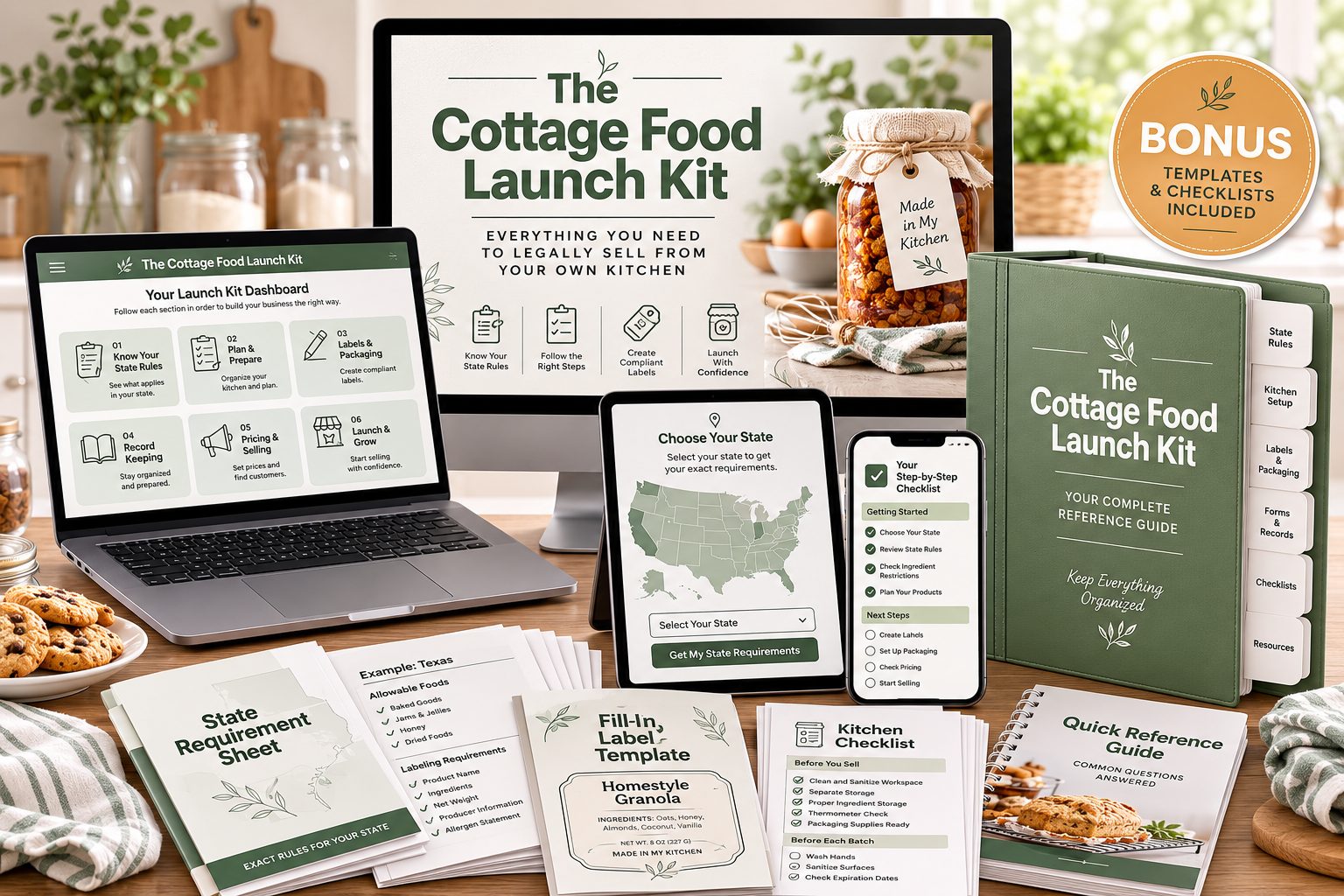
Want the whole path in one place? The kit turns everything on this page into one ordered walkthrough for Oklahoma: your state requirement sheet, a fill-in label template with the exact required wording, the allowed-foods checker, the ordered checklist and your first-market plan. Follow it in an evening.
Where can you sell in Oklahoma?
The venues and channels Oklahoma cottage food operators may use.
| Channel | Allowed in Oklahoma? |
|---|---|
| Direct to consumer at home | Yes |
| Farmers markets | Yes |
| Online orders | Yes. Non-TCS homemade food may be delivered by the producer or a designated agent, or by a third-party vendor or a third-party carrier such as a parcel delivery service. The statute sets no in-state limit on non-TCS sales |
| Third-party retail placement | With conditions. Non-perishable (non-TCS) items only |
| TCS food delivery | With conditions. Must be delivered in person; shipping TCS foods is not allowed |
| Third-party carrier shipping (non-TCS foods) | Yes. 2 O.S. 5-4.3(A)(2)(b) names delivery "by a third-party vendor or a third-party carrier, such as a parcel delivery service" |
| Interstate distribution (non-TCS foods) | With conditions. 2 O.S. 5-4.3(A)(7): "If the homemade food product is packaged and distributed in interstate commerce, it shall also be sold and labeled in accordance with federal law." Oklahoma law contemplates it; federal law and the destination state still apply |
Registration, training and inspection
Registration and permits. No registration is required to operate under the base Homemade Food Freedom Act. An optional $15-a-year ODAFF registration (added by HB 2975, 2024) provides a label ID number in place of a home address and phone number.
Food safety training. No training requirement for non-TCS shelf-stable foods. Sellers of TCS (time/temperature-control-for-safety) items must complete ANAB-accredited food handler training.
Kitchen inspection. No routine home kitchen inspection is required under the Homemade Food Freedom Act.
The fees an Oklahoma cottage food seller can expect.
| Item | Cost |
|---|---|
| Homemade Food Freedom Act operation (no TCS foods) | none, no license required |
| Optional ODAFF registration for a privacy identifier | $15 per year |
Not published centrally. Confirm the current amount with Oklahoma Department of Agriculture, Food and Forestry.
Wondering how Oklahoma compares? See what a cottage food license costs in every state, from the no-fee states to the priciest permits.
The law's real name: the Homemade Food Freedom Act
Oklahoma's law is the Homemade Food Freedom Act. House Bill 1032, enacted in 2021, renamed the Home Bakery Act of 2013 and rewrote it into the broad food-freedom law in force today. If you searched for an Oklahoma home bakery license, the Home Bakery Act is the thing that no longer exists under that name.
The Act calls your business a home food establishment, which it defines as a business on the premises of a residence where homemade food products are created for sale or resale, where gross annual sales of prepared food are under $75,000.00. Gross annual sales counts everything the business produces at any location, not just what you sell at one market. Production and sale of qualifying homemade food products are exempt from all licensing and other requirements of the State Department of Health as well as the Oklahoma Department of Agriculture, Food and Forestry.
Two rules inside the Act catch people out. Non-TCS shelf-stable items may travel through a third-party vendor such as a shop, a farm stand or a craft fair, provided the vendor displays a placard with the required disclosure where the products sit. TCS items, the ones needing time or temperature control, must be sold by the producer directly to the consumer and delivered by the producer. The producer must first pass an approved food safety training course of no more than eight hours. The Act names ServSafe Food Handler Training as one accepted provider.
The label rule is a format rule as much as a wording rule. The required information goes in legible print of at least 10-point font: on the package if packaged, on a placard at the point of sale plus a card the buyer can carry if not, or displayed on the webpage for an internet sale. The required line reads: "This product was produced in a private residence that is exempt from government licensing and inspection."
Where to find it: the Act sits in Title 2 of the Oklahoma Statutes at sections 5-4.1 through 5-4.6, the sections House Bill 1032 amended. From November 1, 2026 House Bill 3720 renames it the Local Food Freedom Act and raises the ceiling to $250,000.