Nebraska Cottage Food Law (2026): Rules, Limits and How to Start
Do you need a license to sell homemade food in Nebraska?
Nebraska lets you sell homemade food from your own kitchen with free, one-time registration through the Department of Agriculture and no cap on how much you can earn. You must finish an accredited food safety course before your first sale and post a visible notice that your kitchen is not state-inspected. A 2024 law expansion (LB262) widened the allowed foods list and confirmed the private-home rule.
Nebraska lets you sell homemade food once you register with Nebraska Department of Agriculture. There is no commercial-kitchen requirement, so foods like baked goods that are not time/temperature-control-for-safety and jams, jellies and preserves can come straight from your own kitchen after you complete the registration and label step below.
Nebraska sets no dollar limit on cottage food sales, so the ceiling on your growth is your own kitchen and time rather than a statutory cap. The other rules that matter, the label, the allowed foods and where you can sell, are in the tables below.
The parts new Nebraska sellers most often get wrong are the exact label disclosure wording, the food safety course and the registration step. Each one has its own row below, with the official source beside it.
How much can you sell? The Nebraska sales cap
The annual sales limit for a Nebraska cottage food operation.
| Item | Nebraska rule |
|---|---|
| Annual sales cap | No annual dollar cap in Nebraska |
| How it works | Nebraska's statute sets no dollar limit on cottage food sales or income. Multiple independent sources (the Nebraska Department of Agriculture page and the UNL Cottage Food Law site) confirm no cap language exists in the Pure Food Act's cottage food sections. Sales must stay direct to the end consumer within the allowed venues. |
What foods can you sell in Nebraska?
Allowed and prohibited categories under current Nebraska law.
| Allowed (examples) | Prohibited |
|---|---|
| Baked goods that are not time/temperature-control-for-safety (TCS) foods; Jams, jellies and preserves; Candy and chocolate-covered strawberries; Freeze-dried items where otherwise permitted; Granola, trail mixes and similar dry goods; Some TCS foods newly permitted after the 2024 LB262 expansion when kept refrigerated or frozen, such as certain ice cream, cheese, cheesecake and pudding items. | Any part of an animal, vertebrate or invertebrate, or animal byproduct; Fluid milk or milk products as defined in the Grade A Pasteurized Milk Ordinance under the Nebraska Milk Act; Raw eggs; Unpasteurized juice; Infused oils or infused honey; Sprouts of any type; Low-acid canned and hermetically sealed acidified foods; Tofu, tempeh and meat substitutes; Kimchi, kombucha and other fermented foods. |
Nebraska cottage food label requirements
Every package you sell needs a label with the elements below in legible print.
- Producer name and specific mailing address
- The visible notification statement (verbatim above), required at the point of sale, on the producer's website if one exists, in any print, radio, television or internet advertisement and at the producer's home for pickup or delivery orders
- Ingredients listed in descending order of predominance for TCS foods sold under the 2024 expansion
Nebraska requires this disclosure statement, word for word:
The food was prepared in a kitchen that is not subject to regulation and inspection by a regulatory authority and may contain allergens.
Reproduced from Nebraska's cottage food labeling requirements. Confirm the current wording with Nebraska Department of Agriculture before you print a run of labels.
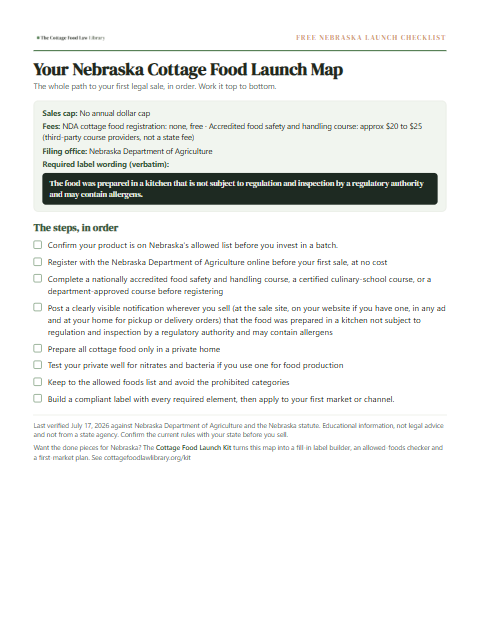
Get the free Nebraska cottage food checklist
The one-page map of the steps, in order, so you can see the whole path at a glance.
Instant download, plus Nebraska law-change alerts. Unsubscribe anytime.
Where can you sell in Nebraska?
The venues and channels Nebraska cottage food operators may use.
| Channel | Allowed in Nebraska? |
|---|---|
| Direct from the producer's private home (pickup or delivery) | Yes. Notification statement must be posted at the home. |
| Farmers markets and roadside stands | Yes |
| Fairs, festivals, craft shows and other public events | Yes. Notification must be provided at the sale location; local county, city or village event rules also apply. |
| Online or mail order for non-TCS foods | Yes. Shippable by US mail or commercial delivery; website must carry the notification statement. |
| Retail stores, restaurants and catering | No |
| Wholesale or third-party retailers (e.g. selling through a coffee shop) | No |
| Mobile trailers or commercial kitchens | No. LB262 (2024) confirmed all cottage food must be prepared in a private home, not a mobile unit. |
Registration, training and inspection
Registration and permits. Every cottage food producer must register with the Nebraska Department of Agriculture online before conducting any sales. Registration is free and does not expire, so no annual renewal is required.
Food safety training. Producers must complete one of: a nationally accredited food safety and handling education course, a certified food safety and handling course offered at a culinary school, or a food safety and handling course approved by the department. Providers cited by the department include ServSafe, StateFoodSafety and Nebraska Extension's own cottage food training.
Kitchen inspection. Home kitchens producing cottage food are not subject to state regulation and inspection by a regulatory authority. Producers using a private well must test it for nitrates and bacteria. They must still follow any applicable county, city or village food safety rules when selling at a public event.
The fees a Nebraska cottage food seller can expect.
| Item | Cost |
|---|---|
| NDA cottage food registration | none, free |
| Accredited food safety and handling course | approx $20 to $25 (third-party course providers, not a state fee) |