South Dakota Cottage Food Law (2026): Rules, Limits and How to Start
Do you need a license to sell homemade food in South Dakota?
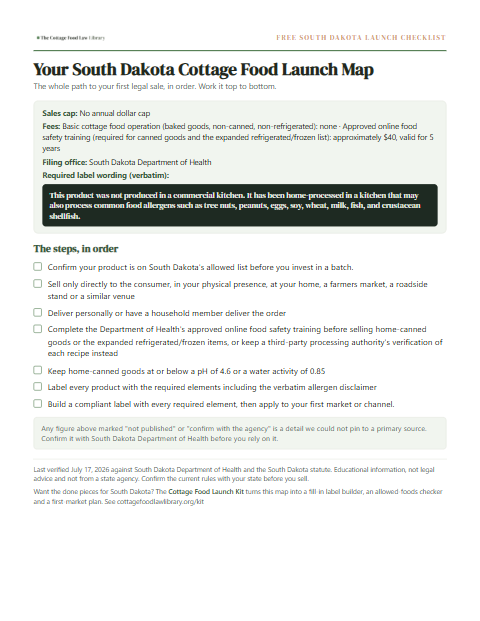
South Dakota does not require a license or permit to sell baked goods and home-canned goods made in your own kitchen directly to consumers. If you sell home-canned goods or want to sell refrigerated items like pies, cheesecake or frozen produce, you must first complete a state-approved food safety training course. There is no statewide sales cap.
South Dakota keeps the path to selling short. There is no state permit and no annual sales cap, so foods like any non-temperature-controlled food prepared at a residence, which per the department of health covers nuts, grains, seeds and dry mixes such as spice and seasoning mixes, baking mixes, powdered drink mixes, home-ground flour, granola and coffee beans. no training required for this category and baked goods prepared at a residence can go to market once your label carries what the state asks for. The rules below are the whole picture.
South Dakota sets no dollar limit on cottage food sales, so the ceiling on your growth is your own kitchen and time rather than a statutory cap. The other rules that matter, the label, the allowed foods and where you can sell, are in the tables below.
The parts new South Dakota sellers most often get wrong are the exact label disclosure wording. Each one has its own row below, with the official source beside it.
How much can you sell? The South Dakota sales cap
The annual sales limit for a South Dakota cottage food operation.
| Item | South Dakota rule |
|---|---|
| Annual sales cap | No annual dollar cap in South Dakota |
| How it works | South Dakota does not set a statewide annual sales cap for home-processed cottage foods. |
What foods can you sell in South Dakota?
Allowed and prohibited categories under current South Dakota law.
| Allowed (examples) | Prohibited |
|---|---|
| Any non-temperature-controlled food prepared at a residence, which per the Department of Health covers nuts, grains, seeds and dry mixes such as spice and seasoning mixes, baking mixes, powdered drink mixes, home-ground flour, granola and coffee beans. No training required for this category; Baked goods prepared at a residence (non-temperature-controlled); Home-canned goods at or below pH 4.6 or water activity 0.85 (training required); Non-heat-processed fermented foods kept at or below 41F (training required); Time and temperature controlled baked goods such as pies and cheesecake kept at or below 41F (training required); Sauces and pesto requiring refrigeration (training required); Home-processed frozen fruits and vegetables kept at or below 0F (training required). | Low pH or high water activity canned goods that fail the 4.6 pH or 0.85 water activity threshold; Meat and poultry products; Raw milk and other foods outside the statute's listed categories. |
South Dakota cottage food label requirements
Every package you sell needs a label with the elements below in legible print.
- Name of the product
- Name of the producer
- Physical address of production
- Mailing address of the producer
- Telephone number of the producer
- Date the product was made or processed
- Ingredients
- For food sold under SDCL 34-18-36.1, a directive to keep the product refrigerated or frozen
- The verbatim allergen disclaimer above
South Dakota requires this disclosure statement, word for word:
This product was not produced in a commercial kitchen. It has been home-processed in a kitchen that may also process common food allergens such as tree nuts, peanuts, eggs, soy, wheat, milk, fish, and crustacean shellfish.
Reproduced from South Dakota's cottage food labeling requirements. Confirm the current wording with South Dakota Department of Health before you print a run of labels.
From the team behind this library
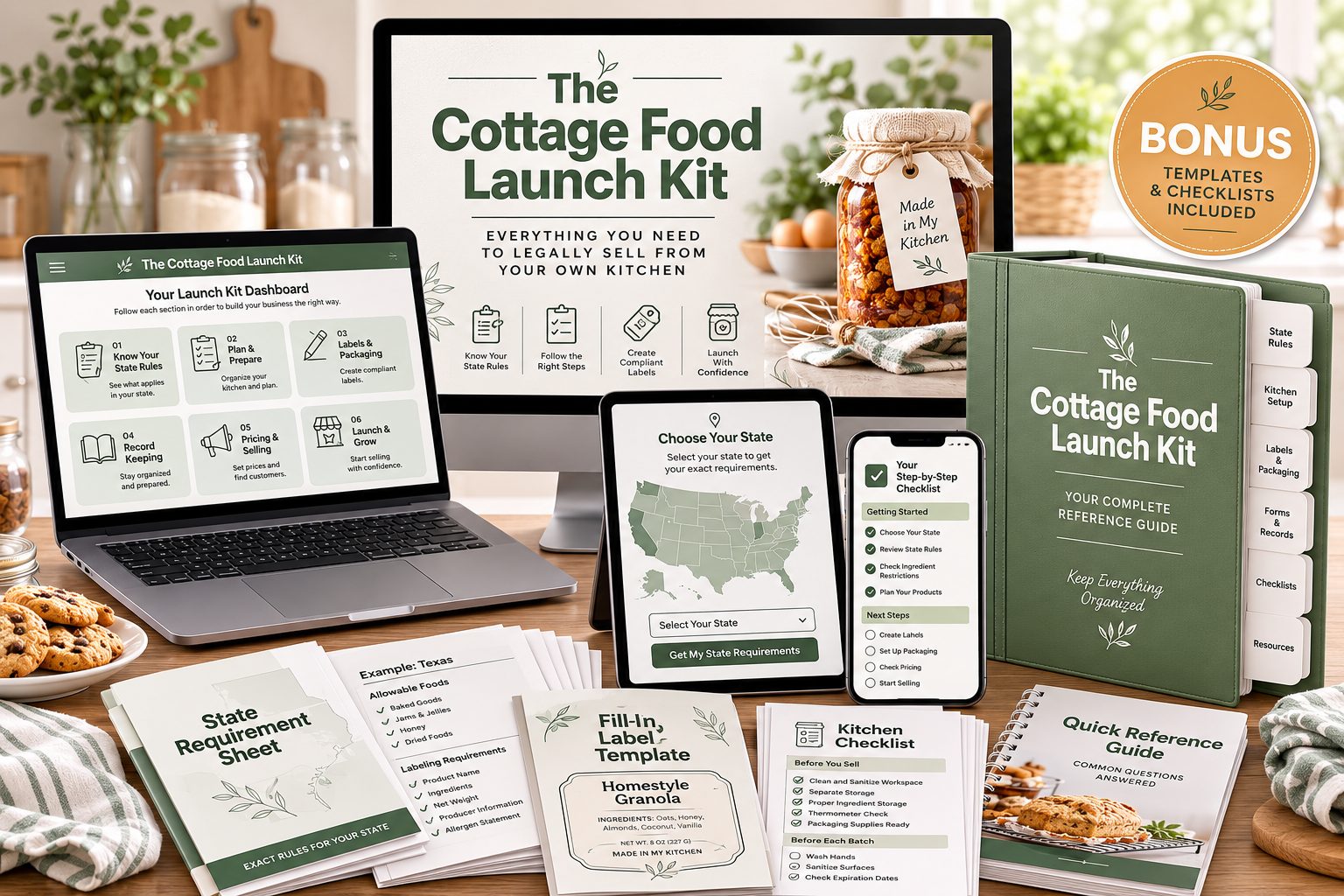
The Cottage Food Launch Kit
Want the whole path in one place? The kit turns everything on this page into one ordered walkthrough for South Dakota: your state requirement sheet, a fill-in label template with the exact required wording, the allowed-foods checker, the ordered checklist and your first-market plan. Follow it in an evening.
Where can you sell in South Dakota?
The venues and channels South Dakota cottage food operators may use.
| Channel | Allowed in South Dakota? |
|---|---|
| Direct to consumer at the producer's home | Yes. Sale must happen in the seller's physical presence. |
| Farmers markets and roadside stands | Yes |
| Personal delivery by the seller or a household member | Yes. Required method of delivery under SDCL 34-18-38. |
| Mail or carrier shipping | No. SD DOH classifies mail and carrier shipping as an indirect sale, which requires a state license: "Examples of indirect sale may include sales from a retail store or via the internet. Indirect sales would require a state license." |
| Online / internet sales | No. SD DOH treats internet selling as an indirect sale requiring a state license |
| Retail stores and wholesale | No. Direct to consumer only. |
South Dakota Department of Health has not settled every channel in one published place. Confirm your specific channel, for example online or out-of-state shipping, with South Dakota Department of Health.
Registration, training and inspection
Registration and permits. No registration, license or permit is required for the exempted cottage food categories under SDCL 34-18-35 through 34-18-38.
Food safety training. Not required for basic non-canned baked goods sold at 34-18-35 level. Required for home-canned goods and the expanded refrigerated/frozen category under 34-18-36 and 34-18-36.1: complete the department's approved online food safety training every five years, or maintain third-party recipe verification instead.
Kitchen inspection. The exempted cottage food categories are not subject to routine home-kitchen inspection by the Department of Health.
The fees a South Dakota cottage food seller can expect.
| Item | Cost |
|---|---|
| Basic cottage food operation (baked goods, non-canned, non-refrigerated) | No state fee |
| Approved online food safety training (required for canned goods and the expanded refrigerated/frozen list) | $40 per person, valid 5 years from the date of completion |
Wondering how South Dakota compares? See what a cottage food license costs in every state, from the no-fee states to the priciest permits.