Oregon Cottage Food Law (2026): Rules, Limits and How to Start
Do you need a license to sell homemade food in Oregon?
Oregon's Cottage Food Exemption lets you sell non-perishable homemade food without a license as long as you stay under a gross sales cap that adjusts yearly for inflation, $52,700 for 2026. Everyone handling the food needs a food handler card and every label needs the exact state disclosure sentence. Farmers and anyone wanting a higher cap have two other legal paths.
In Oregon the path depends on what you make and how you sell it. Many home producers of foods like breads, cookies and cakes without cream fillings and candies need no state license at all, while some foods or channels trigger a registration. The rules below sort out which one is yours.
Oregon caps annual cottage food sales at $52,700 gross annual sales for 2026. Set at a $50,000 base by SB 643 effective January 1, 2024 and indexed to inflation every year under ORS 616.723(2)(d) and OAR 603-025-0320: $51,200 for 2025, raised to $52,700 for 2026 based on a 2.9 percent West-region CPI-U increase.
The parts new Oregon sellers most often get wrong are the exact label disclosure wording and the food safety course. Each one has its own row below, with the official source beside it.
How much can you sell? The Oregon sales cap
The annual sales limit for a Oregon cottage food operation.
| Item | Oregon rule |
|---|---|
| Annual sales cap | $52,700 gross annual sales for 2026 (Cottage Food Exemption path) |
| How it works | Set at a $50,000 base by SB 643 effective January 1, 2024 and indexed to inflation every year under ORS 616.723(2)(d) and OAR 603-025-0320: $51,200 for 2025, raised to $52,700 for 2026 based on a 2.9 percent West-region CPI-U increase. Two other paths carry different caps: the Farm Direct Marketing Law caps processed-value sales at $50,000 for qualifying farmers. The optional Domestic Kitchen License has no sales cap at all. |
What foods can you sell in Oregon?
Allowed and prohibited categories under current Oregon law.
| Allowed (examples) | Prohibited |
|---|---|
| Breads, cookies and cakes without cream fillings; Candies; Dry mixes and granola; Dried herbs and spices; Jams and jellies; Nut butters; Dry pasta; Roasted coffee; Honey; Acidified foods and lacto-fermented products (Farm Direct Marketing Law only, farmers growing the principal ingredient). | Time/temperature-control-for-safety (TCS) foods generally; Meat, poultry and seafood; Dairy products; Low-acid canned goods (all pathways); Acidified foods and ferments under the basic Cottage Food Exemption (reserved for the Farm Direct Marketing Law). |
Oregon cottage food label requirements
Every package you sell needs a label with the elements below in legible print.
- Producer name and address
- Product name
- Ingredients in descending order by weight
- Allergen disclosures
- Net quantity
- The disclosure statement (verbatim above) in minimum 10-point type with a contrasting color
Oregon requires this disclosure statement, word for word:
This product is homemade, is not prepared in an inspected food establishment and must be stored and displayed separately if merchandised by a retailer.
Reproduced from Oregon's cottage food labeling requirements. Confirm the current wording with Oregon Department of Agriculture before you print a run of labels.
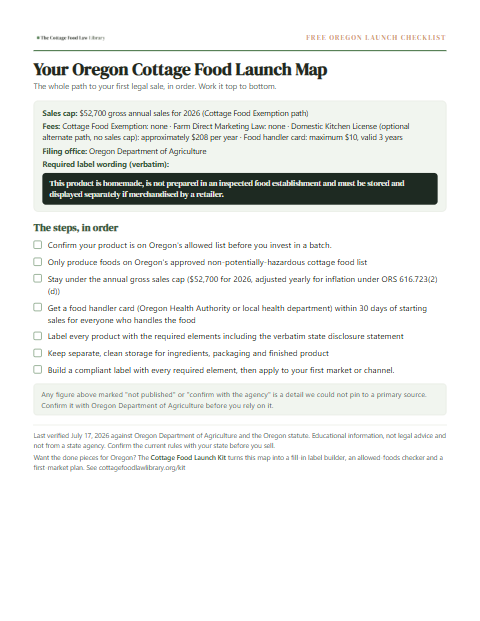
Get the free Oregon cottage food checklist
The one-page map of the steps, in order, so you can see the whole path at a glance.
Instant download, plus Oregon law-change alerts. Unsubscribe anytime.
Where can you sell in Oregon?
The venues and channels Oregon cottage food operators may use.
| Channel | Allowed in Oregon? |
|---|---|
| Direct to consumer from home | Yes |
| Farmers markets and community events | Yes |
| In-state online orders and in-state mail delivery | Yes |
| Retail stores | With conditions. Requires a separate display section and the disclaimer |
| Out-of-state shipping | No. Not allowed under the Cottage Food Exemption; requires the Domestic Kitchen License |
| Catering | No. Reported as prohibited under all three pathways; single-source, not independently confirmed |
Oregon Department of Agriculture has not settled every channel in one published place. Confirm your specific channel, for example online or out-of-state shipping, with Oregon Department of Agriculture.
Registration, training and inspection
Registration and permits. No registration for the Cottage Food Exemption or Farm Direct Marketing Law paths. The optional Domestic Kitchen License is a paid license (~$208/year) for those who want to exceed the exemption cap or sell items outside the allowed list.
Food safety training. Everyone who handles the food must hold a food handler card from the Oregon Health Authority or a local health department, obtained within 30 days of starting sales, valid for three years.
Kitchen inspection. No home kitchen inspection is required under the Cottage Food Exemption or Farm Direct Marketing Law.
The fees a Oregon cottage food seller can expect.
| Item | Cost |
|---|---|
| Cottage Food Exemption | No state fee |
| Farm Direct Marketing Law | No state fee |
| Domestic Kitchen License (optional alternate path, no sales cap) | approximately $208 per year |
| Food handler card | maximum $10, valid 3 years |
Not published centrally. Confirm the current amount with Oregon Department of Agriculture.