Idaho Cottage Food Law (2026): Rules, Limits and How to Start
Do you need a license to sell homemade food in Idaho?
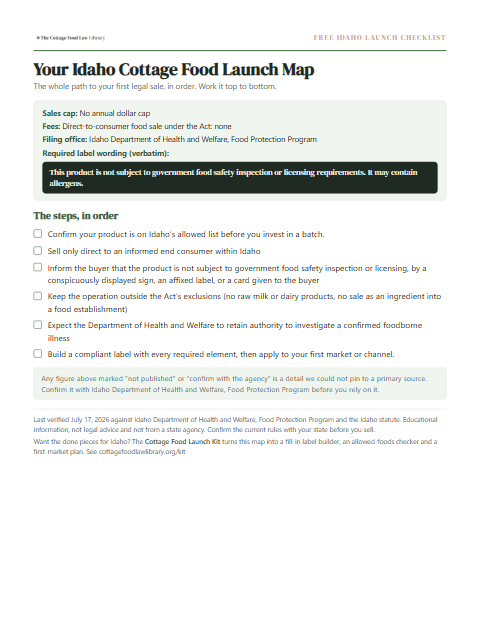
Idaho replaced its old cottage food rule on March 20, 2026 with the Idaho Direct-to-Consumer Commerce Act. You can now sell homemade shelf-stable foods, perishable foods and nonalcoholic drinks straight to Idaho consumers with no license, no permit, no registration, no fee and no sales cap. You only need to tell the buyer, by sign, label or card, that the product was not inspected or licensed.
Idaho keeps the path to selling short. There is no state permit and no annual sales cap, so foods like homemade shelf-stable foods and homemade perishable foods can go to market once your label carries what the state asks for. The rules below are the whole picture.
Idaho sets no dollar limit on cottage food sales, so the ceiling on your growth is your own kitchen and time rather than a statutory cap. The other rules that matter, the label, the allowed foods and where you can sell, are in the tables below.
Senate Bill 1283 took effect March 2026. Idaho enacted a new cottage food framework in 2026. Some procedural details were still settling at verification, so confirm the current rules with the Idaho agency before you rely on them. This page reflects the rule in force today; the full history sits in the law-updates log.
How much can you sell? The Idaho sales cap
The annual sales limit for an Idaho cottage food operation.
| Item | Idaho rule |
|---|---|
| Annual sales cap | No annual dollar cap in Idaho |
| How it works | The Idaho Direct-to-Consumer Commerce Act sets no annual sales cap for qualifying direct-to-consumer food sales. |
What foods can you sell in Idaho?
Allowed and prohibited categories under current Idaho law.
| Allowed (examples) | Prohibited |
|---|---|
| Homemade shelf-stable foods; Homemade perishable foods; Nonalcoholic drinks; Sold to an informed end consumer within Idaho. | Meat and meat products, with six statutory exceptions: poultry where the producer slaughters no more than 1,000 birds of their own raising per calendar year and buys or sells no other poultry; live animals; portions of live animals sold before slaughter for future delivery (animal shares under 37-207); domestic rabbit meat; farm-raised fish other than catfish; and meat from cattle, sheep, swine and goats inspected by USDA or another approved inspector; Milk and dairy products, or products derived from them, UNLESS the producer or designated agent is in full compliance with Idaho Code Title 37 chapters 3, 4, 5 and 12. The Act treats milk and dairy as perishable food at 37-203(7)(e) and shelf-stable milk and dairy at 37-203(10)(h), so this is a conditional bar rather than a flat one; Raw milk and raw milk products; A product sold as an ingredient into a food establishment. |
Idaho cottage food label requirements
Every package you sell needs a label with the elements below in legible print.
- The disclosure above, by conspicuously displayed sign, an affixed label, or a card given to the consumer
- Producer name and contact information
- Complete ingredient list when the product has two or more ingredients
- For perishable products, safe-handling information sufficient to inform the consumer of safe storage and preparation practices (Idaho Code 37-205(4)(b))
Idaho requires this disclosure statement, word for word:
This product is not subject to government food safety inspection or licensing requirements. It may contain allergens.
Reproduced from Idaho's cottage food labeling requirements. Confirm the current wording with Idaho Department of Health and Welfare, Food Protection Program before you print a run of labels.
From the team behind this library
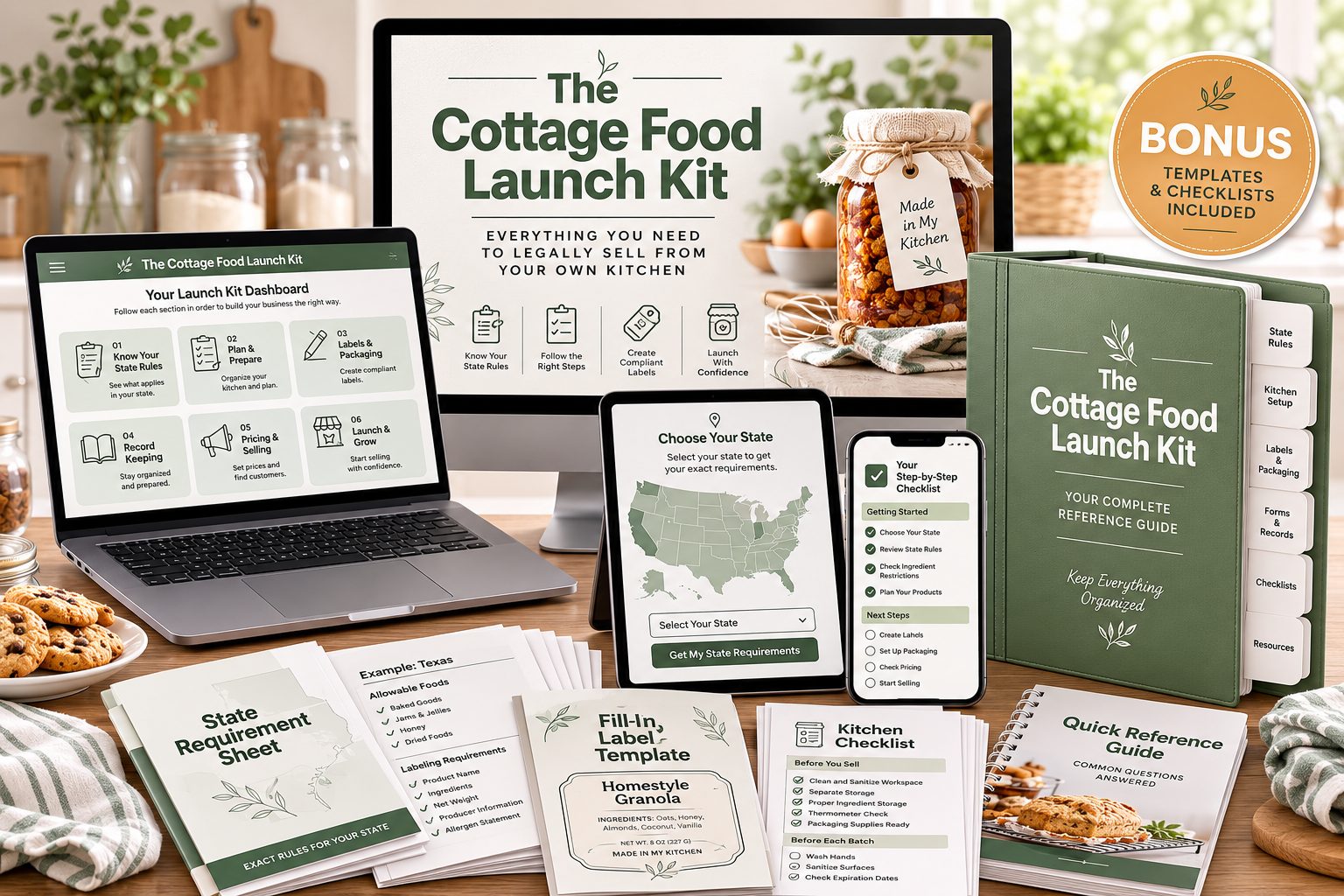
The Cottage Food Launch Kit
Want the whole path in one place? The kit turns everything on this page into one ordered walkthrough for Idaho: your state requirement sheet, a fill-in label template with the exact required wording, the allowed-foods checker, the ordered checklist and your first-market plan. Follow it in an evening.
Where can you sell in Idaho?
The venues and channels Idaho cottage food operators may use.
| Channel | Allowed in Idaho? |
|---|---|
| Direct to consumer in person within Idaho | Yes |
| Wholesale | No. Remains separately regulated, outside the Act. |
| Out-of-state / interstate carrier sales | No. The Act forbids it outright. Idaho Code 37-205(2)(b) requires transactions to "Occur entirely within the state of Idaho and shall not constitute or involve interstate commerce" and the same subdivision requires all production, processing, packaging, sale and delivery activities to take place wholly within Idaho. IDHW adds: "If you sell food or drinks outside of Idaho, you may need FDA approval." Selling out of state is simply outside the Act |
Registration, training and inspection
Registration and permits. No license, permit or registration is required for a qualifying direct-to-consumer food sale under the Idaho Direct-to-Consumer Commerce Act.
Food safety training. No food safety training or certification requirement was found for sales under the Act.
Kitchen inspection. Products sold under the Act are exempt from government food safety inspection. The Department of Health and Welfare retains authority to investigate a confirmed foodborne illness.
The fees an Idaho cottage food seller can expect.
| Item | Cost |
|---|---|
| Direct-to-consumer food sale under the Act | No state fee |
Wondering how Idaho compares? See what a cottage food license costs in every state, from the no-fee states to the priciest permits.
Idaho's law is the Direct-to-Consumer Commerce Act
Idaho no longer runs a cottage food program. Senate Bill 1283 added the Idaho Direct-to-Consumer Commerce Act as a new Chapter 2 of Title 37, Idaho Code, effective March 20, 2026, replacing and superseding the old cottage food rule at IDAPA 16.02.19. Searching for an Idaho cottage food license now turns up a program that has been retired.
The Department of Health and Welfare's position on what the Act does is short: products sold under it "are not subject to inspection or licensing." There is no license, no permit, no registration, no fee and no sales cap.
What replaces all of that is a notice to the buyer. It goes on a conspicuously displayed sign, on a label affixed to the product or on a card. The Department gives the wording: "This product is not subject to government food safety inspection or licensing requirements. It may contain allergens." Alongside it go the producer's name and contact information plus a list of ingredients where the product contains two or more.
Two limits are worth reading before you plan a channel. Wholesale operations are not exempted by the Act, so selling into a business for resale is a different question from selling to the person who will eat the food. And the Department notes that selling food or drink outside Idaho may require FDA approval.