Vermont Cottage Food Law (2026): Rules, Limits and How to Start
Do you need a license to sell homemade food in Vermont?
Vermont lets home producers sell shelf-stable foods up to $30,000 in annual gross sales under the Cottage Food Operator exemption, with a separate $10,000 exemption for processed and packaged foods sold for resale. Both exemptions require a free annual food safety training and an exemption filing with the Vermont Department of Health due each January 15. Vermont was the first state to write dedicated home baker rules and still allows an unusually broad list of foods.
Vermont lets most home food sellers start without a state license, with a permit or registration reserved for certain foods or sales channels. Foods like candy and jams and jellies are the common starting point. The page below shows exactly which step applies to your product.
Vermont caps annual cottage food sales at $30,000 annual gross sales for the Cottage Food Operator exemption. These caps were set by Act 42 (H.401), effective July 1, 2025.
The parts new Vermont sellers most often get wrong are the exact label disclosure wording and the food safety course. Each one has its own row below, with the official source beside it.
How much can you sell? The Vermont sales cap
The annual sales limit for a Vermont cottage food operation.
| Item | Vermont rule |
|---|---|
| Annual sales cap | $30,000 annual gross sales for the Cottage Food Operator exemption; a separate $10,000 annual sales exemption applies to processed and packaged foods sold for resale |
| How it works | These caps were set by Act 42 (H.401), effective July 1, 2025. Producers who exceed the applicable cap must obtain a Home Bakery License or Home Caterer License instead. An older figure describing a $125 per week threshold for home bakers predates Act 42 and should be treated as superseded by the current $30,000 annual figure. |
What foods can you sell in Vermont?
Allowed and prohibited categories under current Vermont law.
| Allowed (examples) | Prohibited |
|---|---|
| Non-potentially hazardous baked goods; Candy; Jams and jellies; Dry herbs; Trail mix, granola and cereal; Mixed nuts; Flavored vinegar; Popcorn; Coffee beans and dry tea; Home-canned pickles, vegetables and fruits meeting pH and water activity requirements. | Potentially hazardous or refrigerated foods outside the exemption's scope; Products sold to restaurants or licensed food establishments. |
Vermont cottage food label requirements
Every package you sell needs a label with the elements below in legible print.
- Producer name and address (the physical home kitchen address, not a P.O. box)
- Product name
- Ingredient list in descending order by weight
- Net weight or volume
- Allergen information
- The verbatim home-kitchen disclosure above, in at least 10-point font in a contrasting color
Vermont requires this disclosure statement, word for word:
Made in a home kitchen not inspected by the Vermont Department of Health
Reproduced from Vermont's cottage food labeling requirements. Confirm the current wording with Vermont Department of Health, Food and Lodging Program before you print a run of labels.
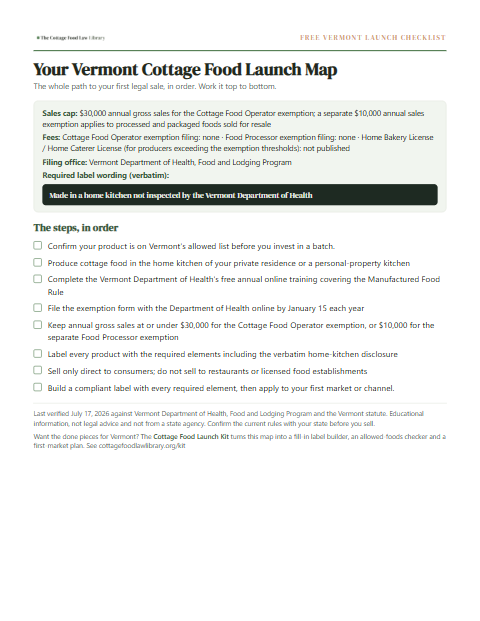
Get the free Vermont cottage food checklist
The one-page map of the steps, in order, so you can see the whole path at a glance.
Instant download, plus Vermont law-change alerts. Unsubscribe anytime.
Where can you sell in Vermont?
The venues and channels Vermont cottage food operators may use.
| Channel | Allowed in Vermont? |
|---|---|
| Direct to consumer at the home | Yes |
| Farmers markets | Yes |
| Restaurants and licensed food establishments | No. Requires a separate commercial license. |
| Online orders | Not confirmed. Not clearly addressed in the sources consulted. |
Registration, training and inspection
Registration and permits. No state license is required within the exemption caps, but an annual exemption filing with the Department of Health is required by January 15. Producers who exceed the $30,000 or $10,000 exemption caps must obtain a Home Bakery License or Home Caterer License.
Food safety training. A free annual online training covering the Manufactured Food Rule is required to claim either exemption, certified at the time of the annual filing.
Kitchen inspection. Exempt operators may be inspected by the Department of Health to verify compliance. Licensed Home Bakery and Home Caterer operations require an opening inspection and may face ongoing inspections.
The fees a Vermont cottage food seller can expect.
| Item | Cost |
|---|---|
| Cottage Food Operator exemption filing | No state fee |
| Food Processor exemption filing | No state fee |
| Home Bakery License / Home Caterer License (for producers exceeding the exemption thresholds) | Not published; confirm with Vermont Department of Health, Food and Lodging Program |