New York Cottage Food Law (2026): Rules, Limits and How to Start
Do you need a license to sell homemade food in New York?
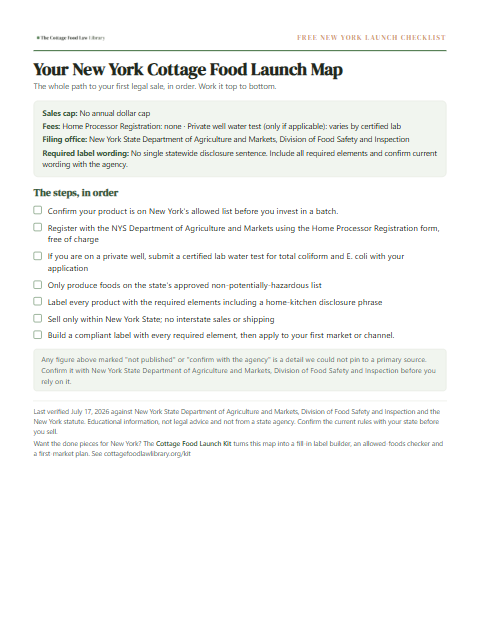
New York lets you sell homemade food from your own kitchen under the Home Processor Exemption once you register for free with the Department of Agriculture and Markets. There is no cap on how much you can sell, but every sale has to stay inside New York State and your label needs to say the food came from a home kitchen.
New York lets you sell homemade food once you register with New York State Department of Agriculture and Markets, Division of Food Safety and Inspection. There is no commercial-kitchen requirement, so foods like baked goods that do not require refrigeration and double-crust fruit pies can come straight from your own kitchen after you complete the registration and label step below.
New York sets no dollar limit on cottage food sales, so the ceiling on your growth is your own kitchen and time rather than a statutory cap. The other rules that matter, the label, the allowed foods and where you can sell, are in the tables below.
The parts new New York sellers most often get wrong are the label elements and the registration step. Each one has its own row below, with the official source beside it.
How much can you sell? The New York sales cap
The annual sales limit for a New York cottage food operation.
| Item | New York rule |
|---|---|
| Annual sales cap | No annual dollar cap in New York |
| How it works | No revenue or unit cap applies to registered home processors. A separate pending bill (A5836, as of January 2026 still in the Agriculture Committee) would create a different 'homegrown foods' category with a $12,500 cap; it is not current law and does not apply to the existing Home Processor Exemption. |
What foods can you sell in New York?
Allowed and prohibited categories under current New York law.
| Allowed (examples) | Prohibited |
|---|---|
| Baked goods that do not require refrigeration (breads, rolls, scones, bagels, muffins, cookies, biscotti, brownies, cakes); Double-crust fruit pies; Traditional fruit preserves (jams, jellies, marmalades) from high-acid fruits; Snack items (popcorn, caramel corn, crackers, pretzels, peanut brittle, granola bars, trail mix); Fudge; Repackaged dry spices and dried goods. | Buttercream and cream cheese frostings; Vegetable breads and other foods needing refrigeration; Alcohol-containing products; No-bake items; Pickles and other acidified/fermented foods; Sauces; Tempered chocolate; Raw nuts; Cheese and dairy products; Meats; Beverages; Nut butters. |
These lists follow New York State Department of Agriculture and Markets, Division of Food Safety and Inspection's published guidance. Confirm your own product against New York State Department of Agriculture and Markets, Division of Food Safety and Inspection before you commit to a batch.
New York cottage food label requirements
Every package you sell needs a label with the elements below in legible print.
- Product name
- Complete ingredient list in descending order by weight
- Net quantity
- Processor's business name and full address
- Allergen declarations for the major allergens (eggs, milk, fish, shellfish, soybeans, peanuts, tree nuts, wheat, sesame)
- A home-kitchen disclosure phrase (state guidance gives examples such as 'Made in a Home Kitchen' or 'Made at Home by [name]', minimum 1/16 inch type; exact wording is not fixed by a single mandated sentence)
No single statewide disclosure sentence. New York does not set one required disclosure line in the sources we checked. Put the required elements above on every label. Confirm the current wording with New York State Department of Agriculture and Markets, Division of Food Safety and Inspection before you print a run.
From the team behind this library
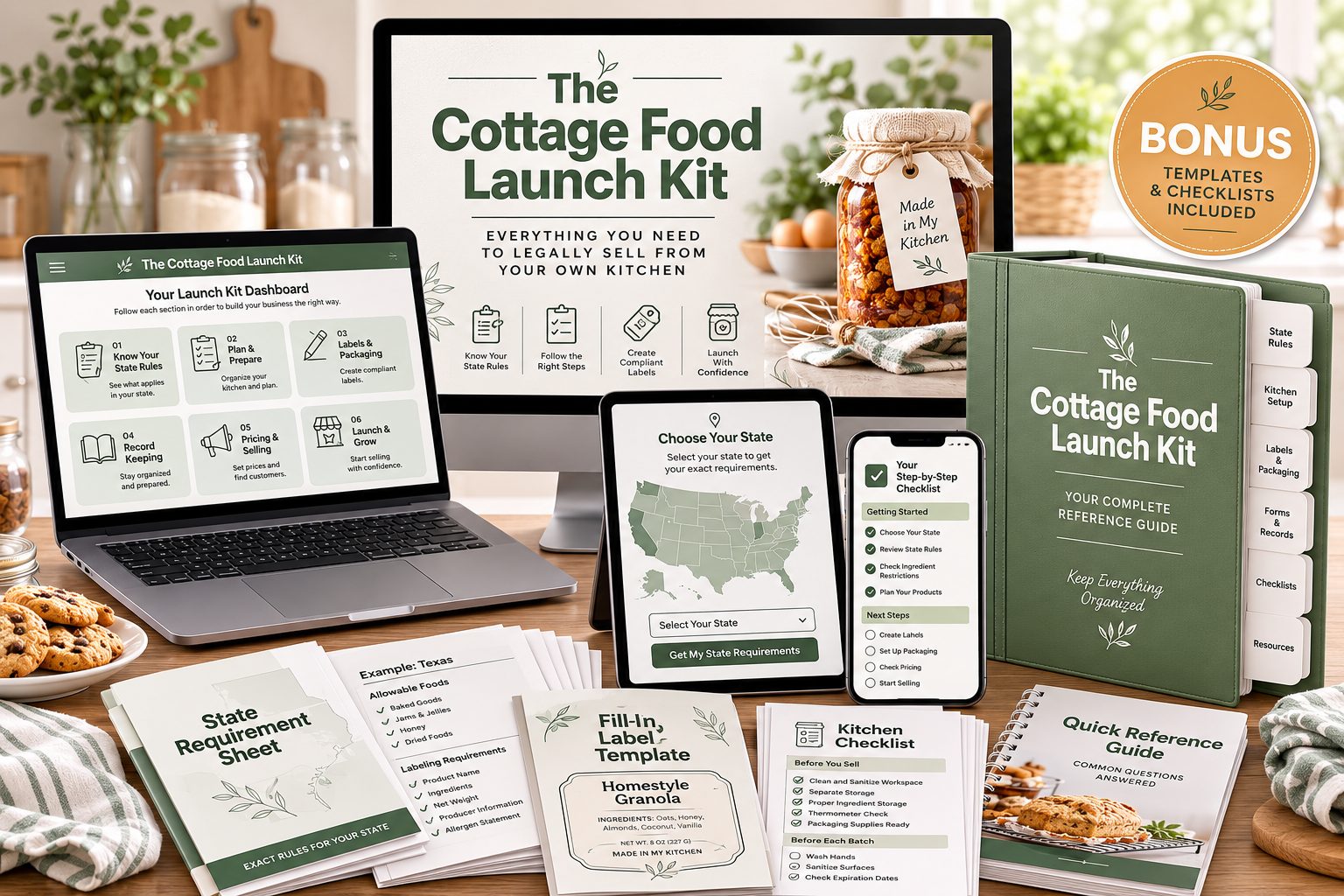
The Cottage Food Launch Kit
Want the whole path in one place? The kit turns everything on this page into one ordered walkthrough for New York: your state requirement sheet, a fill-in label template with the exact required wording, the allowed-foods checker, the ordered checklist and your first-market plan. Follow it in an evening.
Where can you sell in New York?
The venues and channels New York cottage food operators may use.
| Channel | Allowed in New York? |
|---|---|
| Farm stands, farmers markets, green markets | Yes |
| Craft fairs and flea markets | Yes |
| Home delivery within New York State | Yes |
| Internet sales | With conditions. Buyer must be within New York State |
| Wholesale to local restaurants, cafes and grocery stores | Yes |
| Interstate sales or shipping | No. Home Processor Exemption sales are restricted to within New York State |
Registration, training and inspection
Registration and permits. Every home processor must register with the Department of Agriculture and Markets before selling. Registration is free, tied to the specific address and does not currently expire, though it becomes void if the operator produces non-approved foods or opens a licensed food business.
Food safety training. No food safety training course is required to hold the Home Processor Exemption, based on official program materials reviewed. Not exhaustively confirmed for every product category.
Kitchen inspection. Home processor kitchens are not routinely inspected. The Department reviews a kitchen only in response to a complaint.
The fees a New York cottage food seller can expect.
| Item | Cost |
|---|---|
| Home Processor Registration | No state fee |
| Private well water test (only if applicable) | varies by certified lab |
Not published centrally. Confirm the current amount with New York State Department of Agriculture and Markets, Division of Food Safety and Inspection. Confirm the exact course or certificate New York State Department of Agriculture and Markets, Division of Food Safety and Inspection accepts before you enroll.
Wondering how New York compares? See what a cottage food license costs in every state, from the no-fee states to the priciest permits.
New York calls it the Home Processor exemption, not a license
New York does not issue a cottage food license or a home bakery license. What you are looking for is the Home Processor exemption. The thing you file for it is a free Home Processor Registration with the Department of Agriculture and Markets. If a search for a "home processor license ny" or a "nys home processor license" brought you here, the registration is the whole answer.
What the exemption exempts you from
Article 20-C of the Agriculture and Markets Law is the article that licenses food processing establishments. Section 251-z-3 is the licensing section and section 251-z-4 holds the exemptions. Registering as a home processor puts you inside that exemption. The Department states it plainly: home processors "are exempt from obtaining an Article 20-C food processing license and Article 28 retail food store license but are required to register with the Department." The regulation behind the program is 1 NYCRR 276.4.
When you need the real 20-C license instead
Your exemption goes null and void, in the Department's own wording, if you make or sell foods that are not allowed under it or if you open a food business that is inspected and permitted by either Agriculture and Markets or the Department of Health. At that point you are a food processing establishment and you need an actual Article 20-C license. Section 251-z-3 makes that license biennial rather than annual and sets the fees in statute: $400 for a standard establishment, $175 for a small-scale processor employing no more than ten full-time employees and $900 where the product volume or risk calls for enhanced oversight.
The registration, step by step
- Complete the Home Processor Registration Request form.
- Email or mail it to the Division of Food Safety and Inspection.
- If your kitchen runs on a private well, include a total coliform water analysis from a certified laboratory. The Department requires the test result with the application.
- Pay nothing. There is no fee for the registration.
- Sell only inside New York State. The Department is explicit that all items must be sold within New York.
The registration ties to the address where you cook, so moving means applying again. If you outgrow the approved food list rather than the address, the licensing guide for home food sellers lays out what the licensed path looks like.
What "home processor" asks of your kitchen and where the food may go
The New York registration is free and the form is short. The word doing the work inside it is ordinary. The Department's own definition covers food processed in a private home or residence "using only the ordinary kitchen facilities of that home or residence which are also used to prepare food for the owner thereof, their family, nonpaying guests, and household and farm employees who reside therein". That sentence is the test your kitchen has to pass. Ask the Department whether you may install commercial equipment and the answer is one sentence: "Commercial equipment is not considered ordinary kitchen facilities." A home processor kitchen is the kitchen you already cook dinner in.
What a home processor may make, plus the foods that need the real license
The approved list runs to baked goods that keep at room temperature, fruit jams and jellies made from high-acid fruit, fudge, popcorn and caramel corn, peanut brittle made with commercial nuts, granola, crackers, pretzels, vegetable chips, waffle cones and repackaged spices and dried goods. The Department nearly doubled that list in 2018, adding 19 products including dried soup mixes, dried fruit and vegetables, trail mix and toffee apples. The exclusions are what catch people: buttercream and cream cheese frostings, cream-filled pastries, no-bake items, tempered chocolate, raw nuts, pickles, sauces, pepper jellies, cooked or canned fruit and vegetables, nut butters, beverages, coffee, freeze-dried foods and "any finished food product that requires refrigeration".
The jam rule has a fine edge worth knowing before you buy fruit. A registered home processor may make jams and jellies from high-acid fruits such as berries or grapes. Vegetable jams and jellies, low or reduced sugar versions and any jam containing alcohol "must be produced in an Article 20-C licensed and inspected facility", which is the licensed lane described further up this page.
Every channel inside New York, none across the line
Wholesale is open, which surprises people who expect a home exemption to mean direct sales only. The Department tells applicants they may sell "wholesale to local facilities (restaurants, cafes, grocery stores, etc.) that wish to carry them". Farm stands, farmers markets, craft fairs, flea markets, home delivery and internet orders are all on the list. The Department's 2018 announcement described opening "all modes of delivery and sales within New York State" to home processors. The state line is the wall: "Internet sales are allowed within New York State only. Shipping products out of state is not permitted." At a farmers market, baked goods have to be sold packaged and properly labeled rather than loose off a tray.
The rule runs the other way too, which matters if you are moving to New York with a business you already run. New York does not recognize other states' cottage food laws, so a product made under one of them may not be offered for sale at a New York farmers market. You register here or you do not sell here.
Nobody visits unless somebody complains
The Department reviews home processor kitchens on a complaint basis only. There is no routine inspection, no renewal cycle and no fee. Two things end the exemption instead: making or selling a food it does not cover, or opening a food business that the Department or the Department of Health inspects and permits. The Department also publishes a list of registered home processors. Pet food and pet treats sit outside this registration and need their own. Everything on this page traces back to the Department's home processing page and its farmers market guidance.