Washington Cottage Food Law (2026): Rules, Limits and How to Start
Do you need a license to sell homemade food in Washington?
Washington requires a Cottage Food Operation Permit from the Department of Agriculture before you can sell homemade shelf-stable foods. That permit costs $355 for two years and includes a kitchen inspection. Annual gross sales are capped at $35,000 per residence. Every label needs the exact disclosure that the product was made in a home kitchen not subject to standard inspection criteria.
Washington asks more of a home food seller than most states. You work through Washington State Department of Agriculture before your first sale. The page below lays out the registration, the training and the inspection in the order they come. It is a real process, so knowing the steps up front is what keeps it from stalling.
Washington caps annual cottage food sales at $35,000 gross sales annually. The cap is computed per domestic residence, not per person, so two permit holders producing food at the same address share one $35,000 limit.
The parts new Washington sellers most often get wrong are the exact label disclosure wording, the food safety course and the kitchen inspection. Each one has its own row below, with the official source beside it.
How much can you sell? The Washington sales cap
The annual sales limit for a Washington cottage food operation.
| Item | Washington rule |
|---|---|
| Annual sales cap | $35,000 gross sales annually |
| How it works | The cap is computed per domestic residence, not per person, so two permit holders producing food at the same address share one $35,000 limit. The legislature raised this cap from $25,000 to $35,000 in 2023. Exceeding the cap requires obtaining a food processing plant license under chapter 69.07 RCW or ceasing operations. |
What foods can you sell in Washington?
Allowed and prohibited categories under current Washington law.
| Allowed (examples) | Prohibited |
|---|---|
| Oven-baked goods; Standardized fruit jams, jellies and fruit butters; Vinegars; Dried mixes. | Products requiring refrigeration; Other potentially hazardous foods outside the non-potentially-hazardous list. |
Washington cottage food label requirements
Every package you sell needs a label with the elements below in legible print.
- Business name and cottage food operation permit number
- Product name
- Ingredient list in descending order of predominance by weight
- Net weight or net volume
- Allergen labeling per federal FALCPA and FASTER Act standards
- The verbatim disclosure statement above, at least 11-point type, in a contrasting color
Washington requires this disclosure statement, word for word:
Made in a Home Kitchen that has not been subject to standard inspection criteria.
Reproduced from Washington's cottage food labeling requirements. Confirm the current wording with Washington State Department of Agriculture before you print a run of labels.
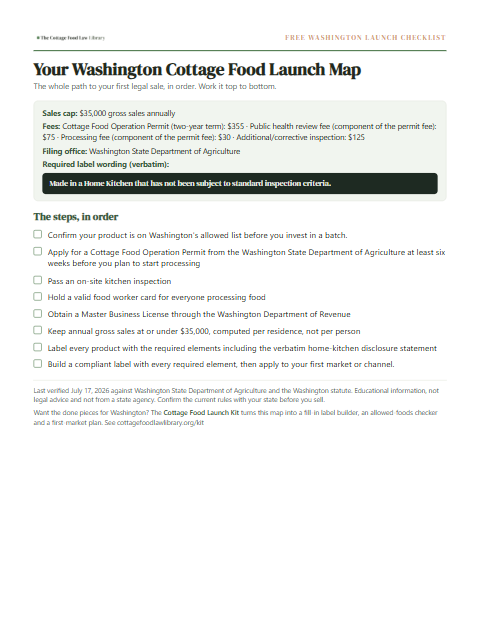
Get the free Washington cottage food checklist
The one-page map of the steps, in order, so you can see the whole path at a glance.
Instant download, plus Washington law-change alerts. Unsubscribe anytime.
Where can you sell in Washington?
The venues and channels Washington cottage food operators may use.
| Channel | Allowed in Washington? |
|---|---|
| Direct to consumer at home | Yes |
| Farmers markets | Yes |
| Retail stores / wholesale | No. RCW 69.22.020(4) restricts sales to direct-to-consumer only; wholesale/retail placement requires a separate WSDA Food Processor's License. |
| Online or mail sales | No. RCW 69.22.020(4): "Cottage food products may only be sold directly to the consumer and may not be sold by internet, mail order, or for retail sale outside the state." |
Registration, training and inspection
Registration and permits. A Cottage Food Operation Permit from WSDA is required before selling. The application includes a water test or water bill, a business license, a food worker card, recipes and labels, plus a kitchen inspection.
Food safety training. Everyone processing food under the permit must hold a valid Washington food worker card.
Kitchen inspection. An on-site inspection of the kitchen and all permitted areas by a WSDA representative is required before the permit is issued. A failed inspection allows one corrective reinspection for an additional $125.
The fees a Washington cottage food seller can expect.
| Item | Cost |
|---|---|
| Cottage Food Operation Permit (two-year term) | $355 |
| Public health review fee (component of the permit fee) | $75 |
| Processing fee (component of the permit fee) | $30 |
| Additional/corrective inspection | $125 |