Georgia Cottage Food Law (2026): Rules, Limits and How to Start
Do you need a license to sell homemade food in Georgia?
Georgia removed its cottage food license and licensing fee effective July 1, 2025 under House Bill 398. You can now sell to grocery stores, convenience stores and restaurants in addition to selling direct to consumers. You still need Food Handler-level training and a compliant label. A city or county can opt out of allowing retail sales in its jurisdiction.
Georgia keeps the path to selling short. There is no state permit and no annual sales cap, so foods like loaf breads, rolls and biscuits and cakes can go to market once your label carries what the state asks for. The rules below are the whole picture.
Georgia sets no dollar limit on cottage food sales, so the ceiling on your growth is your own kitchen and time rather than a statutory cap. The other rules that matter, the label, the allowed foods and where you can sell, are in the tables below.
House Bill 398 took effect July 1, 2025. Georgia dropped the requirement to hold a cottage food license and now lets home producers sell through retail stores, alongside the direct-to-consumer sales the law already allowed. This page reflects the rule in force today; the full history sits in the law-updates log.
How much can you sell? The Georgia sales cap
The annual sales limit for a Georgia cottage food operation.
| Item | Georgia rule |
|---|---|
| Annual sales cap | No annual dollar cap in Georgia |
| How it works | House Bill 398 (effective July 1, 2025) removed Georgia's cottage food licensing requirement and, per multiple secondary sources, also eliminated a prior $5,000 sales limit; the Georgia Department of Agriculture's own HB 398 FAQ document does not itself state a before-or-after cap figure, so the historical $5,000 figure and its removal are corroborated by secondary sources, not read verbatim from a primary GDA document in this sweep. |
Not published as one current figure everyone cites. Confirm this year's cap with Georgia Department of Agriculture before you scale.
What foods can you sell in Georgia?
Allowed and prohibited categories under current Georgia law.
| Allowed (examples) | Prohibited |
|---|---|
| Loaf breads, rolls and biscuits; Cakes (except those requiring refrigeration for safety); Pastries and cookies; Candies and confections; Fruit pies; Jams, jellies and preserves (not fruit butters, per GDA's product list); Dried fruits; Dry herbs, seasonings and mixtures; Cereals, trail mixes and granola; Coated and uncoated nuts; Vinegar and flavored vinegars; Popcorn, popcorn balls and cotton candy. | Any potentially hazardous food requiring refrigeration or temperature control; Meat, poultry, seafood and eggs as standalone products; Dairy products; Cooked vegetables and mushrooms; Raw sprouts; All beverages; Fruit butters (excluded from the jams/jellies/preserves category); Pet food and treats (require separate feed licensing). |
These lists follow Georgia Department of Agriculture's published guidance. Confirm your own product against Georgia Department of Agriculture before you commit to a batch.
Georgia cottage food label requirements
Every package you sell needs a label with the elements below in legible print.
- Business name and address of the cottage food operation, or a GDA-issued Identification Number in its place
- Common name of the product
- Ingredients statement in descending order of predominance by weight, with sub-ingredients broken out
- Net weight or volume
- Allergen declarations following FDA requirements (the nine major allergens: milk, eggs, fish, crustacean shellfish, tree nuts, wheat, peanuts, soybeans, sesame)
- Nutritional information, if any nutritional claims are made
- The cottage food statement above, in 10-point Times New Roman or Arial font, in a legible contrasting color
Georgia requires this disclosure statement, word for word:
MADE IN A COTTAGE FOOD OPERATION THAT IS NOT SUBJECT TO STATE FOOD SAFETY INSPECTIONS.
Reproduced from Georgia's cottage food labeling requirements. Confirm the current wording with Georgia Department of Agriculture before you print a run of labels.
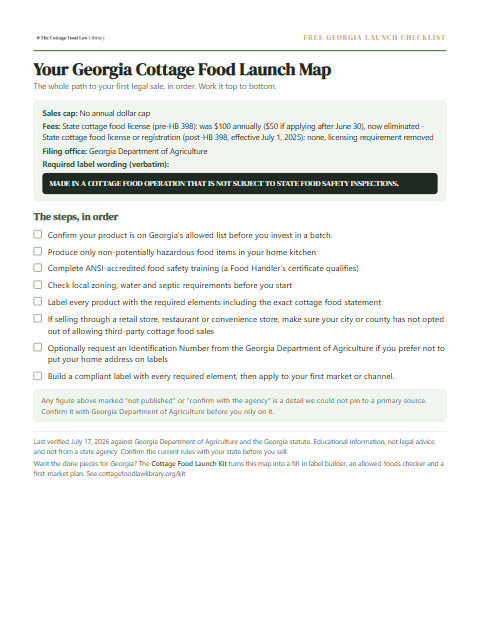
Get the free Georgia cottage food checklist
The one-page map of the steps, in order, so you can see the whole path at a glance.
Instant download, plus Georgia law-change alerts. Unsubscribe anytime.
Where can you sell in Georgia?
The venues and channels Georgia cottage food operators may use.
| Channel | Allowed in Georgia? |
|---|---|
| Direct to consumer in person, at non-profit and for-profit events | Yes |
| Online internet sales | Yes |
| Retail food sales establishments (grocery stores, convenience stores, restaurants) | With conditions. Newly allowed under HB 398 effective July 1, 2025; a city or county may pass an ordinance opting out of allowing this within its jurisdiction, so confirm local rules first |
| Commercial delivery of cottage food items | Yes. HB 398 specifically bars cities or counties from prohibiting commercial delivery companies from delivering cottage food |
| Interstate shipping / distribution across state lines | No. Cottage food products may not be shipped across state lines |
| Wholesale distribution generally | With conditions. Prior guidance barred wholesale/distribution outright; HB 398 specifically carves out retail food sales establishments as a new allowed channel, subject to local opt-out |
Registration, training and inspection
Registration and permits. Georgia removed its cottage food license requirement effective July 1, 2025 under House Bill 398. An optional Identification Number is available from GDA for operators who prefer not to disclose their home address on labels, but it is not a licensing or registration requirement to operate.
Food safety training. Confirmed current and unchanged: GDA's own live cottage-food page (agr.georgia.gov/cottage-food), fetched directly at verification, states cottage food operators must complete an ANSI-accredited food safety training program, with a Food Handler's certificate sufficient.
Kitchen inspection. With the licensing requirement gone, GDA no longer conducts pre-licensing inspections at a cottage food operator's residence. GDA still investigates consumer complaints, foodborne illness reports and public health emergencies.
The fees a Georgia cottage food seller can expect.
| Item | Cost |
|---|---|
| State cottage food license (pre-HB 398) | was $100 annually ($50 if applying after June 30), now eliminated |
| State cottage food license or registration (post-HB 398, effective July 1, 2025) | none, licensing requirement removed |