North Carolina Cottage Food Law (2026): Rules, Limits and How to Start
Do you need a license to sell homemade food in North Carolina?
North Carolina has no separate cottage food statute. Instead the Department of Agriculture and Consumer Services runs a Home Processor program: you apply, pass a one-time free home-kitchen inspection and get a Notice of Inspection rather than a permit. There is no sales cap and no fee.
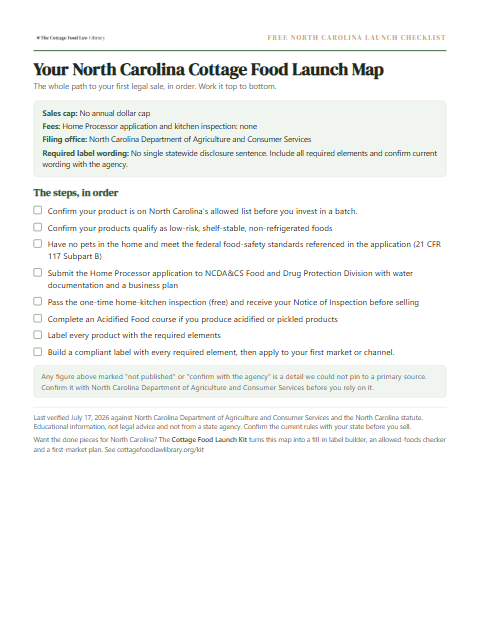
North Carolina asks more of a home food seller than most states. You work through North Carolina Department of Agriculture and Consumer Services before your first sale. The page below lays out the registration, the training and the inspection in the order they come. It is a real process, so knowing the steps up front is what keeps it from stalling.
North Carolina sets no dollar limit on cottage food sales, so the ceiling on your growth is your own kitchen and time rather than a statutory cap. The other rules that matter, the label, the allowed foods and where you can sell, are in the tables below.
The parts new North Carolina sellers most often get wrong are the label elements, the kitchen inspection and the registration step. Each one has its own row below, with the official source beside it.
How much can you sell? The North Carolina sales cap
The annual sales limit for a North Carolina cottage food operation.
| Item | North Carolina rule |
|---|---|
| Annual sales cap | No annual dollar cap in North Carolina |
| How it works | No revenue or unit cap was found in NCDA&CS official program materials. Multiple secondary sources independently describe the program as having no sales cap; treated as corroborated but not textually confirmed on the official program page itself. |
Not published as one current figure everyone cites. Confirm this year's cap with North Carolina Department of Agriculture and Consumer Services before you scale.
What foods can you sell in North Carolina?
Allowed and prohibited categories under current North Carolina law.
| Allowed (examples) | Prohibited |
|---|---|
| Baked goods not requiring refrigeration; Jams, jellies and preserves; Candies; Dried mixes and spices; Certain shelf-stable sauces; Acidified and pickled foods (with Acidified Food course completion); Freeze-dried candies. | Time/temperature-control-for-safety (TCS) foods generally; Refrigerated or frozen products; Low-acid canned goods; Dairy products; Seafood; Meats and eggs; Cut tomatoes, leafy greens, melons and sprouts; Bottled water and juice; Baked goods with cream fillings or cheesecakes. |
North Carolina cottage food label requirements
Every package you sell needs a label with the elements below in legible print.
- Product name
- Manufacturer's (business) name and address
- Net weight or liquid measure
- Complete ingredient list in descending order by predominance
- Allergen declaration in the ingredient list or a following 'Contains' statement
No single statewide disclosure sentence. North Carolina does not set one required disclosure line in the sources we checked. Put the required elements above on every label. Confirm the current wording with North Carolina Department of Agriculture and Consumer Services before you print a run.
From the team behind this library
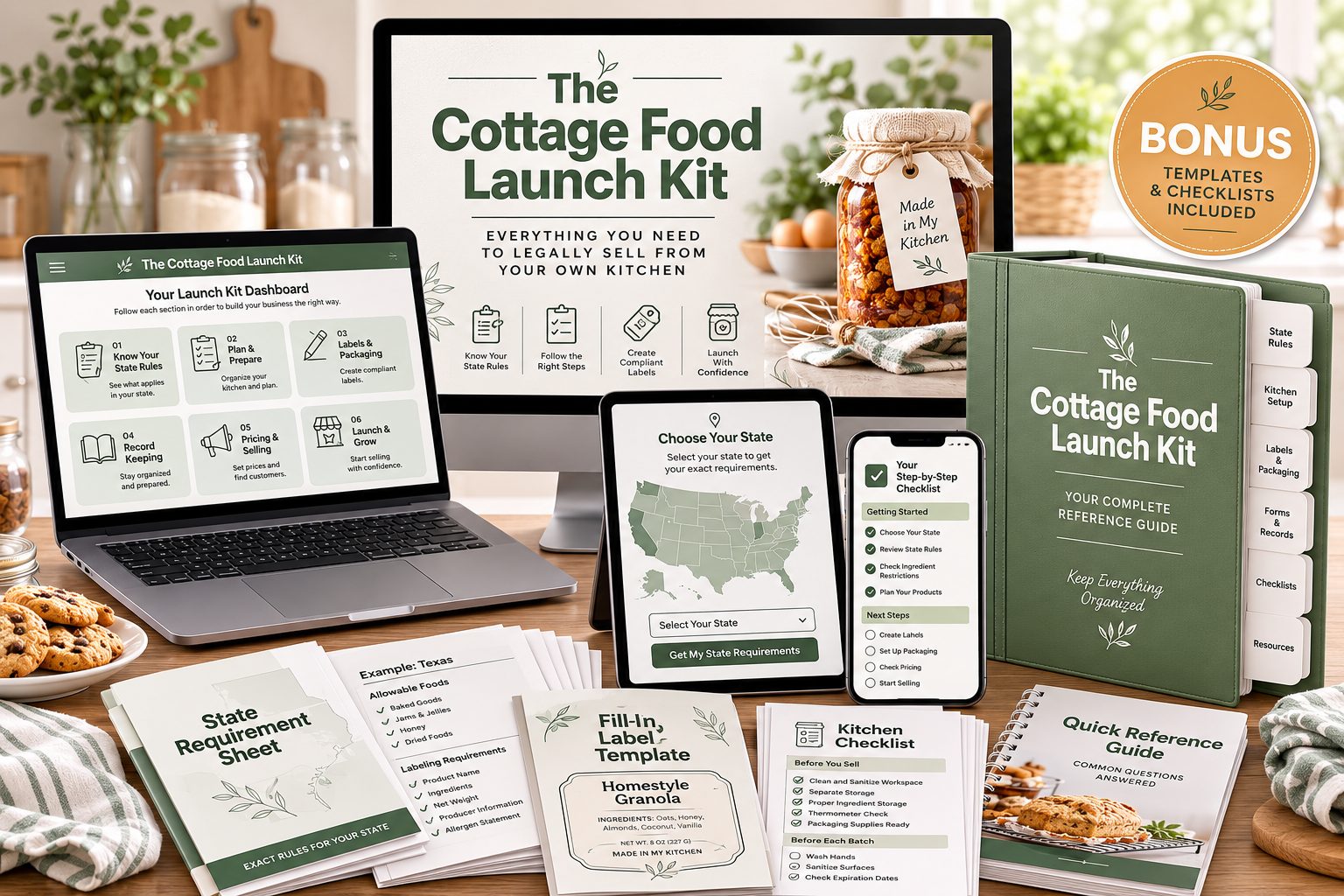
The Cottage Food Launch Kit
Want the whole path in one place? The kit turns everything on this page into one ordered walkthrough for North Carolina: your state requirement sheet, a fill-in label template with the exact required wording, the allowed-foods checker, the ordered checklist and your first-market plan. Follow it in an evening.
Where can you sell in North Carolina?
The venues and channels North Carolina cottage food operators may use.
| Channel | Allowed in North Carolina? |
|---|---|
| Direct to consumer at home | Yes |
| Farmers markets, roadside stands, special events | Yes |
| Online sales | Yes |
| Retail stores and restaurants | Yes. Broader than most cottage food laws, which restrict to direct-to-consumer only |
| Out-of-state or interstate shipping | Not clearly authorized. Not addressed in the sources reviewed; confirm directly with NCDA&CS before shipping across state lines |
North Carolina Department of Agriculture and Consumer Services has not settled every channel in one published place. Confirm your specific channel, for example online or out-of-state shipping, with North Carolina Department of Agriculture and Consumer Services.
Registration, training and inspection
Registration and permits. Not a license or permit, but a required application and one-time home-kitchen inspection through NCDA&CS resulting in a Notice of Inspection, which sources describe as necessary before you may legally sell.
Food safety training. General food handler training is recommended, not required. NCDA&CS may require an Acidified Food Course for producers of acidified or pickled products, decided case by case; where it is required, the Certificate of Completion must be submitted with the application.
Kitchen inspection. A one-time home-kitchen inspection by an NCDA&CS Food Regulatory Specialist is required before selling, free of charge. This differs from most cottage food states, which prohibit or waive inspection entirely.
The fees a North Carolina cottage food seller can expect.
| Item | Cost |
|---|---|
| Home Processor application and kitchen inspection | No state fee |
Wondering how North Carolina compares? See what a cottage food license costs in every state, from the no-fee states to the priciest permits.
What North Carolina checks before it will inspect your kitchen
North Carolina has no cottage food statute to read, so the rules live in the application the Department of Agriculture and Consumer Services asks you to fill in. Four of them decide whether you qualify at all. People usually meet them after they have bought equipment rather than before.
The four that end applications
- The kitchen has to be your home kitchen. The application says it plainly: if the kitchen you plan to produce in sits in another area from your home kitchen, a garage or a basement, or in a separate building on your property, then "you will not qualify as a home processor and will be considered a commercial business." The converted outbuilding that feels like an upgrade is the thing that disqualifies you.
- Pets end it. The program page states that the home must be free of insects, rodents and other pests including privately owned pets. The application asks whether you have pets that come into your home at any time, with a footnote that pets in the home are a violation of Good Manufacturing Practices. That is the federal standard at 21 CFR Part 117 Subpart B, which the state applies to your house rather than to a factory.
- Water gets proved on paper. On municipal water you attach a current copy of the bill. On a well or any non-public supply you attach test results for coliform bacteria and E. coli from inside the last year. The Department states that a store-bought test kit result will not be accepted.
- Zoning gets checked first. The first question in the home requirements section asks whether you have contacted your city or county planning department to verify you can run a food business on the property. A landlord or a homeowners association can close it too.
The business plan is a real document
Six things go in it: every specific product by name, the ingredients with their suppliers, your storage plan for supplies, equipment and finished product, a general production flow with the procedures and equipment you use, how you will transport product to customers, plus the locations where you plan to sell. Alongside it you send one example label for each category. Anything acidified or pickled adds the Acidified Foods course certificate. A product sitting near a safety line adds pH or water activity results with a Process Authority letter from the laboratory.
The allowed side is shelf-stable and low risk: baked goods that need no refrigeration, jams, jellies and preserves, candies, dried mixes and spices, some shelf-stable drinks such as bottled iced tea or coffee, certain sauces, acid and acidified foods like pickles or barbecue sauce, freeze-dried candies. High-risk products are named as not permitted: anything refrigerated or frozen, low-acid canned goods, dairy, seafood, bottled water and juice, bakery items with cream or cream cheese fillings. Meat and meat products are not on the list the program covers. Cream cheese frosting sits in its own category, allowed only where laboratory testing says it can be made in a home kitchen. Products you do not process at all, a gift basket of prepackaged goods for instance, need no inspection in the first place.
Labels are required by how you sell, not by what you make
The Department splits it by point of sale. Custom or on-demand food handed to the customer, from your home or at a special event, can be exempt from individual labeling, as can product served on request out of a secure bulk container or display case, provided ingredient information is available when a customer asks. An affixed label is required on anything shipped by a carrier such as USPS or FedEx, on packaged product sold self-service at farmers, flea, curb or tailgate markets, plus everything sold to retail stores, distributors or restaurants. Four elements go on it: product name, the manufacturer's name and physical address, net quantity in both systems, the full ingredient list in order of predominance by weight. A website address does not substitute for the physical address.
Then you wait for a specialist who issues no permit
Within eight to twelve weeks of receiving your application a Food Regulatory Specialist contacts you to arrange the inspection. The specialist looks at kitchen cleanliness, surfaces and materials, pest activity, equipment, running water, waste disposal and light shielding. At the end of it, in the Department's own words, a permit is not issued: you get a copy of the inspection report plus the Notice of Inspection, which is the document that lets you sell.
Sources for this section: the Department's Home Processor program pages and its Application for Home Processor Inspection, both read in full during this pass.