South Carolina Cottage Food Law (2026): Rules, Limits and How to Start
Do you need a license to sell homemade food in South Carolina?
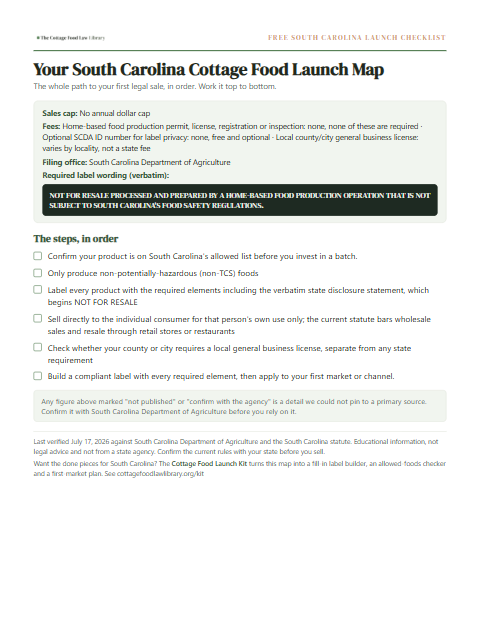
South Carolina needs no permit, license, registration or inspection to sell non-potentially-hazardous homemade food. There is no maximum sales cap. The Department of Agriculture administers the program on Section 44-1-143, which lets you sell directly to people including online and by mail order for delivery inside South Carolina, plus to retail stores including grocery stores that post a visible sign. A second code section, 46-57-20, reproduces the older wording and reads the opposite way, so this page states both and shows you which text each rule follows.
South Carolina keeps the path to selling short. There is no state permit and no annual sales cap, so foods like shelf-stable cakes and cupcakes and shelf-stable cookies can go to market once your label carries what the state asks for. The rules below are the whole picture.
South Carolina sets no dollar limit on cottage food sales, so the ceiling on your growth is your own kitchen and time rather than a statutory cap. The other rules that matter, the label, the allowed foods and where you can sell, are in the tables below.
Act 60 of 2023 took effect July 1, 2024. South Carolina moved its cottage food program to the Department of Agriculture after the former DHEC was dissolved. Producers now work with SCDA rather than the old health agency. This page reflects the rule in force today; the full history sits in the law-updates log.
How much can you sell? The South Carolina sales cap
The annual sales limit for a South Carolina cottage food operation.
| Item | South Carolina rule |
|---|---|
| Annual sales cap | No annual dollar cap in South Carolina |
| How it works | No maximum revenue cap applies. What the law sets is a minimum floor going the other way. Section 44-1-143(G), the text SCDA administers, lifts the section off an operation with net earnings of less than fifteen hundred dollars annually, so a very small hobbyist seller falls outside its labeling and other provisions entirely. SCDA's guidance reads that exemption with two limits attached: no selling at retail locations, plus the producer has to be physically present selling direct to the end consumer. Correction 2026-08-14: this file previously followed Section 46-57-20(G), which sets the same floor at five hundred dollars. Both sections are live South Carolina law. SCDA cites 44-1-143 by name in its July 2025 guidance and its May 2026 fact sheet and cites 46-57-20 in neither, so this file now follows the fifteen hundred dollar figure and records the conflict rather than hiding it. Verification correction 2026-07-17, still standing: earlier notes described a $15,000 annual sales cap removed by Senate Bill 506 in 2022. No primary source contains a $15,000 figure. The real history is a net-earnings floor that moved from five hundred to fifteen hundred dollars in the 2022 amendment, then reappeared at five hundred in the 2024 recodification of the older text. That floor is a minimum threshold below which the law does not apply, never a maximum sales cap. |
What foods can you sell in South Carolina?
Allowed and prohibited categories under current South Carolina law.
| Allowed (examples) | Prohibited |
|---|---|
| Shelf-stable cakes and cupcakes; Shelf-stable cookies; Baked goods without cream fillings; Most breads, including yeast breads; Sourdough bread made with a commercial sourdough starter; Candies; Dried herbs and spices; Pie and pie fillings (high acid); Roasted nuts; Other non-potentially-hazardous (non-TCS) shelf-stable foods generally. | Time/temperature-control-for-safety (TCS) foods generally, such as casseroles, meats, seafood and ice cream; Cream-filled or custard-filled baked goods requiring refrigeration; Cheesecake; Bottled beverages; Charcuterie boards; Hot sauce and BBQ sauce. |
These lists follow South Carolina Department of Agriculture's published guidance. Confirm your own product against South Carolina Department of Agriculture before you commit to a batch.
South Carolina cottage food label requirements
Every package you sell needs a label with the elements below in legible print.
- The disclosure statement (verbatim above), printed in all capital letters in a color that provides a clear contrast to the background
- Your name and address, or the free SCDA identification number in place of a home address
- The standard name of the product
- The ingredients in the product in descending order of predominance by weight
- An allergen statement listing each major allergen by name (Wheat, Soy, Milk, Egg, Finfish, Crustacean Shellfish, Peanuts, Tree Nuts, Sesame, naming the specific tree nut), or a disclaimer that the food may contain any major allergen
- No health claims may be made in association with the food
- Correction 2026-08-14: this file previously carried the disclosure statement with the words NOT FOR RESALE in front of it, following Section 46-57-20(D)(4). Section 44-1-143(D)(4), SCDA's guidance version 1.4 and its May 2026 fact sheet all print the statement without those words. SCDA is the agency that administers the program. Both texts remain published, so confirm the wording with SCDA before you print a run of labels.
South Carolina requires this disclosure statement, word for word:
PROCESSED AND PREPARED BY A HOME-BASED FOOD PRODUCTION OPERATION THAT IS NOT SUBJECT TO SOUTH CAROLINA'S FOOD SAFETY REGULATIONS.
Reproduced from South Carolina's cottage food labeling requirements. Confirm the current wording with South Carolina Department of Agriculture before you print a run of labels.
From the team behind this library
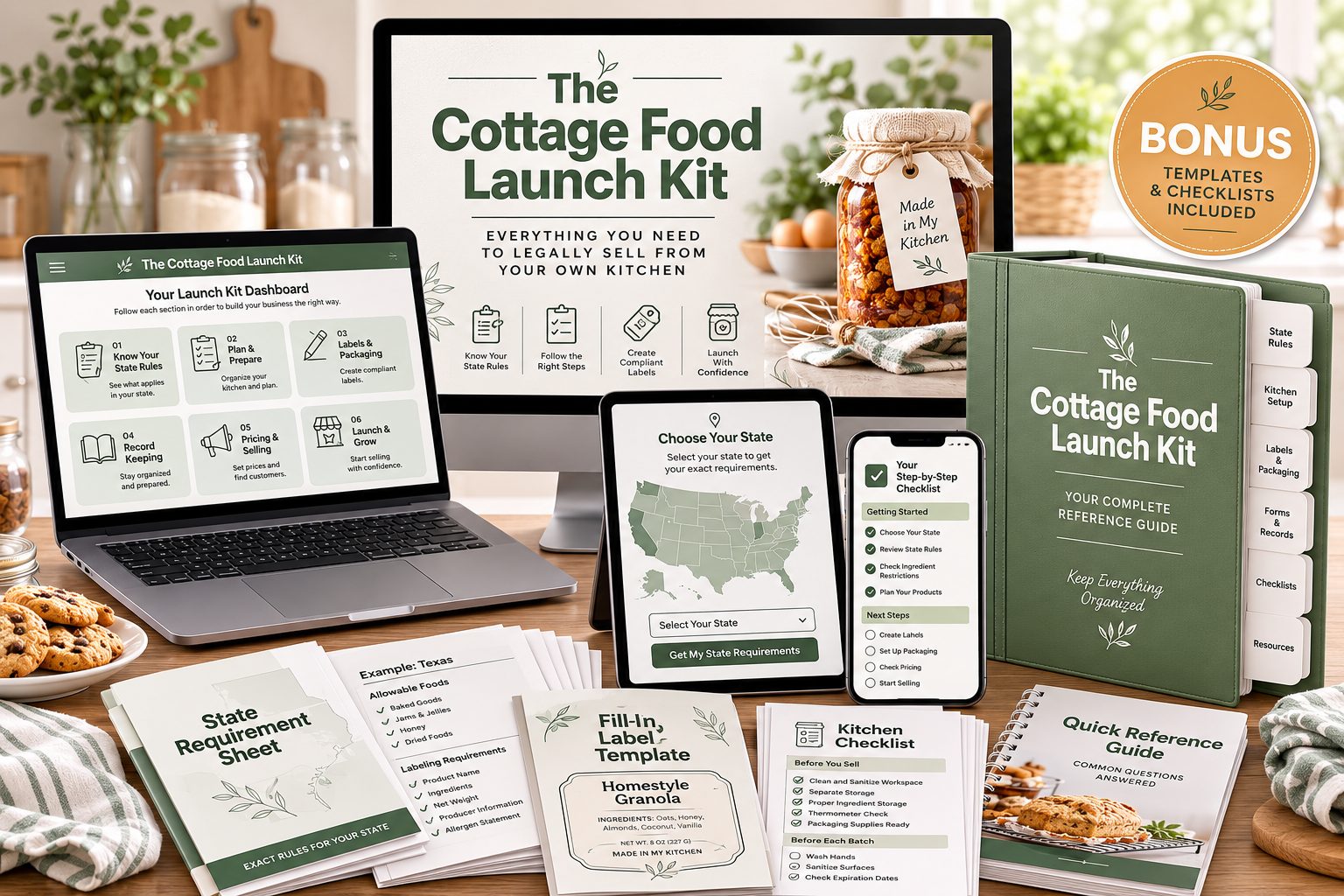
The Cottage Food Launch Kit
Want the whole path in one place? The kit turns everything on this page into one ordered walkthrough for South Carolina: your state requirement sheet, a fill-in label template with the exact required wording, the allowed-foods checker, the ordered checklist and your first-market plan. Follow it in an evening.
Where can you sell in South Carolina?
The venues and channels South Carolina cottage food operators may use.
| Channel | Allowed in South Carolina? |
|---|---|
| Direct to the end consumer, in person | Yes |
| Online and mail order sales to an individual consumer | Yes. Section 44-1-143(E) names online and mail order directly. SCDA's guidance delivers only to South Carolina addresses; its FAQ states the law is only applicable to sales intrastate. |
| Retail and grocery stores | Yes. Correction 2026-08-14: previously marked 'no' on the Section 46-57-20 wording. Section 44-1-143(E), the text SCDA administers, allows sales to retail stores including grocery stores and treats the food as coming from an approved source. The store must post clearly visible signage saying home-based food products are not subject to commercial food regulations. Section 46-57-20 still reads the opposite way; see unverifiedFields. |
| Restaurants | With conditions. A restaurant may sell your packaged labeled product like any retail store. It may not serve your food or use it as an ingredient without a variance approved by SCDA. The restaurant applies for the variance rather than you, on the Request for Operational Variance form. The consumer advisory then carries the disclosure sentence. |
| Wholesale to a distributor | Not clearly authorized. Section 44-1-143(E) names only a person or a retail store, so a distributor sits outside the listed channels. SCDA's guidance says only that a Registration Verification Certificate is not required to sell wholesale where the requirements are met. Confirm with SCDA before agreeing a distribution deal. |
| Mobile food units | Not clearly authorized. Neither code section addresses mobile food units, so this file makes no claim either way. |
South Carolina Department of Agriculture has not settled every channel in one published place. Confirm your specific channel, for example online or out-of-state shipping, with South Carolina Department of Agriculture.
Registration, training and inspection
Registration and permits. No permit, license, registration, certification or inspection is required. SCDA states that it does not issue permits, licenses, certificates or registrations to home-based food producers. An optional free SCDA identification number is available for those who prefer not to print a home address on labels.
Food safety training. No food safety training or certification is required by the Home-Based Food Production Law.
Kitchen inspection. No home kitchen inspection is required or conducted under the Home-Based Food Production Law. Section 44-1-143(F) puts the operation outside Regulation 61.25 retail food establishment oversight.
The fees a South Carolina cottage food seller can expect.
| Item | Cost |
|---|---|
| Home-based food production permit, license, registration or inspection | none, none of these are required |
| Optional SCDA identification number for label privacy | none, free and voluntary |
| Local county/city general business license | varies by locality, not a state fee |
Wondering how South Carolina compares? See what a cottage food license costs in every state, from the no-fee states to the priciest permits.
Which South Carolina law your kitchen runs under and where it lets you sell
Two sections of the South Carolina code describe the same home kitchen. One is Section 44-1-143, amended by 2022 Act No. 208 (Senate Bill 506) and still on the books. The other is Section 46-57-20, enacted by 2023 Act No. 60 as part of moving food safety to the Department of Agriculture on July 1, 2024. They do not say the same thing. The Department administers the program on the 44-1-143 text: its July 2025 guidance names that section as the one to follow. So does the fact sheet it published in May 2026.
One word decides whether a store may stock you
Retail food establishments in South Carolina may only use food from an approved source under Regulation 61-25. The 2022 amendment struck the words "must not" out of that sentence in 44-1-143(E) and wrote in "shall", so the current text reads that food from a home-based food production operation "shall be considered to be from an approved source, as required of a retail food establishment pursuant to Regulation 61.25." The same amendment opened the definition to selling "directly to a person, including online and by mail order, or to retail stores, including grocery stores" and added a duty on the shop: any store selling home-based food products must post clearly visible signage saying those products are not subject to commercial food regulations. The 46-57-20 copy of that subsection still carries the older wording, which reads the opposite way on both points.
What the Department publishes today follows the broader text. Its fact sheet describes home-based food production as preparing non-potentially hazardous food in a residential kitchen for sale directly to consumers or to retail stores inside South Carolina, with the guidance adding that direct sales including online and mail order are delivered only in South Carolina. A restaurant is the one channel that stays closed by default: home-based food may not be served or used as an ingredient in a retail food establishment without a variance approved by the Department. The restaurant applies for that variance rather than you, then the consumer advisory carries the disclosure sentence.
Nobody issues you anything, which is the point
The Department's own retail food safety page puts the licensing question to bed in one line: "SCDA does not issue permits, licenses, certificates, or registrations of HBFP operators." The guidance repeats it, then adds that no retail food establishment permit is needed to sell retail here, no Registration Verification Certificate is needed to sell wholesale here, provided the requirements are met. The identification number is voluntary. Its only job is to keep your home address off the label.
The kitchen conditions written into the law
Subsections (B) and (C) are the part most sellers never read. While you are producing, preparing, packaging or handling food for sale, you supervise anybody else working on it, you keep every animal including pets out of the area and away from stored product, you stop household activities in the kitchen, you keep anyone with a communicable disease, an infected wound or an acute respiratory infection away from the food. The facility list is just as specific: a department-approved water supply, separate storage for the ingredients you sell from, a working refrigeration unit, a sink with enough hot water to clean and sanitize utensils, sanitary storage for those utensils, a hand washing sink separate from the utensil sink, a working toilet, no evidence of insect or rodent activity, department-approved sewage disposal. The guidance translates the water line for you: a public drinking water system, or a private well tested at least annually for total coliform bacteria by a laboratory certified in South Carolina for public drinking water testing.
Ingredients carry their own rule. The allowed-foods tables repeatedly send you to an approved source or a commercially prepared version for the risky component: honey in baklava, the caramel on a caramel apple, pickled jalapenos baked into bread, a sourdough starter that should originate from a commercial culture, alternative flours. Recipes for jams, jellies and preserves have to come from a science-based resource such as the National Center for Home Food Preservation or the USDA Complete Guide to Home Canning rather than from social media.
The very small seller sits outside all of it
Subsection (G) lifts the section off an operation under the earnings floor. The Department's guidance quotes that floor as fifteen hundred dollars a year, the figure the 2022 amendment wrote in. It reads that as permission to produce and sell the same items without the labeling and other provisions. It adds two limits in exchange: no selling at retail locations, plus the producer has to be physically present selling direct to the end consumer. The 46-57-20 copy of the same subsection sets the floor at five hundred dollars.
Sources for this section, all read during this pass: S.C. Code Sections 44-1-143 and 46-57-20 on the General Assembly's site, the conference report for Senate Bill 506 showing which words the 2022 amendment struck, the Department's Home-based Food Production Law Guidance (version 1.4, July 2025) and its 2026 fact sheet.