Missouri Cottage Food Law (2026): Rules, Limits and How to Start
Do you need a license to sell homemade food in Missouri?
Missouri does not require a permit, license or training to sell baked goods, jams, jellies or dried herb mixes made in a home kitchen. There is no cap on how much a cottage food producer can earn and no routine inspection of the home kitchen. The label must carry the producer's name and address plus a statement that the kitchen is not inspected by the state or local health department.
Missouri keeps the path to selling short. There is no state permit and no annual sales cap, so foods like baked goods and canned jams and jellies made with standard sugar content can go to market once your label carries what the state asks for. The rules below are the whole picture.
Missouri sets no dollar limit on cottage food sales, so the ceiling on your growth is your own kitchen and time rather than a statutory cap. The other rules that matter, the label, the allowed foods and where you can sell, are in the tables below.
The parts new Missouri sellers most often get wrong are the label elements. Each one has its own row below, with the official source beside it.
How much can you sell? The Missouri sales cap
The annual sales limit for a Missouri cottage food operation.
| Item | Missouri rule |
|---|---|
| Annual sales cap | No annual dollar cap in Missouri |
| How it works | Missouri removed its $50,000 annual gross income cap effective August 28, 2022 under House Bill 1697. There is currently no limit on how much a cottage food producer can earn in Missouri. |
What foods can you sell in Missouri?
Allowed and prohibited categories under current Missouri law.
| Allowed (examples) | Prohibited |
|---|---|
| Baked goods (cookies, cakes, breads, danish, donuts, pastries, most pies); Canned jams and jellies made with standard sugar content; Dried herb and dried herb mixes; Raw agricultural commodities sold whole and unprocessed (fruit, vegetables, in-shell nuts, fresh herbs, honey, grains) under a separate low-risk exemption; Fruit butters, sorghum, cracked nuts, packaged spices and dry soup mixes under the separate Missouri Food Code exemption, only where local law allows it. | No sugar added, sugar free and hot pepper jams or jellies (altered pH or water activity); Cut produce and baked goods garnished with fresh fruit; Freeze-dried foods; Salsa, pickles and other acidified or low-acid canned foods (BBQ sauce, hot sauce); Sprouts and wild mushrooms; Meringue or cream pies and other potentially hazardous baked goods; Meat, poultry, seafood, dairy and eggs; Pet foods and treats; Marijuana-infused products. |
Missouri cottage food label requirements
Every package you sell needs a label with the elements below in legible print.
- Full name and address of the cottage food production operation
- Common name of the food
- Ingredients listed in descending order by weight, with sub-ingredients in parentheses
- Net weight of the food
- Any allergens present
- A statement that the product is prepared in a kitchen not subject to inspection by the Missouri Department of Health and Senior Services or the local health department
No single statewide disclosure sentence. Missouri does not set one required disclosure line in the sources we checked. Put the required elements above on every label. Confirm the current wording with None. No state filing, registration or permit is required for products sold under the Missouri Cottage Law. before you print a run.
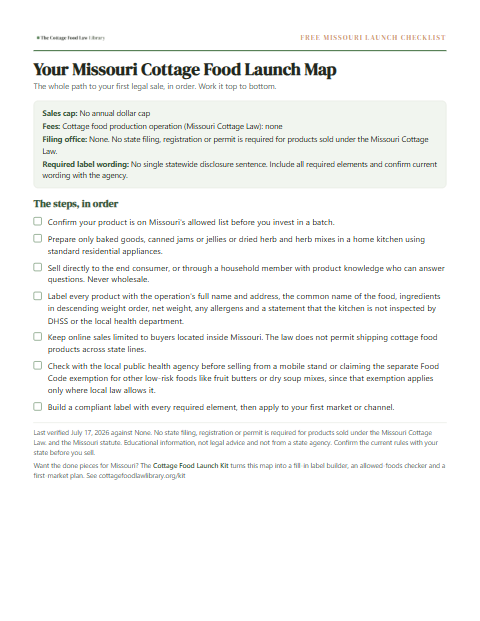
Get the free Missouri cottage food checklist
The one-page map of the steps, in order, so you can see the whole path at a glance.
Instant download, plus Missouri law-change alerts. Unsubscribe anytime.
Where can you sell in Missouri?
The venues and channels Missouri cottage food operators may use.
| Channel | Allowed in Missouri? |
|---|---|
| Direct to consumer in person (home, farmers markets, roadside stands) | Yes |
| Online orders | With conditions. Allowed since the August 2022 amendment, only when both producer and purchaser are located in Missouri |
| Mobile stand vending non-hazardous foods under the Food Code exemption | With conditions. Only where the local public health agency's ordinance allows it. It also requires labeling plus a visible placard |
| Retail stores, restaurants and wholesale | No. Wholesaling removes the product from the Cottage Law; it must then meet DHSS Manufactured Food program rules |
| Mail, carrier shipping or any sale across state lines | No. RSMo 196.298 and DHSS guidance both bar interstate sale of Missouri Cottage Law products |
Registration, training and inspection
Registration and permits. No permit, license or registration exists for a Missouri Cottage Law operation. RSMo 196.298 bars state and local health authorities from regulating, licensing or inspecting a qualifying cottage food production operation.
Food safety training. Missouri does not require a food handler course, food safety certification or any training for a Cottage Law operation.
Kitchen inspection. A Missouri Cottage Law operation is not subject to routine inspection by the state or local health department. State and local health authorities keep the authority to investigate a foodborne illness or disease outbreak.
The fees a Missouri cottage food seller can expect.
| Item | Cost |
|---|---|
| Cottage food production operation (Missouri Cottage Law) | No state fee |