Illinois Cottage Food Law (2026): Rules, Limits and How to Start
Do you need a license to sell homemade food in Illinois?
Illinois lets you sell most homemade foods direct to consumers with no sales cap, but the bar to start is higher than most states. You must register with your local health department and every operator has to hold an ANSI-accredited Certified Food Protection Manager certificate before registering, not just a basic food handler card.
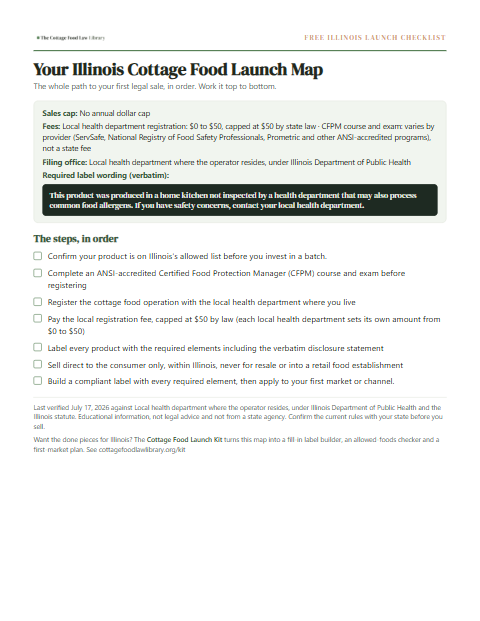
To sell homemade food in Illinois you first register with Local health department where the operator resides, under Illinois Department of Public Health. The kitchen stays your own. Foods like baked goods and candies and confections are on the table once the registration and the label are done, in the order the page below lays out.
Illinois sets no dollar limit on cottage food sales, so the ceiling on your growth is your own kitchen and time rather than a statutory cap. The other rules that matter, the label, the allowed foods and where you can sell, are in the tables below.
The parts new Illinois sellers most often get wrong are the exact label disclosure wording, the food safety course and the registration step. Each one has its own row below, with the official source beside it.
How much can you sell? The Illinois sales cap
The annual sales limit for an Illinois cottage food operation.
| Item | Illinois rule |
|---|---|
| Annual sales cap | No annual dollar cap in Illinois |
| How it works | Illinois removed its sales cap through the 2018 and 2022 amendments (Public Act 102-0633 among them). There is no revenue limit on a registered cottage food operation today. |
What foods can you sell in Illinois?
Allowed and prohibited categories under current Illinois law.
| Allowed (examples) | Prohibited |
|---|---|
| Baked goods (most non-potentially hazardous items); Candies and confections; Condiments (honey, ketchup, mustards, nut butters, oils, pickles, salsas, sauces, syrups, vinegars); Dry goods, pastries, preserves, snacks; Carbonated drinks and extracts; Frozen produce, hardboiled eggs, juices; Canned tomato products meeting the state's acidified/pH requirements. | Meat, poultry, fish, seafood and shellfish; Dairy, except as an ingredient in a qualifying non-potentially hazardous baked good, candy or frosting; Eggs, except as an ingredient in a qualifying baked good, dry noodles, or non-raw frosting; Pumpkin, sweet potato and custard or cream pies, plus cheesecakes; Garlic in oil or oil infused with garlic, unless the garlic oil is acidified; Low-acid canned foods, sprouts, cut leafy greens (except dehydrated, acidified, or blanched and frozen); Cut or puréed fresh tomato or melon, dehydrated tomato or melon, frozen cut melon; Wild-harvested, non-cultivated mushrooms; Alcoholic beverages and kombucha. |
Illinois cottage food label requirements
Every package you sell needs a label with the elements below in legible print.
- Cottage food operation name and the county, township, city or village of registration
- Registration number and the municipality or county where registered
- Common or usual name of the food product
- Ingredients in descending order by weight, including colors, artificial flavors and preservatives
- Net weight, excluding packaging
- Production date
- Allergen statement for any of the nine major allergens
- The disclosure statement above
Illinois requires this disclosure statement, word for word:
This product was produced in a home kitchen not inspected by a health department that may also process common food allergens. If you have safety concerns, contact your local health department.
Reproduced from Illinois's cottage food labeling requirements. Confirm the current wording with Local health department where the operator resides, under Illinois Department of Public Health before you print a run of labels.
From the team behind this library
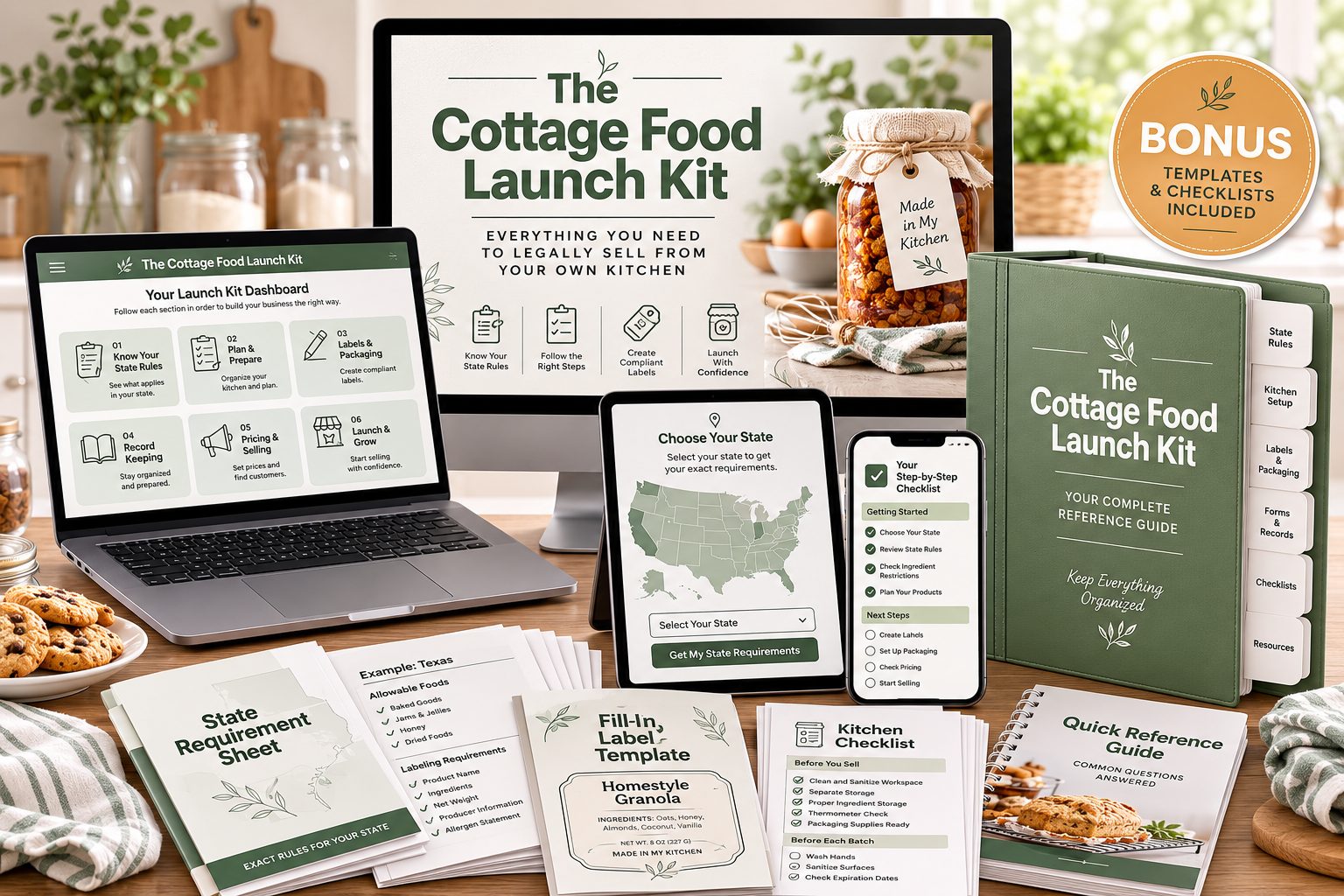
The Cottage Food Launch Kit
Want the whole path in one place? The kit turns everything on this page into one ordered walkthrough for Illinois: your state requirement sheet, a fill-in label template with the exact required wording, the allowed-foods checker, the ordered checklist and your first-market plan. Follow it in an evening.
Where can you sell in Illinois?
The venues and channels Illinois cottage food operators may use.
| Channel | Allowed in Illinois? |
|---|---|
| Direct to consumer in person (home, farmers markets, pop-ups, events) | Yes |
| Online sales with in-state fulfillment | Yes. The online sales interface must show the point-of-sale disclosure notice. |
| Resale through a retail food establishment | No |
| Shipping or delivery out of state | No |
Registration, training and inspection
Registration and permits. Every cottage food operation must register with the local health department where the operator resides before selling.
Food safety training. All cottage food operators and anyone else preparing or packaging the products must complete an ANSI-accredited Certified Food Protection Manager (CFPM) course and exam before registering.
Kitchen inspection. No inspection happens at registration. The local health department may inspect the home kitchen if it has cause to believe the products are unsafe or the operation is out of compliance.
The fees an Illinois cottage food seller can expect.
| Item | Cost |
|---|---|
| Local health department registration | $0 to $50, capped at $50 by state law |
| CFPM course and exam | varies by provider (ServSafe, National Registry of Food Safety Professionals, Prometric and other ANSI-accredited programs), not a state fee |
Wondering how Illinois compares? See what a cottage food license costs in every state, from the no-fee states to the priciest permits.
Registering an Illinois cottage food operation, in the order it happens
Illinois puts its hardest requirement first. The Certified Food Protection Manager certificate has to exist before the local health department will approve your registration, so the eight-hour course is step one rather than paperwork you catch up on later. Everything after it is quick by comparison.
The certificate, then the county
Every cottage food operator, plus anybody who helps prepare or package the product, holds the Certified Food Protection Manager certification before the registration can be approved. Look for an ANSI-accredited course of at least eight hours with a proctored exam, usually $100 to $300, valid for five years. A food handler card does not satisfy it. Employees who only handle sales, marketing or administration do not need one.
Registration is filed with the local health department in the county or municipality where you live, not with the state. It is annual. It can take up to six weeks depending on that department's workload. The fee is capped at $50 by law, with each department free to charge anywhere from nothing to that ceiling. Once you are registered you may sell in any county in the state, so the certificate is worth carrying when you vend outside your own. What you bring: the certificate, your product list, one label for each product category, well water test results if you are not on municipal water, the fee, plus either a food safety plan with a representative pH test or an approved recipe from the USDA National Center for Home Food Preservation or a state cooperative extension for acidified and fermented products, then the same choice again for canned tomato products.
The kitchen has to be in your primary domestic residence, or in an appropriately designed and equipped kitchen on a farm. Farmers get the outbuilding allowance because farm property is often on a different parcel from the house. Everybody else does not. A spare bedroom fitted out as a makeshift kitchen does not count either. One registration covers one kitchen, so two friends cooking in two houses under one business does not work.
Where the product may go since January 2022
The Home to Market Act opened direct sales statewide. Farmers markets, delivery to customers, fairs, festivals and public events, online orders, pickup from your home or farm, third-party private property with the owner's consent and shipping inside Illinois are all in. Shipping carries two conditions: only non-potentially hazardous food travels, then each shipped item is sealed so tampering shows, a sticker or a pop top for instance. Out-of-state shipping is out, because product crossing a state line becomes interstate commerce under federal rules.
The wall is resale. The law says food and drink produced by a cottage food operation is sold directly to consumers for their own consumption and not for resale, which closes more doors than people expect. No selling to a bakery or grocery store to resell. No supplying a restaurant with an ingredient, since using it in something the restaurant sells is resale. No CSA box. No vending machine. No pop-up inside a grocery store either, because a licensed store may not carry product from a source a health department has not inspected. A craft mall stall or a pop-up in a retail space does work, on one condition: you or your employee is present for every transaction rather than leaving stock behind.
Signage is a separate duty from labeling
Wherever you sell, a notice appears at the point of sale carrying the wording "This product was produced in a home kitchen, not inspected by a health department, that may also process common food allergens." At a physical display that notice is a placard, minimum eight inches by ten inches. Online it is a message on your sales interface at the point of sale, which covers an Etsy shop page or an online farmers market listing as much as your own website. The label on the package is the separate job the label section higher up this page sets out.
Inspection happens on cause, not on a schedule
Your home kitchen is not inspected when you register. A local health department may inspect it after a customer complaint or a foodborne illness outbreak, where it or the state has reason to believe an imminent health hazard exists, where your product has been found misbranded, adulterated or out of compliance, or where another local health department passes on any of those. It can ask you to stop selling while that gets resolved. It can revoke the registration through a penalty process that each department sets for itself. Refusing an inspection is allowed on paper. It usually costs you the registration.
One protection runs the other way. Local government may not enforce rules inconsistent with the state law, so a municipality cannot declare cottage food operations illegal, cannot shorten the state's allowed foods list, cannot confine you to farmers markets. It keeps zoning, outdoor signage, traffic, customer numbers and building permits, with a specific provision letting Chicago apply its home occupation rules.
Sources for this section: the 2024 Cottage Food Guide and the Department of Public Health's cottage food page that publishes it, plus the text of 410 ILCS 625/4.