How Much Does a Cottage Food License Cost? (2026, by State)
Free in most states. Where a fee exists it is usually $30 to $100. Here is the figure for every state, plus what a course and local rules add.
A cottage food license costs nothing in most states. The seventeen states that require no registration charge no state fee at all. Several states that do require a registration charge nothing for it either, so more than seventeen let you start free. Where a state does charge, the registration or permit usually runs from about $30 to $100. A handful sit higher, into the $150 to $355 range. A few counties set their own fee. The figure below is the state fee for the basic path; a food-safety course of $10 to $50 or a local business license can add a little on top.
Free in 37 of the 51 US jurisdictions. In those the basic path carries no state fee at all, either because the state asks for no registration or because it registers you for nothing. The other 14 charge a fee or leave the figure to a county, a city or a schedule the state does not publish; most of those land between $20 and $100 a year, with Washington the highest clear state figure at $355 for a two-year permit. Your own state's number is in the table below.

What you actually pay and to whom
Three things make up the cost of getting legal. Only the first is set by the state:
- The state registration or permit fee. Zero in most states. Where it exists it is usually $30 to $100, paid once a year or once at signup. This is the figure in the table below.
- A food-safety course, where your state requires one. Roughly $10 to $50 from a third-party provider, valid for a few years. It is not a state fee and you pay the course provider, not the state.
- Local costs. Some cities and counties want a general business license or set their own registration fee. These vary by locality and sit outside the state cottage food law.
Cottage food fee by state
Whether the state requires a registration and the state fee for the basic path. Tiered, broader or optional paths can carry a different fee, so open a state page for the full figure and any local costs.
| State | State registration? | State fee, basic path |
|---|---|---|
| Alabama | Yes | varies by county |
| Alaska | Depends on food or channel | None for the basic path |
| Arizona | Yes | No state fee |
| Arkansas | No | None |
| California | Yes | varies by county, commonly cited around $100 to $250 |
| Colorado | Depends on food or channel | None for the basic path |
| Connecticut | Yes | $50.00 |
| Delaware | Yes | $30.00 per CFE per fiscal year |
| District of Columbia | Yes | $50 |
| Florida | No | None |
| Georgia | No | None |
| Hawaii | No | None |
| Idaho | No | None |
| Illinois | Yes | $0 to $50, capped at $50 by state law |
| Indiana | No | None |
| Iowa | Depends on food or channel | None for the basic path |
| Kansas | No | None |
| Kentucky | Yes | $50 per year |
| Louisiana | Depends on food or channel | None for the basic path |
| Maine | Yes | $20 per year |
| Maryland | Depends on food or channel | None for the basic path |
| Massachusetts | Yes | varies by municipality |
| Michigan | No | None |
| Minnesota | Yes | No state fee |
| Mississippi | No | None |
| Missouri | No | None |
| Montana | Depends on food or channel | None for the basic path |
| Nebraska | Depends on food or channel | None for the basic path |
| Nevada | Yes | $220, one-time and non-refundable |
| New Hampshire | Depends on food or channel | None for the basic path |
| New Jersey | Yes | $100.00 |
| New Mexico | No | None |
| New York | Yes | No state fee |
| North Carolina | Yes | No state fee |
| North Dakota | No | None |
| Ohio | Depends on food or channel | None for the basic path |
| Oklahoma | Depends on food or channel | None for the basic path |
| Oregon | Depends on food or channel | None for the basic path |
| Pennsylvania | Yes | $35 |
| Rhode Island | Yes | $65 per year |
| South Carolina | No | None |
| South Dakota | No | None |
| Tennessee | No | None |
| Texas | Depends on food or channel | None for the basic path |
| Utah | Depends on food or channel | None for the basic path |
| Vermont | Depends on food or channel | None for the basic path |
| Virginia | Depends on food or channel | None for the basic path |
| Washington | Yes | $355 |
| West Virginia | Depends on food or channel | None for the basic path |
| Wisconsin | No | None |
| Wyoming | No | None |
Get it done in an evening
From the team behind this library
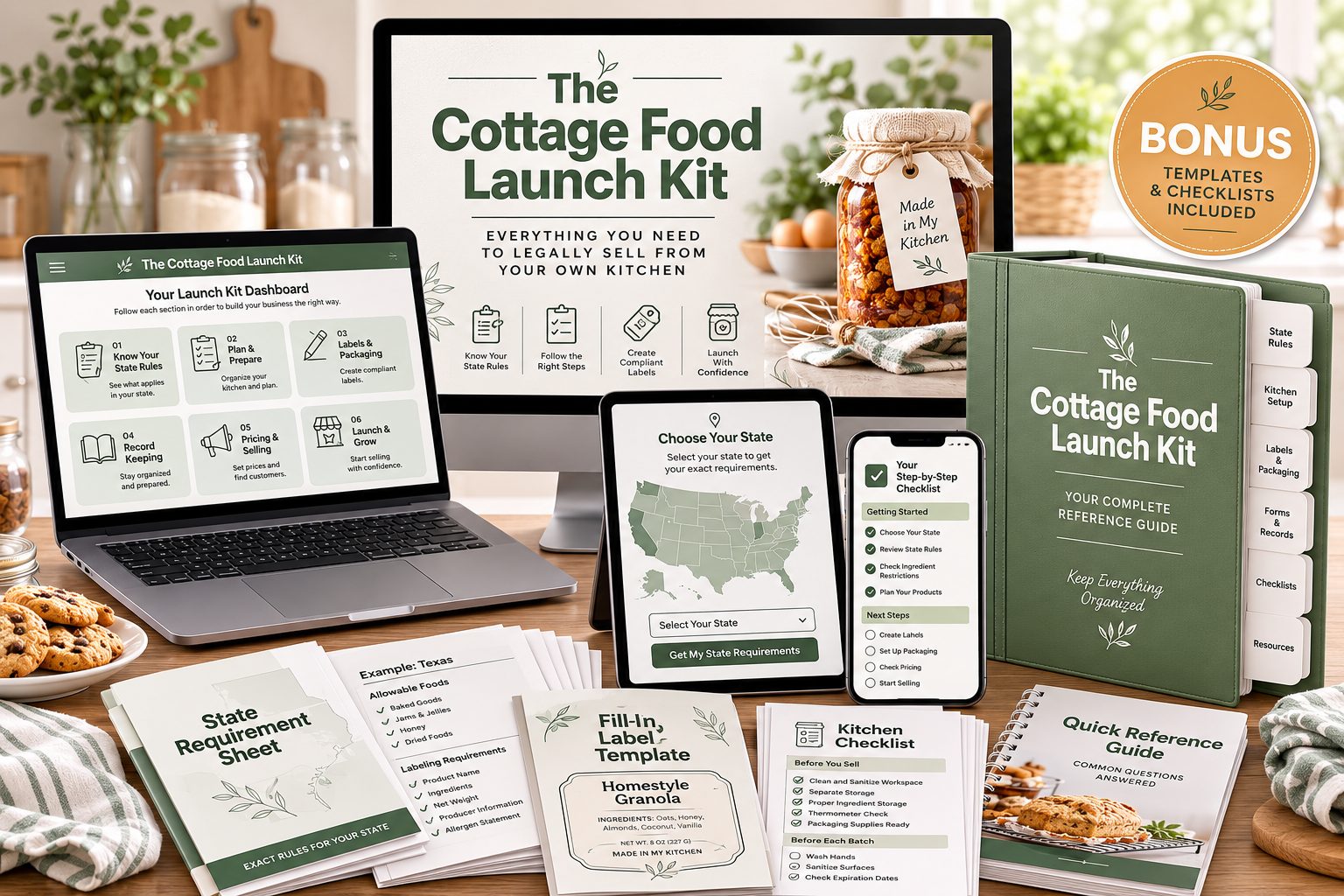
The Cottage Food Launch Kit
Want the whole path in one place? The Cottage Food Launch Kit turns the rules for your state into one ordered walkthrough: your requirement sheet, a fill-in label template with the exact required wording, the allowed-foods checker, the ordered checklist and your first-market plan.
A sales cap is a different thing from a fee
The fee above is what you pay once to register or permit. A sales cap is a separate ceiling: the most a cottage operation may earn in a year before it outgrows the law. The two are not connected. A state can charge no fee and still set a cap, or charge a fee and set none. In 26 jurisdictions there is no state sales cap at all. Where a cap exists it runs from the low thousands to a quarter of a million dollars a year, so it is worth knowing yours before you scale. Your state page carries the exact figure and how it is measured.
Every jurisdiction with a sales cap, plus the states whose cap is split, a threshold or still settling. The dagger marks a figure that is indexed to inflation, scheduled to change on a set date, or not yet confirmed against the primary source. 26 jurisdictions set no state sales cap at all: Alabama, Alaska, Arizona, Arkansas, Delaware, District of Columbia, Georgia, Hawaii, Idaho, Illinois, Kansas, Maine, Massachusetts, Missouri, Montana, Nebraska, New Hampshire, New Mexico, New York, North Carolina, North Dakota, Ohio, Pennsylvania, South Carolina, South Dakota, Tennessee.
| State | Annual sales cap | Basis | Note |
|---|---|---|---|
| Virginia | $9,000 | acidified vegetables and pickles only | Category cap only. Most cottage foods are uncapped in Virginia. |
| Colorado | $10,000 † | per product per year | Rises to $150,000 per product on January 1, 2027 (HB26-1033). |
| Vermont | $30,000 | Cottage Food Operator tier | A separate $10,000 tier applies to processed foods sold for resale. |
| Mississippi | $35,000 | gross annual | |
| Nevada | $35,000 † | per operation | Rises to $100,000 on July 1, 2027 (AB 352). |
| Washington | $35,000 | per residence | One limit is shared by permit holders at the same address. |
| Connecticut | $50,000 | gross annual | |
| Maryland | $50,000 † | gross annual | Rises to $100,000 on October 1, 2026 (Chapter 320). |
| Michigan | $50,000 † | gross annual | Adjusts for inflation after October 1, 2026. Higher if all units are priced $250 or more. |
| New Jersey | $50,000 | gross annual | |
| Rhode Island | $50,000 | per registration | |
| Oregon | $52,700 † | gross annual, 2026 | Indexed to inflation every year. |
| Kentucky | $60,000 † | combined program | Not confirmed against the primary regulation this pass. Confirm the scope with the state. |
| Oklahoma | $75,000 † | gross annual | Rises to $250,000 on November 1, 2026 (HB 3720). |
| Minnesota | $78,000 † | per individual | Top of a two-tier structure. The threshold starts adjusting to inflation in 2027. |
| Louisiana | $100,000 | non-bakery cottage foods | No cap on bakery goods such as breads, cakes and cookies. |
| Texas | $150,000 † | gross income | Indexed to inflation. |
| Florida | $250,000 | gross annual | The highest confirmed cap in this sweep. |
| California | $88,878 / $177,756 † | Class A / Class B, indexed | CDPH's own sheet, effective January 1, 2026. The statutory bases are $75,000 and $150,000 and the figure moves every January. |
| Indiana | none / $1.5M | Home Based Vendor vs 2026 exemption | No cap under the Home Based Vendor law. A separate exemption ends at $1.5 million in gross sales. |
| Iowa | none / $50,000 | exemption vs HFPE license | No cap on the direct-to-consumer exemption. $50,000 on the licensed path. |
| Utah | not stated † | registered and exempt paths | No cap was found in the official sources. Confirm with the state. |
| West Virginia | unverifiable † | rules still in draft | No cap confirmed while the SB 44 rules are still being drafted. |
| Wisconsin | none / $5,000 | baked goods vs pickle law | No cap on the court-order baked goods path. $5,000 on the separate pickle law. |
| Wyoming | $250,000 producer ceiling | food-freedom producer definition | A ceiling of 250,000 units or $250,000 in revenue, not a per-sale cap. |
The cheapest way to start
If cost is the deciding factor, the seventeen no-registration states let you begin with no state fee at all. Shelf-stable foods like baked goods, jams and candy avoid the extra steps that push cost up. Even in states that charge, the fee is a small part of getting started; the bigger inputs are your ingredients, your packaging and your time. The pricing guide covers how to set a price that covers all of it.
See your state's exact cost
Open your state page for the precise fee, the office that collects it and whether a course or inspection applies. Or check whether you need a license at all. To put the fee beside the rest of the rules, the cottage food laws by state comparison carries registration, inspection, training, the sales cap, the food model and the online selling rules for all 51 jurisdictions in one table.
This guide is educational information, not legal advice or financial advice. Fees change and vary by county. The figures here are the state fees we verified per state; confirm the current amount with your state before you rely on it.
Cottage food cost FAQ
How much does a cottage food license cost?
In most states, nothing. Seventeen US jurisdictions charge no state fee because they require no registration at all. Where a state does charge a registration or permit fee, it usually runs from about $30 to $100. A handful sit higher, into the $150 to $355 range. A few counties set their own figure. A food-safety course of $10 to $50 and a local business license can add a little on top.
Which states have no cottage food fee?
The seventeen states that require no state registration charge no state fee to start: Arkansas, Florida, Georgia, Hawaii, Idaho, Indiana, Kansas, Michigan, Mississippi, Missouri, New Mexico, North Dakota, South Carolina, South Dakota, Tennessee, Wisconsin, Wyoming. Several states that do require a registration also charge nothing, so the number of no-fee states is higher still. Open a state page for its exact figure.
What is the most expensive cottage food license?
Washington runs the highest clear state fee in this library at $355 for a two-year permit that includes a public-health review. Nevada county registrations are reported around $220 to $325, New Hampshire's broader Homestead license is about $150 and California county registrations commonly land around $100 to $250. Most other states are free or under $100.
How much is a cottage food license?
Usually nothing. In 37 of the 51 US jurisdictions there is no state fee at all for the basic path. Where a fee applies it is normally between $20 and $100 a year, with a small number of states and counties running higher. The table above gives the figure for your own state.
Is a cottage food license free?
In most states, yes. Seventeen jurisdictions require no registration at all, so there is nothing to pay for. Several states that do require a registration also charge no fee for it. Where a state does charge, the fee is small next to your ingredients and packaging.
How much does a cottage food permit cost?
The same range as a registration or license, because the words describe the same filing in different states. Most permit fees sit between $20 and $100 a year. Washington is the highest clear state figure at $355 for a two-year permit. County-set permits in California and Nevada also run above the typical state fee.
How much does it cost to start selling food from home?
Less than most people expect. In a no-fee state the real costs are your ingredients, your packaging and your labels. Where the state charges, add the registration or permit fee from the table above, then $10 to $50 for a food-safety course if your state requires one and whatever your city or county charges for a general business license.
Do you pay the cottage food fee every year?
It depends on the state. Many registration and permit fees renew annually, some are a one-time charge at signup and Washington runs a two-year permit. Your state page says which applies, because a fee that renews changes the arithmetic once you are a few years in.