Do You Need a License to Sell Food From Home? (2026, by State)
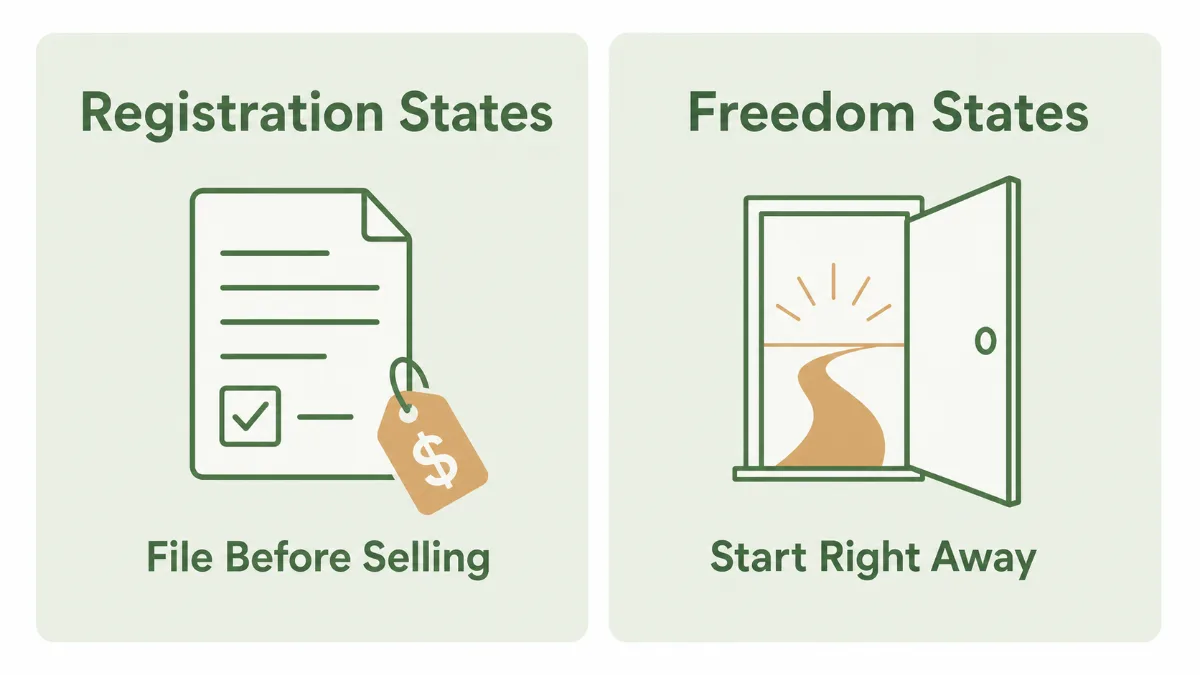
In most states there is no traditional license, but many want a registration or permit first. Seventeen require nothing at all.
In most states you do not need a traditional business license to sell food from home, but you may need to register or get a permit first. Cottage food laws set up a lighter path than a full food business. Seventeen US jurisdictions ask for nothing before you start, most of the rest want a free or low-cost registration or permit and a handful run a fuller process with a course or a kitchen inspection. Which one applies is set by your state, so the honest answer to "do I need a license" is that it depends on your state. Here is how to tell.
License, registration or permit: the word your state uses matters
Searchers ask for a "cottage food license," but many states do not use that word. Some issue an actual license or permit. Many use a registration, which is often free or under $100. Seventeen require no state filing at all. The thing you are looking for might be called a registration or a permit in your state, so do not assume you are exempt just because your state never says "license." Your state page names the exact requirement and the office behind it.
The 17 states with no state registration
These jurisdictions let you start selling most homemade shelf-stable foods with no state registration, permit or license. You still follow the labeling and allowed-foods rules. Local zoning or a general business license can still apply, so check your city or county too.
Arkansas, Florida, Georgia, Hawaii, Idaho, Indiana, Kansas, Michigan, Mississippi, Missouri, New Mexico, North Dakota, South Carolina, South Dakota, Tennessee, Wisconsin, Wyoming.
The states that require a registration or permit
Most states ask you to register or get a permit before your first sale. It is usually a short online or mail filing, sometimes with a small fee and sometimes free. These states require it up front:
Alabama, Arizona, California, Connecticut, Delaware, District of Columbia, Illinois, Kentucky, Maine, Massachusetts, Minnesota, Nevada, New Jersey, New York, North Carolina, Pennsylvania, Rhode Island, Washington.
Get the whole path in one place
From the team behind this library
The Cottage Food Launch Kit
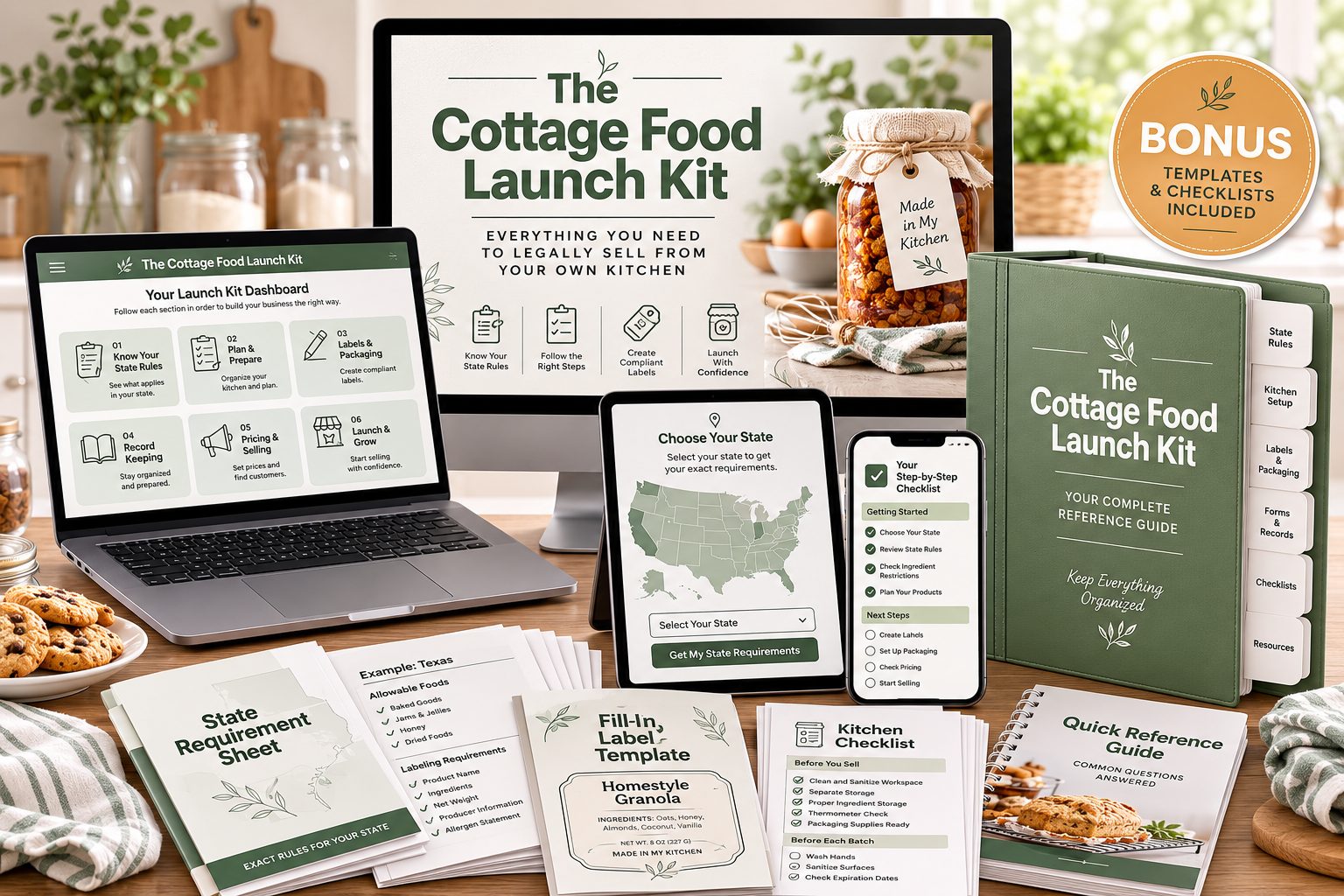
Want the whole path in one place? The Cottage Food Launch Kit turns the rules for your state into one ordered walkthrough: your requirement sheet, a fill-in label template with the exact required wording, the allowed-foods checker, the ordered checklist and your first-market plan.
The states where it depends on your food or your channel
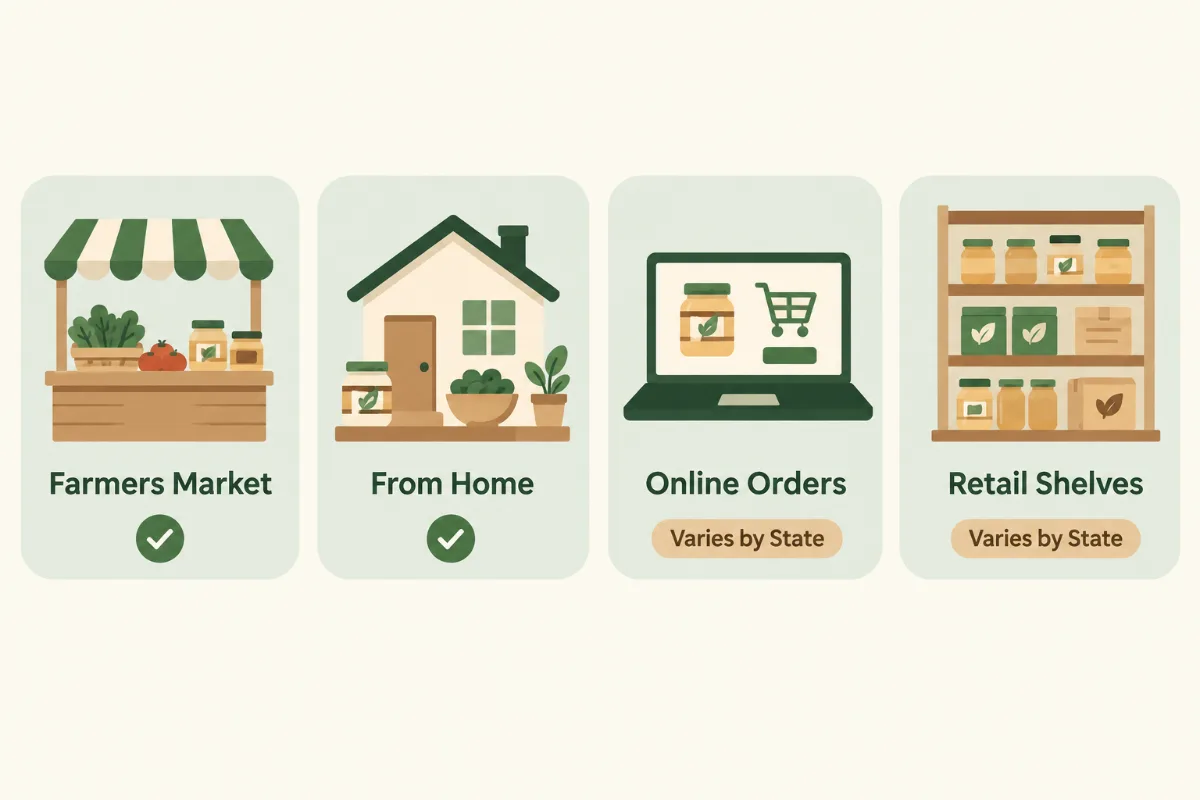
In these states the answer turns on what you make or how you sell it. Many home producers need no filing, while certain foods, often refrigerated or canned items, or certain channels like shipping or wholesale, trigger a registration or permit:
Alaska, Colorado, Iowa, Louisiana, Maryland, Montana, Nebraska, New Hampshire, Ohio, Oklahoma, Oregon, Texas, Utah, Vermont, Virginia, West Virginia.
What happens if you sell food without a license
There is no national answer, because the consequence is written into each state's own law and the states sit further apart here than anywhere else in cottage food. In one state an inspector cannot come to your kitchen at all unless a consumer complains. In another every permitted home kitchen is inspected before the permit issues then once a year after that, with selling unpermitted a misdemeanor on the first offense. Anyone who tells you what "usually" happens is guessing. Here is what is actually written down, with the section number for each one so you can read it yourself.
Two states, two opposite rules
California keeps its inspectors out unless somebody complains. Health and Safety Code section 114365 says a Class A cottage food operation "shall not be subject to initial or routine inspections" and lets an enforcement officer access the home only where, on the basis of a consumer complaint, there is reason to suspect that adulterated or otherwise unsafe food has been produced. Section 114381(a) then holds the other half of the deal for anyone outside that exemption: a food facility may not be open for business without a valid permit.
Washington does the reverse. RCW 69.22.040(1) requires the permitted area of all cottage food operations to be inspected for basic hygiene before the permit issues then annually afterward. RCW 69.22.090 makes engaging in a cottage food operation without a valid permit a misdemeanor, a gross misdemeanor for a second or subsequent violation, alongside a civil penalty not exceeding one thousand dollars per violation per day. No warning step appears in the section.
Where a dollar figure is actually written down
Most states leave the number to the general food licensing law rather than to the cottage food law. These are the ones where the figure is on the page rather than in somebody's blog post:
- Florida. Operating a public food service establishment without a license is a misdemeanor of the second degree under Florida Statutes 509.241(1), while 509.261(1)(a) lets the division impose fines not to exceed $1,000 per offense. Opening a food establishment without a permit is a second degree misdemeanor too, under 500.121(5). The per-offense wording matters: Florida's stacking rule keys to critical violations, not to being unlicensed as such.
- New York. A food processing establishment may not operate unless licensed biennially (Agriculture and Markets Law 251-z-3), each day of unlicensed operation is a separate violation (251-z-10) then the civil penalty under section 39 is not more than $600 for a first violation with not more than $1,200 for a second or later one. This is the Article 20-C track, the same licence the New York home processor exemption exempts you from.
- Washington. One thousand dollars per violation per day, plus the misdemeanor, under RCW 69.22.090 above.
- California. Health and Safety Code section 114387 puts operators without the necessary permits at risk of closure of the facility plus a penalty not to exceed three times the cost of the permit.
- Mississippi. The health department names a figure in its own cottage food FAQ rather than in statute: a fine of up to $1,000 for operating as an illegal food establishment. It sits on the Mississippi page with that source noted.
What your own state page tells you about this
More than a dozen state pages in this library record, in their own state's words, that nobody inspects a home kitchen unless a complaint or an illness report arrives. Montana takes an agreement to allow an inspection if a complaint or illness is linked to a product. Georgia ended routine pre-licensing inspections along with the licence requirement while the Department of Agriculture kept its complaint and outbreak investigations. Minnesota runs no routine home inspection though staff do check registration status at farmers markets. New Mexico inspects in response to a complaint or a suspected illness. That is a real pattern. It is still not a national rule, which is why the Washington example above sits at the top of this section.
The useful way to read all of it: the exemption is a boundary rather than a shield. Inside it, most states have no permit to revoke and no fee to collect. Step outside it, by making a food your state excludes, by passing your cap or by selling through a channel your state does not allow, then the ordinary licensing rules apply to you along with the penalties above. The penalties are the licensing law's, not the cottage food law's.
What nobody can promise you
That a warning comes first. Minnesota's statute lists thirteen things the commissioner may do, from a written warning or a cease and desist to embargo, citation or an administrative penalty (Minn. Stat. 34A.06). The Department of Agriculture's own cottage food guidance says actions depend on the severity of the violation, listing prosecution in the same breath as written notice. Texas puts it the same way: different actions depending on severity, history, the effort made to correct it then the harm done. Nothing in any of these gives a first-timer a guaranteed pass.
What you can control is the cheap part. In most jurisdictions the filing that keeps you inside the exemption costs nothing at all, which the cost-by-state guide works out state by state. Texas gets the question most, so its page carries the Texas version in full: what the exemption covers, what applies once you leave it and what a complaint against a cottage operation actually does.
The longer version of this question now has its own page. Penalties for selling food without a license works through what enforcement actually looks like, the figures written into five states' statutes and the steps that fix it if you have already sold something.
Find your state's exact requirement
Open your state page for the precise rule, the office that handles it and the official source. Or use the free can-I-sell-this checker to see the requirement for a specific food. The cost-by-state guide shows what any fee runs.
This guide is educational information, not legal advice. Whether you need a license, a registration or a permit is set by your state and sometimes your county. Confirm the current rule with your state before you sell.
License and permit FAQ
Do I need a license to sell food from home?
It depends on your state. Seventeen US jurisdictions require no state registration, permit or license to sell most homemade foods. The rest ask for a registration or a permit before your first sale. A few add a food-safety course or a kitchen inspection on top. Your state page names the exact requirement and links the office that handles it.
Do I need a permit to sell food from home?
In many states, yes. What some states call a permit, others call a registration or a license; the words vary but the idea is the same, a filing you complete before you sell. Seventeen jurisdictions require none at all. Check your state page for whether a permit applies to you and what it costs.
Can you sell food from home without a license?
Yes. In seventeen US jurisdictions you can sell most homemade shelf-stable foods with no state license, permit or registration at all, Arkansas, Florida, Georgia, Hawaii, Idaho among them. Everywhere else you complete a registration or permit first. Local zoning or a general business license can still apply even where the state asks for nothing.
Do I need a cottage food license?
Maybe, though your state may not call it a license. Some states issue a cottage food license or permit, many use a free or low-cost registration and seventeen require nothing. If your search for a "cottage food license" turns up a "registration" instead, that registration is your requirement. Your state page names it.