North Carolina Cottage Food Law (2026): Rules, Limits and How to Start
Do you need a license to sell homemade food in North Carolina?
North Carolina has no separate cottage food statute. Instead the Department of Agriculture and Consumer Services runs a Home Processor program: you apply, pass a one-time free home-kitchen inspection and get a Notice of Inspection rather than a permit. There is no sales cap and no fee.
North Carolina asks more of a home food seller than most states. You work through North Carolina Department of Agriculture and Consumer Services before your first sale. The page below lays out the registration, the training and the inspection in the order they come. It is a real process, so knowing the steps up front is what keeps it from stalling.
North Carolina sets no dollar limit on cottage food sales, so the ceiling on your growth is your own kitchen and time rather than a statutory cap. The other rules that matter, the label, the allowed foods and where you can sell, are in the tables below.
The parts new North Carolina sellers most often get wrong are the label elements, the kitchen inspection and the registration step. Each one has its own row below, with the official source beside it.
How much can you sell? The North Carolina sales cap
The annual sales limit for a North Carolina cottage food operation.
| Item | North Carolina rule |
|---|---|
| Annual sales cap | No annual dollar cap in North Carolina |
| How it works | No revenue or unit cap was found in NCDA&CS official program materials. Multiple secondary sources independently describe the program as having no sales cap; treated as corroborated but not textually confirmed on the official program page itself. |
Not published as one current figure everyone cites. Confirm this year's cap with North Carolina Department of Agriculture and Consumer Services before you scale.
What foods can you sell in North Carolina?
Allowed and prohibited categories under current North Carolina law.
| Allowed (examples) | Prohibited |
|---|---|
| Baked goods not requiring refrigeration; Jams, jellies and preserves; Candies; Dried mixes and spices; Certain shelf-stable sauces; Acidified and pickled foods (with Acidified Food course completion); Freeze-dried candies. | Time/temperature-control-for-safety (TCS) foods generally; Refrigerated or frozen products; Low-acid canned goods; Dairy products; Seafood; Meats and eggs; Cut tomatoes, leafy greens, melons and sprouts; Bottled water and juice; Baked goods with cream fillings or cheesecakes. |
North Carolina cottage food label requirements
Every package you sell needs a label with the elements below in legible print.
- Product name
- Manufacturer's (business) name and address
- Net weight or liquid measure
- Complete ingredient list in descending order by predominance
- Allergen declaration in the ingredient list or a following 'Contains' statement
No single statewide disclosure sentence. North Carolina does not set one required disclosure line in the sources we checked. Put the required elements above on every label. Confirm the current wording with North Carolina Department of Agriculture and Consumer Services before you print a run.
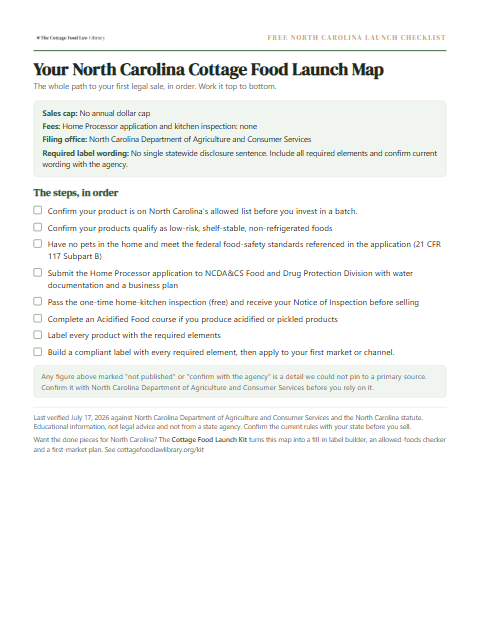
Get the free North Carolina cottage food checklist
The one-page map of the steps, in order, so you can see the whole path at a glance.
Instant download, plus North Carolina law-change alerts. Unsubscribe anytime.
Where can you sell in North Carolina?
The venues and channels North Carolina cottage food operators may use.
| Channel | Allowed in North Carolina? |
|---|---|
| Direct to consumer at home | Yes |
| Farmers markets, roadside stands, special events | Yes |
| Online sales | Yes |
| Retail stores and restaurants | Yes. Broader than most cottage food laws, which restrict to direct-to-consumer only |
| Out-of-state or interstate shipping | Not clearly authorized. Not addressed in the sources reviewed; confirm directly with NCDA&CS before shipping across state lines |
North Carolina Department of Agriculture and Consumer Services has not settled every channel in one published place. Confirm your specific channel, for example online or out-of-state shipping, with North Carolina Department of Agriculture and Consumer Services.
Registration, training and inspection
Registration and permits. Not a license or permit, but a required application and one-time home-kitchen inspection through NCDA&CS resulting in a Notice of Inspection, which sources describe as necessary before you may legally sell.
Food safety training. General food handler training is recommended, not required. An Acidified Food course and certificate of completion is required specifically for producers of acidified or pickled products.
Kitchen inspection. A one-time home-kitchen inspection by an NCDA&CS Food Regulatory Specialist is required before selling, free of charge. This differs from most cottage food states, which prohibit or waive inspection entirely.
The fees a North Carolina cottage food seller can expect.
| Item | Cost |
|---|---|
| Home Processor application and kitchen inspection | No state fee |