Virginia Cottage Food Law (2026): Rules, Limits and How to Start
Do you need a license to sell homemade food in Virginia?
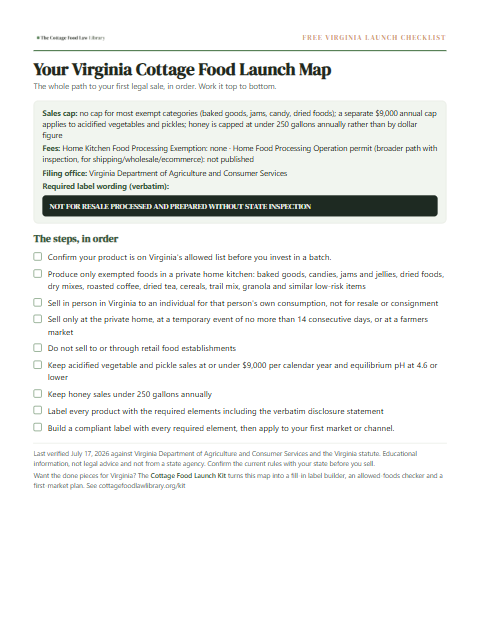
Virginia lets you make a wide list of shelf-stable foods in your home kitchen and sell them without a permit, inspection or fee under the Home Kitchen Food Processing Exemption. Since July 1, 2026 the exemption also covers internet and phone orders and delivery by mail or delivery service, as long as the buyer is an individual in Virginia. Acidified vegetables and pickles carry a separate $9,000 annual cap and honey is capped at under 250 gallons a year. Selling out of state, for resale or consignment, or to a retail food establishment still sits outside the exemption.
Virginia lets most home food sellers start without a state license, with a permit or registration reserved for certain foods or sales channels. Foods like candies, jams and jellies that are not low-acid or acidified low-acid products and dried fruits, dry herbs, dry seasonings and dry mixtures are the common starting point. The page below shows exactly which step applies to your product.
Virginia sets no dollar limit on cottage food sales, so the ceiling on your growth is your own kitchen and time rather than a statutory cap. The other rules that matter, the label, the allowed foods and where you can sell, are in the tables below.
The parts new Virginia sellers most often get wrong are the exact label disclosure wording. Each one has its own row below, with the official source beside it.

How much can you sell? The Virginia sales cap
The annual sales limit for a Virginia cottage food operation.
| Item | Virginia rule |
|---|---|
| Annual sales cap | No annual dollar cap in Virginia |
| How it works | The $9,000 acidified-vegetable cap was raised from $3,000 by HB 759 in 2024. This is a category-specific cap, not a whole-operation cap: an operator selling both baked goods and pickles has unlimited revenue on the baked goods but is capped on the pickles. |
What foods can you sell in Virginia?
Allowed and prohibited categories under current Virginia law.
| Allowed (examples) | Prohibited |
|---|---|
| Candies, jams and jellies that are not low-acid or acidified low-acid products; Dried fruits, dry herbs, dry seasonings and dry mixtures; Coated and uncoated nuts; Vinegars and flavored vinegars; Popcorn, popcorn balls and cotton candy; Dried pasta and dry baking mixes; Roasted coffee and dried tea; Cereals, trail mix and granola; Baked goods; Acidified vegetables and pickles at or below pH 4.6 (capped at $9,000 per year); Honey (under 250 gallons annually). | Low-acid canned foods outside the acidified-vegetable exemption; Products sold for resale or consignment; Products offered to or through retail food establishments. |
Virginia cottage food label requirements
Every package you sell needs a label with the elements below in legible print.
- Name of the person preparing the food product
- Physical address of the person preparing the food product
- Telephone number
- Date the food product was processed
- The verbatim disclosure statement above, on a label placed on the principal display panel. For a product in packaging not large enough to bear such a label, the product may instead be offered for sale with a SIGN displaying the same information: the name, physical address or post office box number and telephone number of the person preparing the food, the date it was processed and the statement (subdivision 3(v))
- For honey: PROCESSED AND PREPARED WITHOUT STATE INSPECTION. WARNING: Do Not Feed Honey to Infants Under One Year Old.
Virginia requires this disclosure statement, word for word:
NOT FOR RESALE PROCESSED AND PREPARED WITHOUT STATE INSPECTION
Reproduced from Virginia's cottage food labeling requirements. Confirm the current wording with Virginia Department of Agriculture and Consumer Services before you print a run of labels.
From the team behind this library
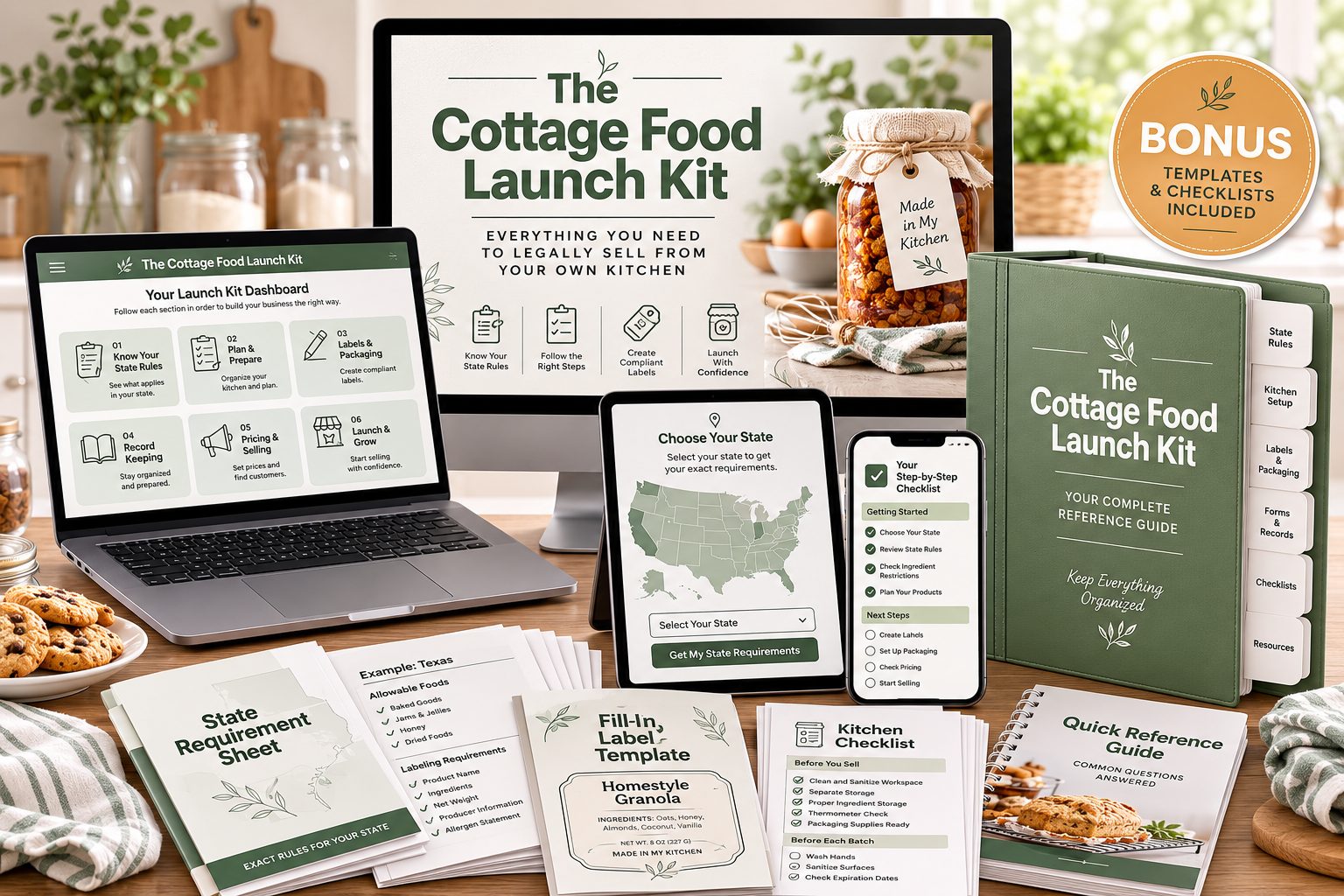
The Cottage Food Launch Kit
Want the whole path in one place? The kit turns everything on this page into one ordered walkthrough for Virginia: your state requirement sheet, a fill-in label template with the exact required wording, the allowed-foods checker, the ordered checklist and your first-market plan. Follow it in an evening.
Where can you sell in Virginia?
The venues and channels Virginia cottage food operators may use.
| Channel | Allowed in Virginia? |
|---|---|
| Direct to consumer at the private home | Yes |
| Any location, including temporary events and farmers markets | Yes. The statute's venue list was struck by 2026, c. 605 (HB 402). Subdivision 3(ii) now reads simply "sold at any location, through the internet, or by phone" |
| Internet and phone orders | Yes. Permitted since July 1, 2026, to an individual in the Commonwealth for their own consumption and not for resale or consignment. The closing sentence of subdivision 3 also confirms nothing prohibits a resident from advertising the food product on the Internet |
| Delivery by mail or delivery service within Virginia | Yes. Subdivision 3(iii): "delivered in person, by mail, or by delivery service to an individual in the Commonwealth for his own consumption and not for resale or consignment" |
| Acidified vegetables and pickles, all channels | Yes. Subdivision 4 carries the same internet and phone sale clauses and the same mail or delivery-service delivery clauses as subdivision 3, still capped at $9,000 in gross sales per calendar year |
| Sales to a buyer outside Virginia | No. The buyer must be "an individual in the Commonwealth", so the exemption is in-state only even though the channel restrictions are gone |
| Retail food establishments, resale and consignment | No. Not permitted under the exemption |
Registration, training and inspection
Registration and permits. No registration, permit or inspection is required for the exempt Home Kitchen Food Processing path. A permit and VDACS inspection are required only for the broader Home Food Processing Operation path (shipping, wholesale, full ecommerce).
Food safety training. No food safety training requirement was found for the Home Kitchen Food Processing Exemption.
Kitchen inspection. No inspection for the exempt Home Kitchen Food Processing path. Required for the Home Food Processing Operation permit path.
The fees a Virginia cottage food seller can expect.
| Item | Cost |
|---|---|
| Home Kitchen Food Processing Exemption | No state fee |
| Home Food Processing Operation permit (broader path with inspection, for shipping/wholesale/ecommerce) | Not published; confirm with Virginia Department of Agriculture and Consumer Services |
Wondering how Virginia compares? See what a cottage food license costs in every state, from the no-fee states to the priciest permits.