South Carolina Cottage Food Law (2026): Rules, Limits and How to Start
Do you need a license to sell homemade food in South Carolina?
South Carolina needs no permit, license, registration or inspection to sell non-potentially-hazardous homemade food. There is no maximum sales cap either. But the current statute restricts you to direct-to-consumer sales only: no wholesale and no reselling through retail stores or restaurants. Every label must carry the exact disclosure statement, which starts with the words NOT FOR RESALE.
South Carolina keeps the path to selling short. There is no state permit and no annual sales cap, so foods like baked goods without cream fillings and candies can go to market once your label carries what the state asks for. The rules below are the whole picture.
South Carolina sets no dollar limit on cottage food sales, so the ceiling on your growth is your own kitchen and time rather than a statutory cap. The other rules that matter, the label, the allowed foods and where you can sell, are in the tables below.
Act 60 of 2023 took effect July 1, 2024. South Carolina moved its cottage food program to the Department of Agriculture after the former DHEC was dissolved. Producers now work with SCDA rather than the old health agency. This page reflects the rule in force today; the full history sits in the law-updates log.
How much can you sell? The South Carolina sales cap
The annual sales limit for a South Carolina cottage food operation.
| Item | South Carolina rule |
|---|---|
| Annual sales cap | No annual dollar cap in South Carolina |
| How it works | No maximum revenue cap applies. Separately, the current statute (S.C. Code Section 46-57-20(G)) sets a minimum floor: the section's requirements do not apply to an operation with net earnings of less than five hundred dollars annually. A very small hobbyist seller under that floor falls outside the law's coverage entirely. Verification correction 2026-07-17: earlier notes described a '$15,000 annual sales cap removed by Senate Bill 506 in 2022.' No primary source in this sweep, including the enrolled text of Bill 506 itself, contains a $15,000 figure. Bill 506 (2022) raised the pre-existing net-earnings floor from $500 to $1,500; the current recodified statute (2023 Act No. 60, effective July 1, 2024) sets that floor back at $500. This floor is a minimum threshold below which the law does not apply, not a maximum sales cap. No primary source supports the claim that a $15,000 ceiling ever existed or was removed. |
What foods can you sell in South Carolina?
Allowed and prohibited categories under current South Carolina law.
| Allowed (examples) | Prohibited |
|---|---|
| Baked goods without cream fillings; Candies; Cookies; Most breads, including yeast breads; Other non-potentially-hazardous (non-TCS) shelf-stable foods generally. | Time/temperature-control-for-safety (TCS) / potentially hazardous foods generally; Cream-filled or custard-filled baked goods requiring refrigeration. |
South Carolina cottage food label requirements
Every package you sell needs a label with the elements below in legible print.
- The disclosure statement (verbatim above) in all capital letters with high-contrast text
- Verification correction 2026-07-17: requiredDisclosure previously omitted the leading words 'NOT FOR RESALE'. Confirmed against the primary S.C. Code text at scstatehouse.gov (fetched twice independently) and corroborated by the Institute for Justice's South Carolina page and an independent search result quoting the same statute language (https://www.scstatehouse.gov/code/t46c057.php).
South Carolina requires this disclosure statement, word for word:
NOT FOR RESALE PROCESSED AND PREPARED BY A HOME-BASED FOOD PRODUCTION OPERATION THAT IS NOT SUBJECT TO SOUTH CAROLINA'S FOOD SAFETY REGULATIONS.
Reproduced from South Carolina's cottage food labeling requirements. Confirm the current wording with South Carolina Department of Agriculture before you print a run of labels.
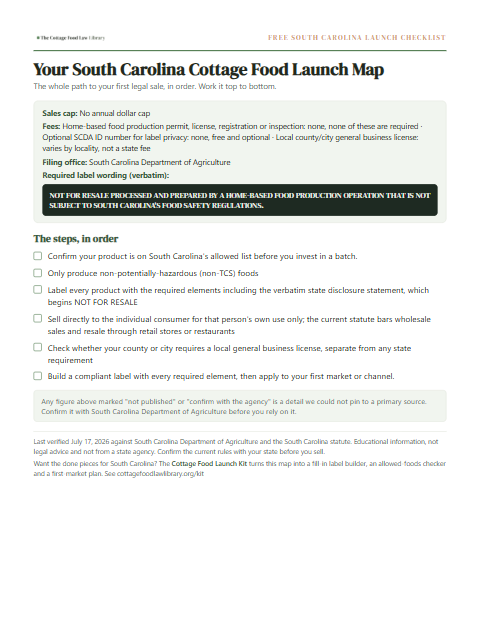
Get the free South Carolina cottage food checklist
The one-page map of the steps, in order, so you can see the whole path at a glance.
Instant download, plus South Carolina law-change alerts. Unsubscribe anytime.
Where can you sell in South Carolina?
The venues and channels South Carolina cottage food operators may use.
| Channel | Allowed in South Carolina? |
|---|---|
| Direct to the end consumer, in person or online, for that consumer's own use | Yes |
| Online sales and shipping to an individual consumer | Yes |
| Retail and grocery stores | No. Verification correction 2026-07-17: previously marked 'yes'. S.C. Code Section 46-57-20(E), read directly from the primary source, states a home-based food operation 'may only sell food items directly to a person for their own use and not for resale and may not sell food items at wholesale.' This conflicts with several secondary cottage-food guide sites; see unverifiedFields. |
| Restaurants | No. Verification correction 2026-07-17: previously marked 'conditional... requires a DHEC variance'. DHEC no longer has any role in this program (its food-safety duties moved to SCDA July 1, 2024) and the current statute bars wholesale/resale sales outright with no restaurant carve-out found in the text read this sweep. |
| Mobile food units and other permitted retail food establishments | No. Consistent with the direct-to-consumer-only restriction in the current statute |
South Carolina Department of Agriculture has not settled every channel in one published place. Confirm your specific channel, for example online or out-of-state shipping, with South Carolina Department of Agriculture.
Registration, training and inspection
Registration and permits. No permit, license, registration, certification or inspection is required. An optional free SCDA ID number is available for those who prefer not to print a home address on labels.
Food safety training. No food safety training or certification is required by the Home-Based Food Production Law.
Kitchen inspection. No home kitchen inspection is required or conducted under the Home-Based Food Production Law.
The fees a South Carolina cottage food seller can expect.
| Item | Cost |
|---|---|
| Home-based food production permit, license, registration or inspection | none, none of these are required |
| Optional SCDA ID number for label privacy | none, free and optional |
| Local county/city general business license | varies by locality, not a state fee |