Wisconsin Cottage Food Law (2026): Rules, Limits and How to Start
Do you need a license to sell homemade food in Wisconsin?
Wisconsin has no cottage food statute passed by the legislature. Home bakers sell shelf-stable baked goods without a license, cap or inspection only because of a court order. That order was narrowed by a November 2024 appeals court ruling that excludes anything not baked with dry oven heat. A separate 2009 pickle law lets you sell home-canned pickles and acidified vegetables up to $5,000 a year at farmers markets and community events.
Wisconsin keeps the path to selling short. There is no state permit and no annual sales cap, so foods like baked goods produced primarily by dry oven heat above 140f, shelf-stable without refrigeration and home-canned pickles and other acidified vegetables, up to $5,000 in annual sales, sold at farmers markets and community events can go to market once your label carries what the state asks for. The rules below are the whole picture.
Wisconsin sets no dollar limit on cottage food sales, so the ceiling on your growth is your own kitchen and time rather than a statutory cap. The other rules that matter, the label, the allowed foods and where you can sell, are in the tables below.
The parts new Wisconsin sellers most often get wrong are the label elements. Each one has its own row below, with the official source beside it.
How much can you sell? The Wisconsin sales cap
The annual sales limit for a Wisconsin cottage food operation.
| Item | Wisconsin rule |
|---|---|
| Annual sales cap | No annual dollar cap in Wisconsin |
| How it works | There are two unrelated caps in Wisconsin because there are two unrelated legal bases: a court order for baked goods (no cap) and a 2009 statute for pickled/acidified goods (capped). |
What foods can you sell in Wisconsin?
Allowed and prohibited categories under current Wisconsin law.
| Allowed (examples) | Prohibited |
|---|---|
| Baked goods produced primarily by dry oven heat above 140F, shelf-stable without refrigeration (court-order exemption); Home-canned pickles and other acidified vegetables, up to $5,000 in annual sales, sold at farmers markets and community events (Pickle Bill, Wis. Stat. 97.29(2)(b)2g). | Items dried in a dehydrator; Potentially hazardous baked goods; Candy, chocolates, roasted coffee and other non-oven-processed shelf-stable foods, per the November 2024 Court of Appeals ruling; Wholesale or distributor sales; Commercial-kitchen-produced items marketed as home-produced. |
Wisconsin cottage food label requirements
Every package you sell needs a label with the elements below in legible print.
- Not confirmed in official sources for either exemption at verification.
No single statewide disclosure sentence. Wisconsin does not set one required disclosure line in the sources we checked. Put the required elements above on every label. Confirm the current wording with Wisconsin Department of Agriculture, Trade and Consumer Protection before you print a run.
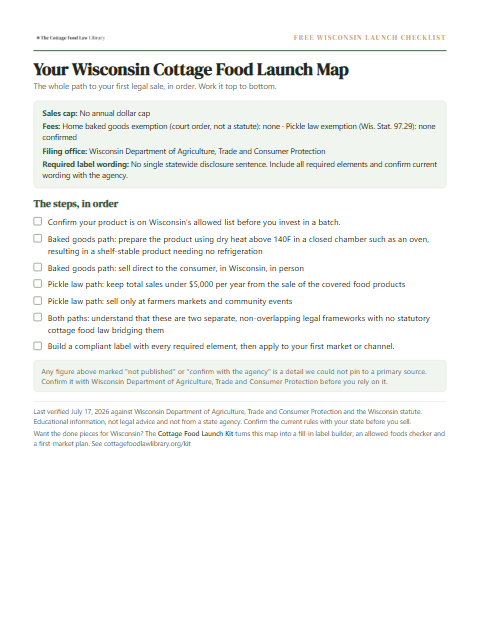
Get the free Wisconsin cottage food checklist
The one-page map of the steps, in order, so you can see the whole path at a glance.
Instant download, plus Wisconsin law-change alerts. Unsubscribe anytime.
Where can you sell in Wisconsin?
The venues and channels Wisconsin cottage food operators may use.
| Channel | Allowed in Wisconsin? |
|---|---|
| Direct to consumer, in person, in Wisconsin (baked goods) | Yes |
| Farmers markets and community events (pickle law) | Yes. Required venue restriction for the pickle law exemption. |
| Online sales, mail order, interstate shipping | No. Not permitted under the current cottage food framework. |
| Wholesale or distributor sales | No |
Registration, training and inspection
Registration and permits. No registration, license or permit is required for either the court-order baked goods exemption or the statutory pickle law exemption.
Food safety training. No training requirement was found for the baked goods exemption. Not confirmed for the pickle law exemption.
Kitchen inspection. No kitchen inspection is required under the baked goods exemption. Not confirmed for the pickle law exemption.
The fees a Wisconsin cottage food seller can expect.
| Item | Cost |
|---|---|
| Home baked goods exemption (court order, not a statute) | No state fee |
| Pickle law exemption (Wis. Stat. 97.29) | none confirmed |
Not published centrally. Confirm the current amount with Wisconsin Department of Agriculture, Trade and Consumer Protection. Confirm the exact course or certificate Wisconsin Department of Agriculture, Trade and Consumer Protection accepts before you enroll.