Minnesota Cottage Food Law (2026): Rules, Limits and How to Start
Do you need a license to sell homemade food in Minnesota?
Minnesota requires every cottage food producer to register with the Department of Agriculture before selling, even in the lowest sales tier. Tier 1 registrants selling $7,665 or less a year pay no fee and complete a free online training course each year. Tier 2 registrants selling $7,666 to $78,000 a year pay a $50 annual fee and take an approved food safety course once every three years.
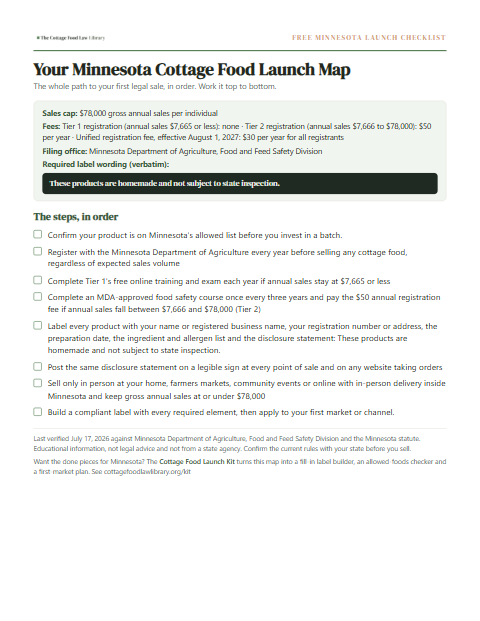
To sell homemade food in Minnesota you first register with Minnesota Department of Agriculture, Food and Feed Safety Division. The kitchen stays your own. Foods like baked goods without cream, custard or meat fillings and jams, jellies and preserves meeting the non-potentially-hazardous ph or water activity limits are on the table once the registration and the label are done, in the order the page below lays out.
Minnesota caps annual cottage food sales at $78,000 gross annual sales per individual. Two tiers apply through July 31, 2027: Tier 1 tops out at $7,665 with no fee and annual online training; Tier 2 runs $7,666 to $78,000 with a $50 annual fee and a food safety course every three years.
The parts new Minnesota sellers most often get wrong are the exact label disclosure wording, the food safety course and the registration step. Each one has its own row below, with the official source beside it.

How much can you sell? The Minnesota sales cap
The annual sales limit for a Minnesota cottage food operation.
| Item | Minnesota rule |
|---|---|
| Annual sales cap | $78,000 gross annual sales per individual |
| How it works | Two tiers apply through July 31, 2027: Tier 1 tops out at $7,665 with no fee and annual online training; Tier 2 runs $7,666 to $78,000 with a $50 annual fee and a food safety course every three years. Laws 2025, chapter 34, article 5 collapses this into one tier at a flat $30 annual fee effective August 1, 2027 and requires the $78,000 threshold to adjust every two years to the Consumer Price Index using July 2025 as the base month. The cap is per individual. CORRECTION 2026-08-15: this file previously said eligible business structures are limited to sole proprietors, single-member LLCs and two-person LLCs sharing the same residence. That is the AUGUST 1, 2027 rule, not current law. Under Minn. Stat. 28A.152 subd. 1(c) as in force today, "An individual who qualifies for an exemption under paragraph (a) may organize the individual's cottage food business as a business entity recognized by state law" and MDA's guidance repeats it. The narrower list appears only in the amended subdivision and the Revisor's own NOTE reads: "The amendments to subdivisions 1 to 5 by Laws 2025, chapter 34, article 5, sections 14 to 18, are effective August 1, 2027." As written, the old sentence would have told a multi-member LLC or a corporation it was ineligible today. |
What foods can you sell in Minnesota?
Allowed and prohibited categories under current Minnesota law.
| Allowed (examples) | Prohibited |
|---|---|
| Baked goods without cream, custard or meat fillings; Jams, jellies and preserves meeting the non-potentially-hazardous pH or water activity limits; Dried herb and spice mixes; Granola, popcorn and dry snack mixes; Candy and chocolate (not chocolate-covered fresh fruit); Roasted coffee and tea blends; Dry baking mixes; Home-canned pickles, vegetables and fruits with an equilibrium pH of 4.6 or less or a water activity of 0.85 or less, processed and canned in Minnesota; Baked or dehydrated pet treats for dogs or cats that are non-toxic to the intended species. | Meat and poultry products; Dairy products including raw milk; Potentially hazardous (time/temperature control for safety) foods requiring refrigeration; Chocolate-covered fresh fruit; Tamales and egg rolls; Charcuterie boards; Home-canned acidified foods sold or shipped outside Minnesota; Products containing THC or CBD. |
Minnesota cottage food label requirements
Every package you sell needs a label with the elements below in legible print.
- Producer's full name or registered business name
- Registration number or producer's address
- Date of preparation
- Complete ingredient list with major allergens declared
- The disclosure statement: These products are homemade and not subject to state inspection.
- Point-of-sale sign and website disclosure carrying the same statement
Minnesota requires this disclosure statement, word for word:
These products are homemade and not subject to state inspection.
Reproduced from Minnesota's cottage food labeling requirements. Confirm the current wording with Minnesota Department of Agriculture, Food and Feed Safety Division before you print a run of labels.
From the team behind this library
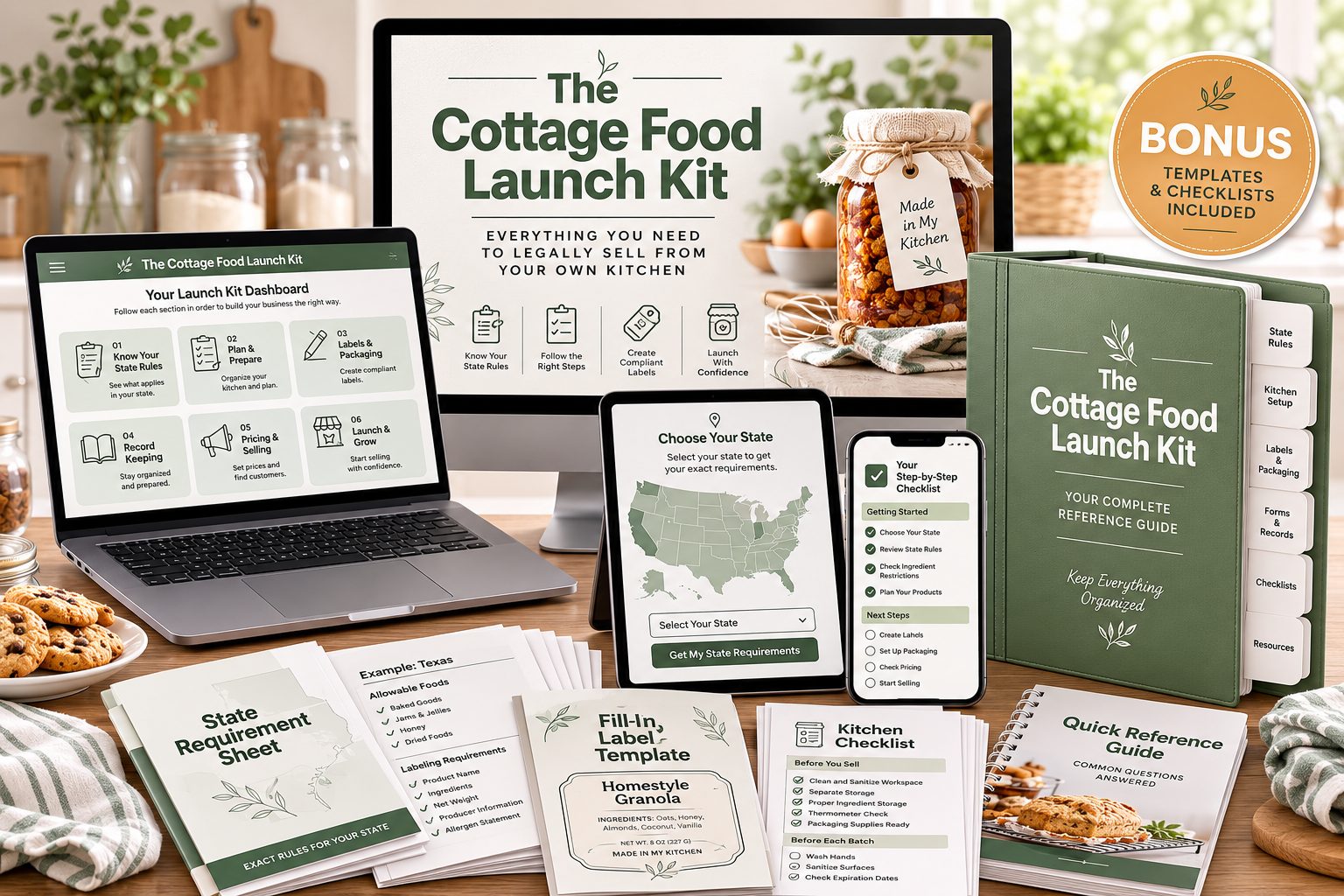
The Cottage Food Launch Kit
Want the whole path in one place? The kit turns everything on this page into one ordered walkthrough for Minnesota: your state requirement sheet, a fill-in label template with the exact required wording, the allowed-foods checker, the ordered checklist and your first-market plan. Follow it in an evening.
Where can you sell in Minnesota?
The venues and channels Minnesota cottage food operators may use.
| Channel | Allowed in Minnesota? |
|---|---|
| Direct sale at producer's home | With conditions. Allowed only where local zoning or ordinance permits it |
| Farmers markets | Yes. Markets with three or more vendors at a defined location |
| Community events | Yes. Organized multi-vendor gatherings with a defined timeframe |
| Retail stores | With conditions. Only during a farmers market or community event held at that retail location, not as ongoing shelf sales |
| Online orders with in-person delivery | With conditions. Orders and advertising may happen online but the producer must deliver or meet the buyer in person inside Minnesota; the disclosure statement must also appear on the website |
| Mail or commercial carrier shipping of human cottage foods | No. Not allowed under the currently effective law. Laws 2025 permits shipping within Minnesota starting August 1, 2027 |
| Mail or commercial carrier shipping of cottage pet treats | Yes. Pet treats are the one product currently allowed to ship by mail or commercial carrier |
| Charitable donation (one-time, no sale) | Yes. Exempt from registration when it is a one-time donation to a charitable event rather than a sale |
Registration, training and inspection
Registration and permits. Every cottage food producer must register annually with the Minnesota Department of Agriculture before selling, at every sales tier. The only exemption is a one-time donation of food to a charitable event, which is not a sale.
Food safety training. Tier 1 registrants (sales $7,665 or less) complete a free MDA online training course and pass an exam every year. Tier 2 registrants (sales $7,666 to $78,000) complete a commissioner-approved food safety course, not to exceed eight hours, once every three years while actively selling. Effective August 1, 2027, all registrants must complete advanced training regardless of sales volume.
Kitchen inspection. Cottage food production is exempt from Minnesota's standard food licensing and inspection statutes (chapter 28A, sections 28A.01 to 28A.16). MDA staff verify registration status at farmers markets and community events and may investigate following a specific complaint or illness report, but there is no routine home kitchen inspection requirement.
The fees a Minnesota cottage food seller can expect.
| Item | Cost |
|---|---|
| Tier 1 registration (annual sales $7,665 or less) | No state fee |
| Tier 2 registration (annual sales $7,666 to $78,000) | $50 per year |
| Unified registration fee, effective August 1, 2027 | $30 per year for all registrants |
Wondering how Minnesota compares? See what a cottage food license costs in every state, from the no-fee states to the priciest permits.