Michigan Cottage Food Law (2026): Rules, Limits and How to Start
Do you need a license to sell homemade food in Michigan?
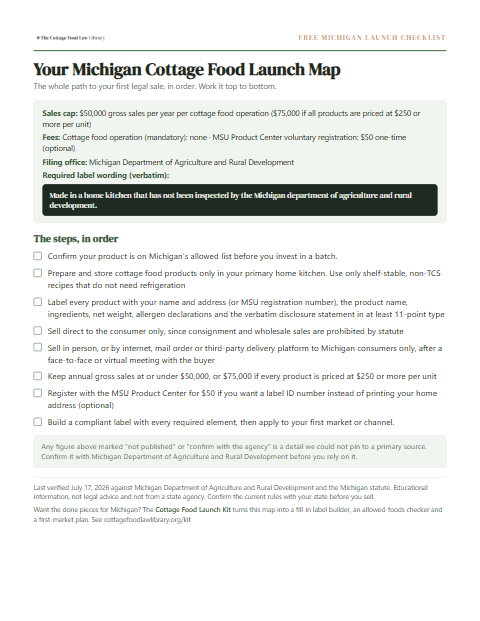
Michigan lets you sell homemade non-refrigerated food straight from your home kitchen without a license or inspection, as long as you stay under the annual sales cap. Since March 24, 2026, in-state online orders, mail order and third-party delivery platform sales are allowed too, on top of in-person sales. Registering with the MSU Product Center is optional and only matters if you want to keep your home address off the label.
In Michigan the path depends on what you make and how you sell it. Many home producers of foods like breads and similar baked goods and cakes including celebration cakes, with shelf-stable frostings need no state license at all, while some foods or channels trigger a registration. The rules below sort out which one is yours.
Michigan caps annual cottage food sales at $50,000 gross sales per year per cottage food operation. Raised from $25,000 by House Bill 4122 (2025 PA 51), effective March 24, 2026.
The parts new Michigan sellers most often get wrong are the exact label disclosure wording. Each one has its own row below, with the official source beside it.
How much can you sell? The Michigan sales cap
The annual sales limit for a Michigan cottage food operation.
| Item | Michigan rule |
|---|---|
| Annual sales cap | $50,000 gross sales per year per cottage food operation ($75,000 if all products are priced at $250 or more per unit) |
| How it works | Raised from $25,000 by House Bill 4122 (2025 PA 51), effective March 24, 2026. The statute directs MDARD to adjust the limit for inflation using the Detroit Consumer Price Index starting after October 1, 2026. The statute does not specify whether the cap is per person or per household if multiple family members operate from the same kitchen; treat this as unresolved. |
Not published as one current figure everyone cites. Confirm this year's cap with Michigan Department of Agriculture and Rural Development before you scale.
What foods can you sell in Michigan?
Allowed and prohibited categories under current Michigan law.
| Allowed (examples) | Prohibited |
|---|---|
| Breads and similar baked goods; Cakes including celebration cakes, with shelf-stable frostings; Sweet breads and muffins containing fruits or vegetables; Cooked fruit pies with butter, lard or shortening crusts (shelf-stable only); Jams and jellies in glass jars stored at room temperature; Vinegar and flavored vinegars; Dry mixes (baking, soup, dip, herb and spice blends); Dried pasta; Popcorn, granola and nuts; Chocolate-covered pretzels and similar shelf-stable candy; Roasted coffee beans; Dehydrated fruits and vegetables. | Any food requiring time or temperature control for safety (TCS), including refrigerated items; Meat, poultry and fish products; Dairy products; Canned low-acid foods; Pickled products; Fresh pasta and garlic-in-oil mixtures; Cream-based pies and cream cheese frostings; Caramel apples; Beverages; CBD, cannabis or foods containing these; Dietary supplements; Pet food. |
These lists follow Michigan Department of Agriculture and Rural Development's published guidance. Confirm your own product against Michigan Department of Agriculture and Rural Development before you commit to a batch.
Michigan cottage food label requirements
Every package you sell needs a label with the elements below in legible print.
- Cottage food operation's name and physical address, or MSU Product Center registration number and phone number
- Product name
- Ingredients in descending order of predominance by weight
- Net weight or net volume with metric equivalent
- Federal allergen declarations (milk, eggs, wheat, peanuts, soybeans, fish, shellfish, tree nuts with type specified)
- The disclosure statement in at least 11-point type with clear contrast to the background
Michigan requires this disclosure statement, word for word:
Made in a home kitchen that has not been inspected by the Michigan department of agriculture and rural development.
Reproduced from Michigan's cottage food labeling requirements. Confirm the current wording with Michigan Department of Agriculture and Rural Development before you print a run of labels.
From the team behind this library
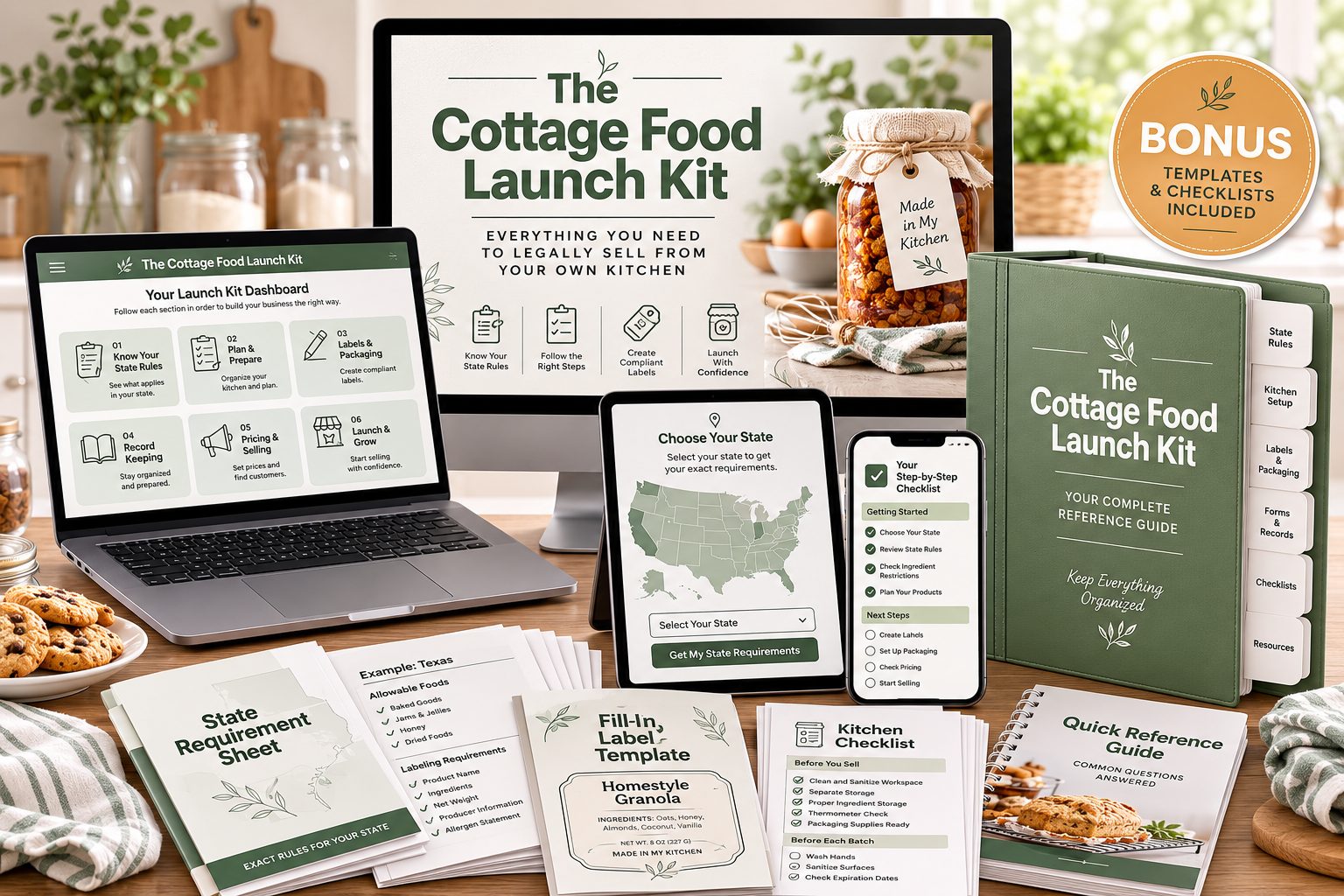
The Cottage Food Launch Kit
Want the whole path in one place? The kit turns everything on this page into one ordered walkthrough for Michigan: your state requirement sheet, a fill-in label template with the exact required wording, the allowed-foods checker, the ordered checklist and your first-market plan. Follow it in an evening.
Where can you sell in Michigan?
The venues and channels Michigan cottage food operators may use.
| Channel | Allowed in Michigan? |
|---|---|
| Direct to consumer in person (home, farmers markets, craft shows, roadside stands) | Yes |
| In-state online orders and mail order | With conditions. Allowed since March 24, 2026 (2025 PA 51) only to consumers located in Michigan and only after a face-to-face or virtual meeting between producer and buyer before the sale. |
| Third-party food delivery platforms | With conditions. Allowed since March 24, 2026 for in-state deliveries only, under the same pre-sale meeting requirement. |
| Wholesale or consignment sales | No. Prohibited by statute (MCL 289.4102). |
| Sales to out-of-state consumers | No. The statute limits internet, mail-order and third-party delivery sales to consumers located in Michigan. |
Registration, training and inspection
Registration and permits. No license or registration is required to operate a Michigan cottage food operation. Registering with the MSU Product Center for $50 is optional and only relevant if you want a label ID number and phone number in place of your home address.
Food safety training. No state law requires a food safety course. MSU Extension runs a voluntary MDARD-funded online training on safe production, packaging, labeling, storage and transport.
Kitchen inspection. A cottage food operation is exempt from the licensing and inspection provisions of the Michigan Food Law.
The fees a Michigan cottage food seller can expect.
| Item | Cost |
|---|---|
| Cottage food operation (mandatory) | No state fee |
| MSU Product Center voluntary registration | $50 one-time (optional) |
Not published centrally. Confirm the current amount with Michigan Department of Agriculture and Rural Development.
Wondering how Michigan compares? See what a cottage food license costs in every state, from the no-fee states to the priciest permits.