District of Columbia Cottage Food Law (2026): Rules, Limits and How to Start
Do you need a license to sell homemade food in District of Columbia?
DC is not a state, but it runs a formal Cottage Food Act with its own registry through DC Health. You register your home kitchen, get a Certified Food Protection Manager certification and a home occupancy permit, then you can sell non-potentially-hazardous foods direct, at retail, wholesale to licensed food establishments and online, all within the District. There is no dollar sales cap.
District of Columbia lets you sell homemade food once you register with DC Health, Division of Food Safety, Cottage Food Business Registry. There is no commercial-kitchen requirement, so foods like additional products can be added to the approved list with ph or water activity confirmation from a state-accredited laboratory, submitted to dc health for review can come straight from your own kitchen after you complete the registration and label step below.
District of Columbia sets no dollar limit on cottage food sales, so the ceiling on your growth is your own kitchen and time rather than a statutory cap. The other rules that matter, the label, the allowed foods and where you can sell, are in the tables below.
a 2025 amendment was enacted in 2025. The District added wholesale sales to its registration-based cottage food regime. Confirm the current registration steps and effective date with the DC agency before you rely on them. This page reflects the rule in force today; the full history sits in the law-updates log.
How much can you sell? The District of Columbia sales cap
The annual sales limit for a District of Columbia cottage food operation.
| Item | District of Columbia rule |
|---|---|
| Annual sales cap | No annual dollar cap in District of Columbia |
| How it works | DC previously capped cottage food revenue at $25,000; the Cottage Food Expansion Amendment Act of 2019 (D.C. Law 23-61, B23-0192), effective 2020, removed that cap. Verification correction 2026-07-17: the cap removal is now confirmed against primary sources, the DC Council's own Law Library entry for D.C. Law 23-61 (https://code.dccouncil.gov/us/dc/council/laws/23-61) and the current codified text of D.C. Code Section 7-742.02 (https://code.dccouncil.gov/us/dc/council/code/sections/7-742.02), fetched directly, which contains no dollar sales cap language. |
What foods can you sell in District of Columbia?
Allowed and prohibited categories under current District of Columbia law.
| Allowed (examples) | Prohibited |
|---|---|
| Non-potentially-hazardous (non-TCS) foods approved by DC Health, such as baked goods, candy, dry mixes and jams; Additional products can be added to the approved list with pH or water activity confirmation from a state-accredited laboratory, submitted to DC Health for review. | Potentially hazardous (TCS) foods not on the DC Health approved list; Sales to restaurants and grocery stores through the retail channel (wholesale to licensed food establishments is handled as its own channel since June 10, 2025). |
These lists follow DC Health, Division of Food Safety, Cottage Food Business Registry's published guidance. Confirm your own product against DC Health, Division of Food Safety, Cottage Food Business Registry before you commit to a batch.
District of Columbia cottage food label requirements
Every package you sell needs a label with the elements below in legible print.
- Cottage food business identification number
- Ingredients in descending order by weight, including sub-ingredients
- Net weight or net volume
- Allergen information per federal labeling requirements
- Nutritional information if any nutritional claim is made
- The verbatim disclosure statement above, printed in 10-point or larger type in a color providing clear contrast to the background
District of Columbia requires this disclosure statement, word for word:
Made by a cottage food business that is not subject to the District of Columbia's food safety regulations.
Reproduced from District of Columbia's cottage food labeling requirements. Confirm the current wording with DC Health, Division of Food Safety, Cottage Food Business Registry before you print a run of labels.
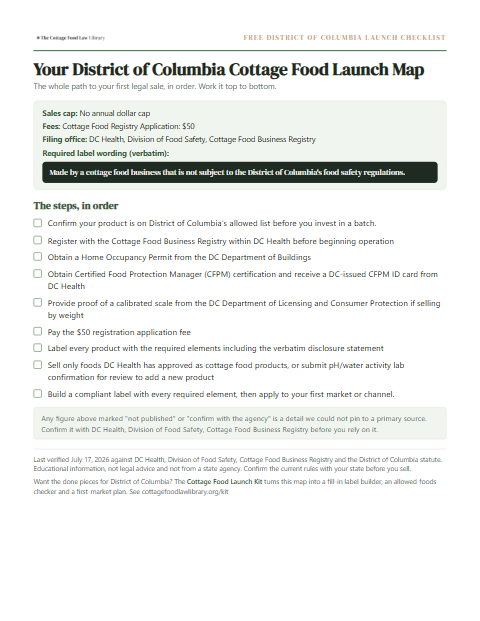
Get the free District of Columbia cottage food checklist
The one-page map of the steps, in order, so you can see the whole path at a glance.
Instant download, plus District of Columbia law-change alerts. Unsubscribe anytime.
Where can you sell in District of Columbia?
The venues and channels District of Columbia cottage food operators may use.
| Channel | Allowed in District of Columbia? |
|---|---|
| Direct to consumer | Yes |
| Retail sales | Yes. Excludes sales to restaurants and grocery stores. |
| Online sales | Yes. Within the District of Columbia only. |
| Wholesale to licensed food establishments | Yes. New as of the Certificate of Need Improvement Amendment Act of 2025, effective June 10, 2025. |
| Sales outside the District of Columbia | Not clearly authorized. The statute frames all listed sales channels as within the District. |
Registration, training and inspection
Registration and permits. Registration with the Cottage Food Business Registry within DC Health is required before operating, along with a Home Occupancy Permit from the Department of Buildings and, if selling by weight, a calibrated scale verified by the Department of Licensing and Consumer Protection.
Food safety training. Certified Food Protection Manager (CFPM) certification is required. DC Health issues a CFPM ID card once certified.
Kitchen inspection. A pre-operational inspection may be required prior to commencing operations, in accordance with DC Health's cottage food regulations.
The fees a District of Columbia cottage food seller can expect.
| Item | Cost |
|---|---|
| Cottage Food Registry Application | $50 |