Pennsylvania Cottage Food Law (2026): Rules, Limits and How to Start
Do you need a license to sell homemade food in Pennsylvania?
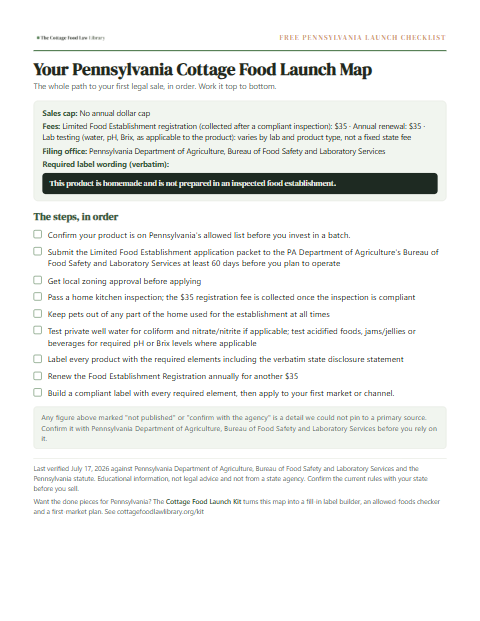
Pennsylvania has no separate cottage food statute. Home producers register as a Limited Food Establishment with the Department of Agriculture, pass a home inspection and pay a $35 annual fee. There is no sales cap. The label carries five elements and Pennsylvania sets no statewide disclosure sentence.
Pennsylvania asks more of a home food seller than most states. You work through Pennsylvania Department of Agriculture, Bureau of Food Safety and Laboratory Services before your first sale. The page below lays out the registration, the training and the inspection in the order they come. It is a real process, so knowing the steps up front is what keeps it from stalling.
Pennsylvania sets no dollar limit on cottage food sales, so the ceiling on your growth is your own kitchen and time rather than a statutory cap. The other rules that matter, the label, the allowed foods and where you can sell, are in the tables below.
The parts new Pennsylvania sellers most often get wrong are the label elements, the kitchen inspection and the registration step. Each one has its own row below, with the official source beside it.

How much can you sell? The Pennsylvania sales cap
The annual sales limit for a Pennsylvania cottage food operation.
| Item | Pennsylvania rule |
|---|---|
| Annual sales cap | No annual dollar cap in Pennsylvania |
| How it works | No revenue or unit cap was found in official Pennsylvania Department of Agriculture materials for Limited Food Establishments. |
Not published as one current figure everyone cites. Confirm this year's cap with Pennsylvania Department of Agriculture, Bureau of Food Safety and Laboratory Services before you scale.
What foods can you sell in Pennsylvania?
Allowed and prohibited categories under current Pennsylvania law.
| Allowed (examples) | Prohibited |
|---|---|
| Baked goods, breads, cakes, cookies and pies (non-TCS); Dry goods (coffee, cereal, snack mixes); Jams, jellies, honey and maple syrup; Sauces, dressings, vinegars and fruit butters; Candy and nut mixes; Acidified and canned acid foods (pickles, salsa, sauerkraut) with required pH testing; Dehydrated items and dried herbs; Certain beverages, including retail juice sales with pH testing and kombucha (pH 4.6 or below). | Time/temperature-control-for-safety (TCS) foods, including dairy, meat, poultry, fish and eggs; Cream-filled pastries, cheesecake and cream pies; Cut produce and garlic-in-oil products; Low-acid canned foods (corn, beans, mushrooms, soups); Wholesale juice distribution without meeting separate federal juice HACCP rules. |
Pennsylvania cottage food label requirements
Every package you sell needs a label with the elements below in legible print.
- Name of the product
- Name and address of the manufacturer
- Ingredients listed in decreasing order by weight
- Allergen declaration if needed
- Net weight or unit count
- BAKERY RELAXATION: bakery items made and sold directly to a Commonwealth consumer by the baker or their employee need no labeling information on the product at all, though ingredient information must be available on request. All other baked goods (bake-off or purchased product) require full labeling
- For unpasteurized juice specifically, the federal juice warning statement about pathogenic microorganisms
No single statewide disclosure sentence. Pennsylvania does not set one required disclosure line in the sources we checked. Put the required elements above on every label. Confirm the current wording with Pennsylvania Department of Agriculture, Bureau of Food Safety and Laboratory Services before you print a run.
From the team behind this library
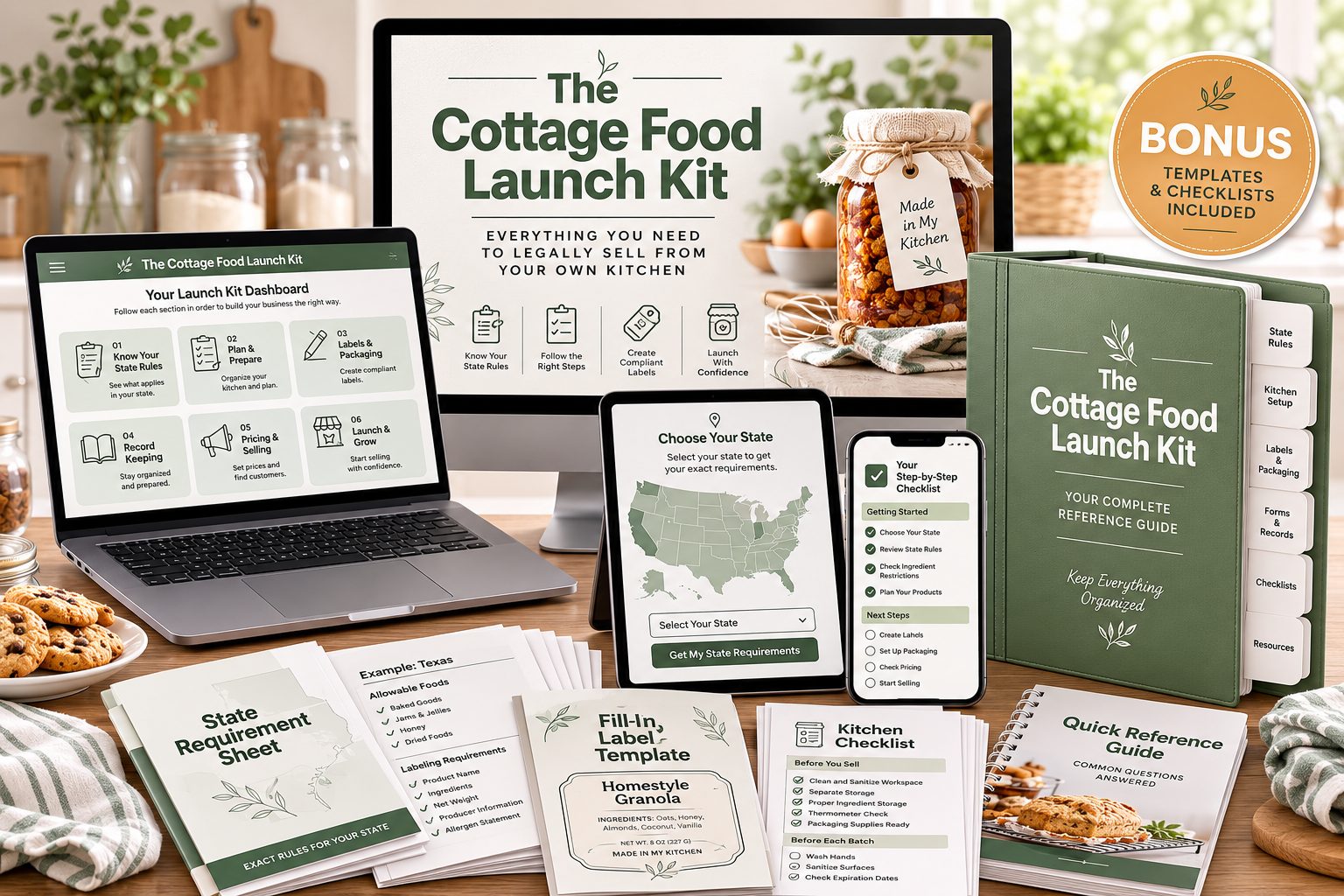
The Cottage Food Launch Kit
Want the whole path in one place? The kit turns everything on this page into one ordered walkthrough for Pennsylvania: your state requirement sheet, a fill-in label template with the exact required wording, the allowed-foods checker, the ordered checklist and your first-market plan. Follow it in an evening.
Where can you sell in Pennsylvania?
The venues and channels Pennsylvania cottage food operators may use.
| Channel | Allowed in Pennsylvania? |
|---|---|
| Direct sales from the production site, including internet sales | Yes |
| Farmers markets and events | With conditions. May require a separate Retail Food Facility License depending on the venue |
| Wholesale to restaurants, cafes and other food service establishments | With conditions. One source describes this as broadly allowed; a Penn State Extension source describes wholesale as restricted for most products, treat as unresolved and confirm per product |
| Interstate/out-of-state sales | With conditions. May require separate FDA registration; acidified foods sold interstate require an FDA-approved processing course |
Pennsylvania Department of Agriculture, Bureau of Food Safety and Laboratory Services has not settled every channel in one published place. Confirm your specific channel, for example online or out-of-state shipping, with Pennsylvania Department of Agriculture, Bureau of Food Safety and Laboratory Services.
Registration, training and inspection
Registration and permits. Must register as a Limited Food Establishment with the PA Department of Agriculture, including a home kitchen inspection, before selling. $35 fee collected after a compliant inspection, renewed annually.
Food safety training. No general training requirement found for most products. Acidified food processors intending to sell interstate must complete an FDA-approved acidified canning course.
Kitchen inspection. A home kitchen inspection by the Department of Agriculture is required before the Food Establishment Registration is issued.
The fees a Pennsylvania cottage food seller can expect.
| Item | Cost |
|---|---|
| Limited Food Establishment registration (collected after a compliant inspection) | $35 |
| Annual renewal | $35 |
| Lab testing (water, pH, Brix, as applicable to the product) | varies by lab and product type, not a fixed state fee |
Wondering how Pennsylvania compares? See what a cottage food license costs in every state, from the no-fee states to the priciest permits.
Pennsylvania's official term is Limited Food Establishment
Pennsylvania has no cottage food law and issues no cottage food license. The Department of Agriculture's program name for the home-kitchen path is Limited Food Establishment. That is the phrase to search, to write on a form and to say on the phone.
The Department describes the program as one that registers "home-based and noncommercial food production sites that meet specific guidelines," and it treats a residential-style kitchen as "any kitchen meant for home use, regardless of location." That wording is why a church kitchen, a fire hall or a remodeled garage can register under the same program as a home kitchen. What you may make is limited to non-hazardous foods that need no refrigeration of the finished product.
The sequence matters more here than in most states because the fee comes last. Submit your application materials at least 60 days before you plan to operate. The Department reviews the plans and tells you yes or no within about 15 business days. An inspector then schedules an on-site inspection of the facility. Only "upon a compliant inspection" is the $35 registration fee collected. Renewal is $35 a year, with a notice arriving roughly 45 days before your expiry date.
On the statute: the governing law is the Food Safety Act, which is Subchapter B of 3 Pa.C.S. Chapter 57, sections 5721 to 5737. Section 5721 carries the short title and section 5734 puts the duty to register on "every person operating a food establishment within this Commonwealth." We read the chapter's section list, the short title and the registration duty at the General Assembly's own site on this pass. The definitions section would not render for us, so we do not claim either way whether the phrase "limited food establishment" is written into the statute itself. What is certain is that it is the name the Department uses for the program you apply to.
What the Limited Food Establishment registration asks of your kitchen
The registration is one packet and $35. The conditions attached to it are where the surprises are. The Department prints most of them in the application packet rather than on the program page. Read them before you plan a kitchen day, because two of them decide who else may be in the house.
The kitchen rules, in the Department's own words
- "No animals/pets are permitted in the home at any time if the personal home kitchen is used." The packet applies the same rule to a residential-style kitchen in any other location.
- "Children are not permitted in the kitchen area during food processing for the business."
- Your water has to come from an approved supply. "Private sources must be tested annually for coliform bacteria and Nitrate/Nitrite by the limited food establishment."
- Business ingredients stay separate from the household's, on separate shelves or in separate cupboards, labeled, stored and protected.
- Household use of the room pauses while you work: "There must be restricted use of the residential-style kitchen during any business related food processing."
- Zoning is still yours to sort out. "Department approval does not imply that the business will be in compliance with any local zoning or ordinances."
The packet also settles who the program is for. It names three of them: warehousing food on a residential property, processing from a home residential kitchen, processing in a residential-style kitchen elsewhere "such as a church, fire hall, or remodeled garage area or out-building". That is the same program in all three cases.
Non-hazardous only, proven with numbers rather than opinions
Limited food establishments make foods that are not potentially hazardous. The packet names cheesecakes, pumpkin pies, cream, custard and meringue desserts and baked goods containing meat or cheese as the ones that are out, then gives the general test: "any product which is not shelf-stable at room temperature, and requires refrigeration after preparation would be considered 'potentially hazardous.'" Where a product sits near the line, Pennsylvania asks for lab results rather than a judgement call. Canned and acidified products have to reach a pH of 4.6 or less. Drinks and beverages are tested to confirm the same 4.6. Jams and jellies are measured for soluble solids, with the standard of identity putting finished jelly and jam at not less than 65 percent. You arrange the testing and you pay for it. The packet is blunt that the list of allowed foods is not fixed: "Products are evaluated individually, as to whether or not they can be produced in a limited food establishment."
The second license nobody expects, plus one fee exemption
Your registration covers the kitchen. Selling somewhere else can carry its own paperwork: "If you are going to sell your product at a retail satellite location (farmers market, roadside stand, fair, etc...) or create a retail store at the processing site, this retail site may additionally need a Retail Food License" with the Department or with a local health jurisdiction. Where a local health department has jurisdiction over the venue, that license comes from them rather than from Harrisburg. A Retail or Farmer Market Vendor Plan Review packet covers the application. Beekeepers get the one break in the fee schedule: honey produced and processed on the same farm is exempt from the registration fee, though a honey processor selling off that farm still registers and is still inspected.
On timing, the packet is more specific than the program page. Apply about 60 days before you want to open, expect 30 to 60 days to get the registration, then call your regional office at least ten days before you start production so the registration inspection can be scheduled. Applications go to the regional office for your county rather than to one central address.
The label rule the packet actually states
The packet lists five elements for a product label: the name of the product, the name and address of the manufacturer, the ingredients in decreasing order by weight, an allergen declaration where one is needed and the net weight or unit count. Bakery items sold direct to a Pennsylvania consumer by the baker or their employee are exempt from carrying that information on the product, provided ingredient information is available on request. Once your baked goods sit in a retail facility you do not own, full labeling applies: on the package where it is packaged, posted by the display where it is loose or bulk.