Delaware Cottage Food Law (2026): Rules, Limits and How to Start
Do you need a license to sell homemade food in Delaware?
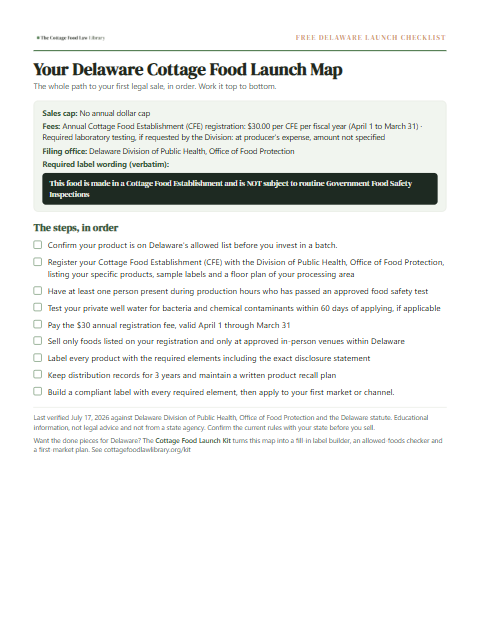
Delaware requires you to register your cottage food establishment with the Division of Public Health, pass a food safety test, submit a floor plan and pay a $30 annual fee before you sell. There is no dollar sales cap, but you can only sell approved shelf-stable foods in person at farmers markets, craft fairs and similar approved venues inside Delaware; online sales and shipping are not allowed.
Delaware lets you sell homemade food once you register with Delaware Division of Public Health, Office of Food Protection. There is no commercial-kitchen requirement, so foods like traditional baked goods: cakes, breads, cookies, rolls, muffins, brownies, fruit pies, pastries without tcs and jams, jellies and fruit preserves can come straight from your own kitchen after you complete the registration and label step below.
Delaware sets no dollar limit on cottage food sales, so the ceiling on your growth is your own kitchen and time rather than a statutory cap. The other rules that matter, the label, the allowed foods and where you can sell, are in the tables below.
The parts new Delaware sellers most often get wrong are the exact label disclosure wording, the food safety course and the registration step. Each one has its own row below, with the official source beside it.
How much can you sell? The Delaware sales cap
The annual sales limit for a Delaware cottage food operation.
| Item | Delaware rule |
|---|---|
| Annual sales cap | No annual dollar cap in Delaware |
| How it works | No dollar or volume sales cap appears in 16 Del. Admin. Code 4458A. The limiting factors are the closed list of registered products and the restriction to approved in-person venues within Delaware. |
What foods can you sell in Delaware?
Allowed and prohibited categories under current Delaware law.
| Allowed (examples) | Prohibited |
|---|---|
| Traditional baked goods: cakes, breads, cookies, rolls, muffins, brownies, fruit pies, pastries without TCS (potentially hazardous) fillings; Jams, jellies and fruit preserves; Candy products: fudge, lollipops, chocolates, hard candy, rock candy; Dry goods and certain snacks and condiments (non-TCS); Other non-time/temperature-controlled-for-safety foods specifically listed on the operator's registration. | Any time/temperature-controlled-for-safety (TCS) food; Products containing cannabis; Bakery items with TCS components such as cream fillings or meat; Any product not specifically listed on the operator's registration. |
Delaware cottage food label requirements
Every package you sell needs a label with the elements below in legible print.
- Cottage Food Establishment name
- Product name
- Town/city, Delaware
- Contact information
- Net weight or unit count
- Production date or lot number
- Ingredient list in decreasing order by weight
- Major food allergen declarations
- The disclosure statement above, minimum 10-point type in a contrasting color
Delaware requires this disclosure statement, word for word:
This food is made in a Cottage Food Establishment and is NOT subject to routine Government Food Safety Inspections
Reproduced from Delaware's cottage food labeling requirements. Confirm the current wording with Delaware Division of Public Health, Office of Food Protection before you print a run of labels.
From the team behind this library
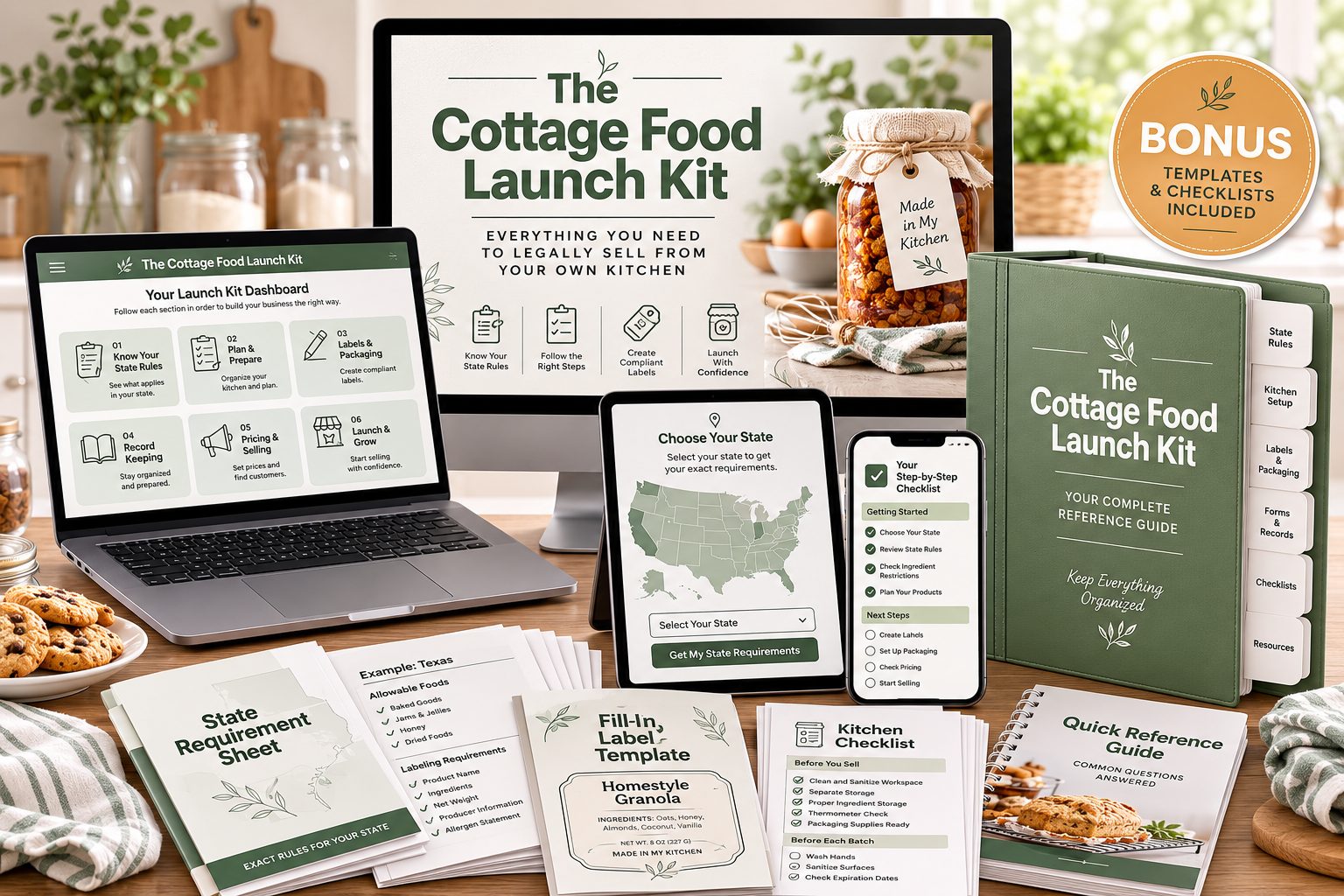
The Cottage Food Launch Kit
Want the whole path in one place? The kit turns everything on this page into one ordered walkthrough for Delaware: your state requirement sheet, a fill-in label template with the exact required wording, the allowed-foods checker, the ordered checklist and your first-market plan. Follow it in an evening.
Where can you sell in Delaware?
The venues and channels Delaware cottage food operators may use.
| Channel | Allowed in Delaware? |
|---|---|
| Farmers markets | Yes |
| Craft fairs | Yes |
| Charitable organization functions | Yes |
| Other Division-approved venues | With conditions. Must be pre-approved and shown on the registration |
| Online sales | No. Online marketing/advertising is permitted; the actual sale transaction may not occur online |
| Wholesale or sale to resellers/food establishments | No |
| Sales outside Delaware / interstate shipping | No. Direct sales to Delaware consumers only |
Registration, training and inspection
Registration and permits. Register the Cottage Food Establishment annually with the Division of Public Health's Office of Food Protection, listing specific products, sample labels and a facility floor plan. Pay the $30 fee.
Food safety training. At least one person on location during hours of operation must have passed a food safety test that is part of a Division-approved program.
Kitchen inspection. The Division may conduct a preoperational inspection to verify compliance before registration, plus additional inspections for complaints, foodborne illness reports, or as otherwise deemed necessary.
The fees a Delaware cottage food seller can expect.
| Item | Cost |
|---|---|
| Annual Cottage Food Establishment (CFE) registration | $30.00 per CFE per fiscal year (April 1 to March 31) |
| Required laboratory testing, if requested by the Division | at producer's expense, amount not specified |
Wondering how Delaware compares? See what a cottage food license costs in every state, from the no-fee states to the priciest permits.