Maryland Cottage Food Law (2026): Rules, Limits and How to Start
Do you need a license to sell homemade food in Maryland?
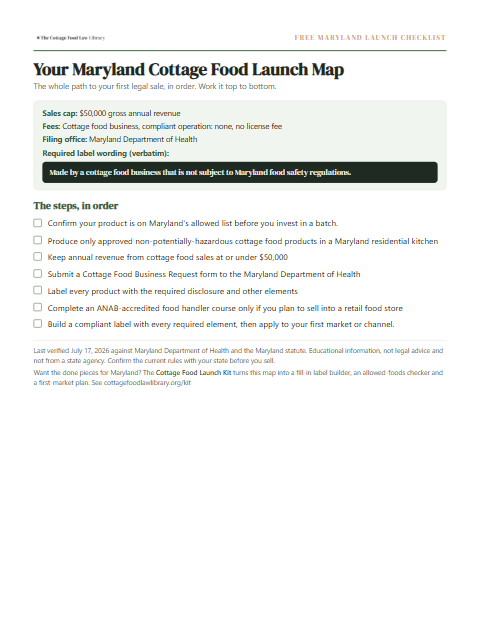
Maryland lets you run a cottage food business from a residential kitchen without a Department of Health license, as long as you stay under $50,000 in annual revenue and stick to the approved non-potentially-hazardous product list. No food safety training is required unless you plan to sell into a retail store. House Bill 535 would raise the cap to $100,000 if and when it takes effect.
In Maryland the path depends on what you make and how you sell it. Many home producers of foods like high-acid fruit jams, preserves and jellies at a ph of 4.6 or lower and fruit butters from qualifying acid-canned fruits need no state license at all, while some foods or channels trigger a registration. The rules below sort out which one is yours.
Maryland caps annual cottage food sales at $50,000 gross annual revenue. Raised from $25,000 effective October 1, 2022.
House Bill 535 (Chapter 320) was passed and takes effect October 1, 2026. Maryland doubles its cottage food sales cap from $50,000 to $100,000. The current $50,000 figure stays the operative rule until the new limit takes effect. This page reflects the rule in force today; the full history sits in the law-updates log.
How much can you sell? The Maryland sales cap
The annual sales limit for a Maryland cottage food operation.
| Item | Maryland rule |
|---|---|
| Annual sales cap | $50,000 gross annual revenue |
| How it works | Raised from $25,000 effective October 1, 2022. Verification correction 2026-07-17: House Bill 535 (2026) is further along than this file previously recorded. Confirmed directly against the Maryland General Assembly's own bill-status page (mgaleg.maryland.gov): HB 535 passed the House 136-0 on 2/26/2026, passed the Senate 42-0 on 4/13/2026 and was SIGNED by the Governor on 4/28/2026 as Chapter 320, not merely "passed both chambers." It is not yet in effect: the $100,000 cap takes effect October 1, 2026. The $50,000 figure remains the correct current cap as of this verification date (2026-07-17). |
What foods can you sell in Maryland?
Allowed and prohibited categories under current Maryland law.
| Allowed (examples) | Prohibited |
|---|---|
| Non-potentially-hazardous baked goods (no cream cheese, custard or refrigerated fillings); High-acid fruit jams, preserves and jellies at a pH of 4.6 or lower; Fruit butters from qualifying acid-canned fruits; Fruit leathers, pies and turnovers made from fruits with a natural pH of 4.6 or below; Non-potentially hazardous candy: brittles, gummy bears, lollipops, toffee, marshmallows made with non-PHF ingredients and freeze-dried non-PHF commercial candy; Chocolate confections made from commercially manufactured chocolate or commercial non-PHF ingredients: chocolate-covered dried fruit, nuts, pretzels, caramels, marshmallows and peanut butter cups; Whole roasted coffee beans; Repackaged commercial seasoning blends, spice blends and tea blends; Non-perishable snacks: popcorn, kettle corn, popcorn balls and nuts; Snack mixes from commercial sources: cereal, granola and trail mixes. | Potentially hazardous foods and any item requiring refrigeration; Flavored honey and maple syrup, which require an on-farm home processing licence or a processing licence. Unflavored honey including creamed honey is not prohibited: it is a raw agricultural product and simply not a cottage food; Acidified or pickled products: relish, pepper jelly, pickled beets, pumpkin butter, salsa; Fermented foods: kimchi, kombucha, pickles, sauerkraut; Low-acid canned foods; Condiments and sauces: BBQ, hot sauce, ketchup, mustard; Homemade nut butters and seed butters; Raw dough and unbaked energy balls; Dehydrated fruits, herbs and vegetables, including vegetable chips; Ground coffee and flavored coffee; Sugar-free jams, jellies, preserves, fruit butters and syrups; Syrups and any extracts; Beverages of any kind; Ice or ice products of any kind; Freeze-dried products, except non-potentially hazardous commercially prepared candy; Fresh-cut fruit and vegetables; Garlic or vegetable-in-oil mixtures; Raw seed sprouts; Fresh or dehydrated pasta; Meat and poultry products; Fish and shellfish; Milk and dairy products; Perishable baked goods: cheesecake, cream and custard pies, meringue, pumpkin and sweet potato pies, macarons, waffles and buttercream, cream cheese or royal icings. |
Maryland cottage food label requirements
Every package you sell needs a label with the elements below in legible print.
- Name and address of the cottage food business, or the name plus a phone number plus an MDH-assigned identification number
- Name of the cottage food product
- Ingredients in descending order by weight, including sub-ingredients
- Net weight, count or net volume
- Allergen information per federal labeling requirements
- Nutritional information per federal requirements, if any nutritional or health claim is made
- The disclosure statement above, printed in 10 point or larger type in a color that provides a clear contrast to the background of the label
- Labels must be in English
- FOR PRODUCT SOLD AT A RETAIL FOOD STORE, additionally: the business phone number, the business email address and the date the product was made
Maryland requires this disclosure statement, word for word:
Made by a cottage food business that is not subject to Maryland's food safety regulations.
Reproduced from Maryland's cottage food labeling requirements. Confirm the current wording with Maryland Department of Health before you print a run of labels.
From the team behind this library
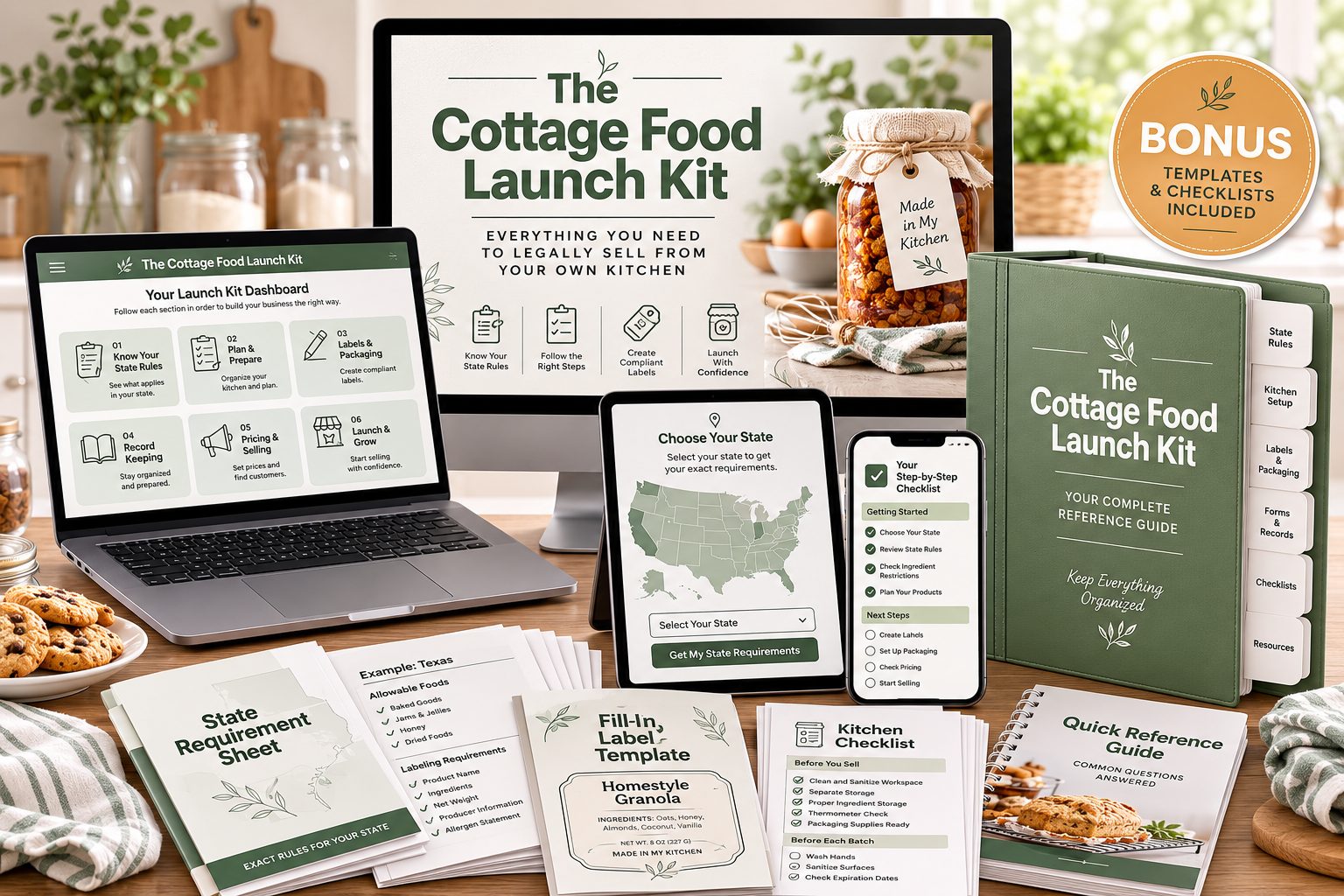
The Cottage Food Launch Kit
Want the whole path in one place? The kit turns everything on this page into one ordered walkthrough for Maryland: your state requirement sheet, a fill-in label template with the exact required wording, the allowed-foods checker, the ordered checklist and your first-market plan. Follow it in an evening.
Where can you sell in Maryland?
The venues and channels Maryland cottage food operators may use.
| Channel | Allowed in Maryland? |
|---|---|
| Farmer's market, public event | Yes |
| Directly from the producer's home | Yes |
| Online, with personal delivery or mail delivery | Yes. Within Maryland. |
| Retail food stores | With conditions. Original packaging only, per COMAR definitions; training requirement applies for this channel. |
| Interstate commerce | No |
Registration, training and inspection
Registration and permits. No MDH filing at all for a direct-to-consumer cottage food business and no licence. The Cottage Food Business Request Form (also called the ID and Retail Sales Request Form) is submitted only in two situations: to obtain a unique MDH identification number to use in place of the home address on the label, or to obtain the compliance letter required before selling to a retail food store. Local county or municipal requirements may still apply.
Food safety training. Not required for direct-to-consumer sales. Required only if selling into a retail food store: an ANSI/ANAB-accredited food safety course completed in the past 3 years. Confirmed directly against the official COMAR 10.15.03.27 text (via Cornell Law's regulation mirror), which explicitly conditions the course requirement on retail-store sale and lists direct-to-consumer channels (farmer's market, bake sale, public event, personal delivery, mail order) as not requiring it.
Kitchen inspection. No preliminary and no routine inspection. MDH FAQ Q6: "Does my kitchen need to be inspected? No. A cottage food business doesn't require a preliminary or routine inspection. However, if a consumer complaint or illness is reported, the home kitchen may be inspected by the local health department." COMAR 10.15.03.27C(4)-(5) gives the Department authority on complaint or outbreak to investigate, enter and inspect the premises and collect samples and the owner may not refuse access. Health-General 21-330.1 carries the same enforcement language.
The fees a Maryland cottage food seller can expect.
| Item | Cost |
|---|---|
| Cottage food business, compliant operation | none, no license fee |
Wondering how Maryland compares? See what a cottage food license costs in every state, from the no-fee states to the priciest permits.