Indiana Cottage Food Law (2026): Rules, Limits and How to Start
Do you need a license to sell homemade food in Indiana?
Indiana has run a Home Based Vendor law since 2022 that lets you sell shelf-stable homemade food direct to consumers with an ANSI food handler certificate and a required label statement, no sales cap and no routine inspection. A much broader deregulation, House Enrolled Act 1424, took effect July 1, 2026 and strips most licensing, certification and inspection requirements for homestead vendors and small farms under $1.5 million in annual gross sales, so check which path applies to your product before you build.
Indiana keeps the path to selling short. There is no state permit and no annual sales cap, so foods like baked goods and candy and confections can go to market once your label carries what the state asks for. The rules below are the whole picture.
Indiana sets no dollar limit on cottage food sales, so the ceiling on your growth is your own kitchen and time rather than a statutory cap. The other rules that matter, the label, the allowed foods and where you can sell, are in the tables below.
House Enrolled Act 1424 was enacted in 2026. Indiana enacted a second, overlapping home-food law alongside its existing home-based vendor rules. The two regimes interact in ways that were still settling at verification, so confirm which path fits your product with the Indiana agency. This page reflects the rule in force today; the full history sits in the law-updates log.
How much can you sell? The Indiana sales cap
The annual sales limit for a Indiana cottage food operation.
| Item | Indiana rule |
|---|---|
| Annual sales cap | No annual dollar cap in Indiana |
| How it works | IC 16-42-5.3 (Home Based Vendor) sets no revenue cap. The 2026 exemption under HEA 1424 is bounded by gross sales, not a hard sales cap in the cottage-food sense: at $1.5 million or more in gross annual sales, the homestead vendor or small farm no longer qualifies for the exemption and falls back under standard food establishment regulation. |
What foods can you sell in Indiana?
Allowed and prohibited categories under current Indiana law.
| Allowed (examples) | Prohibited |
|---|---|
| Baked goods (cookies, cupcakes, bread, muffins); Candy and confections (chocolates, caramels, nuts); Tree nuts and legumes; Honey, molasses, maple syrup; Traditional high-acid fruit jams, jellies and preserves (home-canned); Whole, uncut produce; Under the 2026 homestead vendor / small farm exemption: a broader range including prepared foods and specified meat products, per secondary reporting. | TCS (time-temperature control for safety) foods under the Home Based Vendor law: raw or heat-treated animal products, heat-treated plant foods, raw seed sprouts, cut melons or leafy greens, garlic-in-oil. |
Indiana cottage food label requirements
Every package you sell needs a label with the elements below in legible print.
- Name and address of the producer
- Common or usual name of the food product
- Ingredients in descending order by predominance by weight
- Net weight or volume by standard measure or numerical count
- The date the food product was processed
- The disclosure statement above, in at least 10-point type
Indiana requires this disclosure statement, word for word:
This product is home produced and processed and the production area has not been inspected by Indiana Department of Health. NOT FOR RESALE.
Reproduced from Indiana's cottage food labeling requirements. Confirm the current wording with Indiana Department of Health before you print a run of labels.
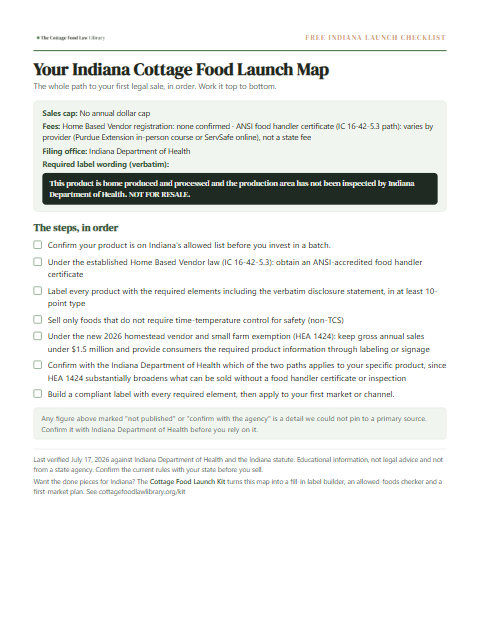
Get the free Indiana cottage food checklist
The one-page map of the steps, in order, so you can see the whole path at a glance.
Instant download, plus Indiana law-change alerts. Unsubscribe anytime.
Where can you sell in Indiana?
The venues and channels Indiana cottage food operators may use.
| Channel | Allowed in Indiana? |
|---|---|
| Direct to consumer in person (home, farmers markets, roadside stands) | Yes |
| Telephone and internet sales | Yes |
| Mail delivery or third-party carrier | Yes. Within Indiana only. |
| Sale from the homestead vendor's or small farm's property, or at a farmers market (2026 exemption) | Yes |
Registration, training and inspection
Registration and permits. No state registration or license applies under either the Home Based Vendor law or the 2026 homestead vendor / small farm exemption.
Food safety training. Required under the established Home Based Vendor law (IC 16-42-5.3): an ANSI-accredited food handler certificate. The 2026 homestead vendor and small farm exemption (HEA 1424) removes this requirement for qualifying producers under $1.5 million in gross annual sales.
Kitchen inspection. Home Based Vendors are exempt from routine inspection. HEA 1424 bars the state and local health departments from imposing licensing or inspection requirements on qualifying homestead vendors and small farms beyond federal law, though IDOH retains inspection authority on a complaint or a suspected health hazard.
The fees a Indiana cottage food seller can expect.
| Item | Cost |
|---|---|
| Home Based Vendor registration | none confirmed |
| ANSI food handler certificate (IC 16-42-5.3 path) | varies by provider (Purdue Extension in-person course or ServSafe online), not a state fee |