Ohio Cottage Food Law (2026): Rules, Limits and How to Start
Do you need a license to sell homemade food in Ohio?
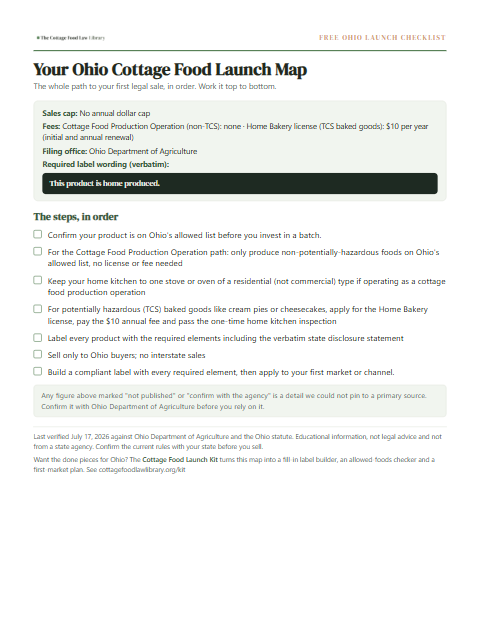
Ohio gives you two paths. The Cottage Food Production Operation path needs no license, no fee and no inspection for non-perishable items, with no sales cap. If you want to sell cream pies, cheesecakes or other refrigerated baked goods, you need the separate Home Bakery license, which costs $10 a year and requires a one-time kitchen inspection.
In Ohio the path depends on what you make and how you sell it. Many home producers of foods like baked goods without cream or custard filling and jams, jellies and fruit butters need no state license at all, while some foods or channels trigger a registration. The rules below sort out which one is yours.
Ohio sets no dollar limit on cottage food sales, so the ceiling on your growth is your own kitchen and time rather than a statutory cap. The other rules that matter, the label, the allowed foods and where you can sell, are in the tables below.
The parts new Ohio sellers most often get wrong are the exact label disclosure wording. Each one has its own row below, with the official source beside it.
How much can you sell? The Ohio sales cap
The annual sales limit for an Ohio cottage food operation.
| Item | Ohio rule |
|---|---|
| Annual sales cap | No annual dollar cap in Ohio |
| How it works | No annual gross-revenue or unit cap applies to either the Cottage Food Production Operation path or the Home Bakery license path. |
What foods can you sell in Ohio?
Allowed and prohibited categories under current Ohio law.
| Allowed (examples) | Prohibited |
|---|---|
| Baked goods without cream or custard filling (cookies, breads, brownies, cakes, fruit pies); Jams, jellies and fruit butters; Candy; Granola bars and popcorn; Unfilled doughnuts; Flavored honey (at least 75 percent from the seller's own hives); Cream pies, cheesecakes, custard pies and other TCS baked goods (Home Bakery license only). | Potentially hazardous (TCS) foods generally, under the basic Cottage Food Production Operation path; Acidified or canned goods, pickles, salsa, canned vegetables; Refrigerated items with cream or custard fillings (without a Home Bakery license); Hot prepared meals; Alcohol-infused products. |
Ohio cottage food label requirements
Every package you sell needs a label with the elements below in legible print.
- Business name and address
- Product name
- Complete ingredient list in descending order by weight
- Net weight in both US and metric units
- Allergen declarations per 21 CFR Part 101
- The disclosure statement (verbatim above) in at least 10-point type
Ohio requires this disclosure statement, word for word:
This product is home produced.
Reproduced from Ohio's cottage food labeling requirements. Confirm the current wording with Ohio Department of Agriculture before you print a run of labels.
From the team behind this library
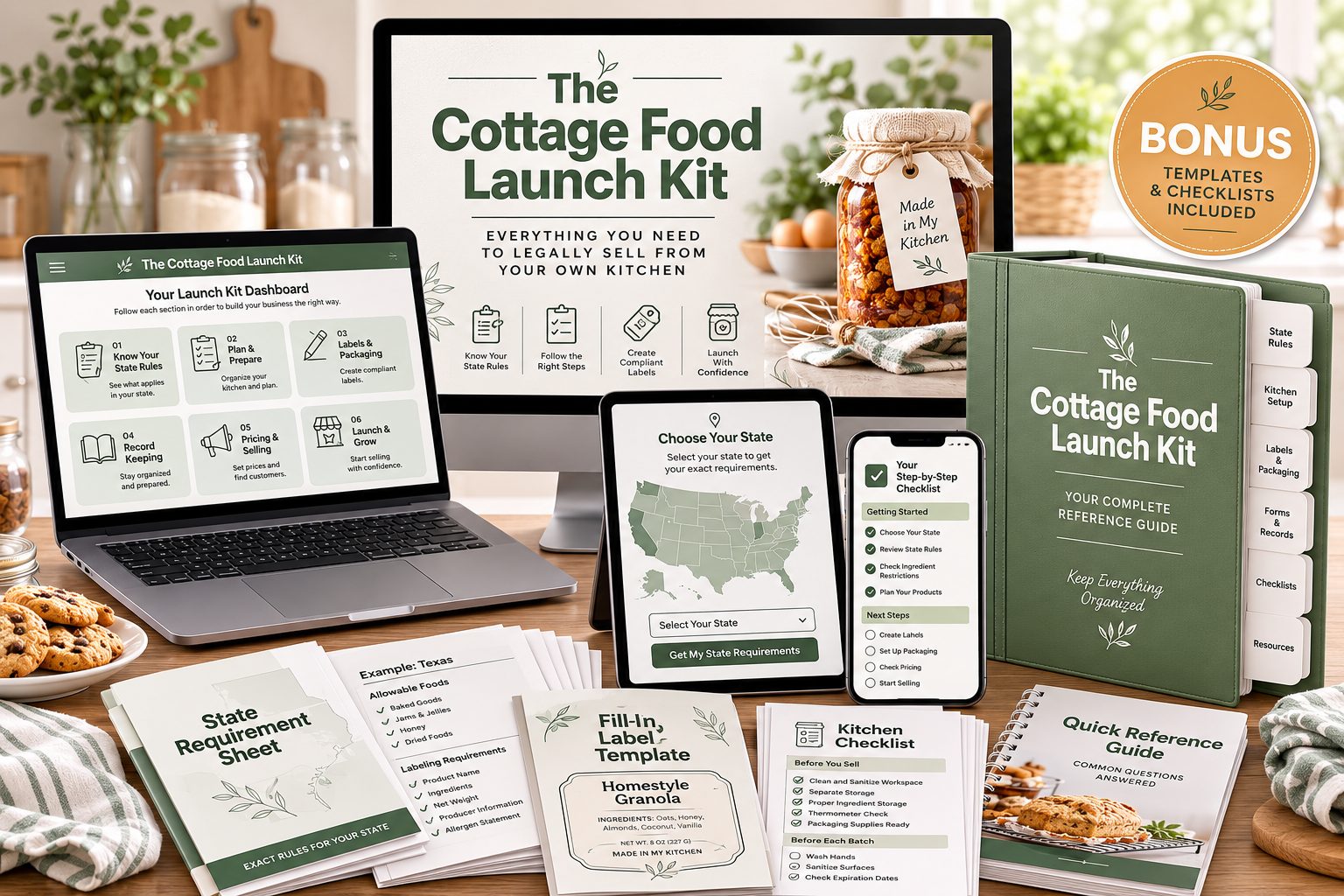
The Cottage Food Launch Kit
Want the whole path in one place? The kit turns everything on this page into one ordered walkthrough for Ohio: your state requirement sheet, a fill-in label template with the exact required wording, the allowed-foods checker, the ordered checklist and your first-market plan. Follow it in an evening.
Where can you sell in Ohio?
The venues and channels Ohio cottage food operators may use.
| Channel | Allowed in Ohio? |
|---|---|
| Direct to consumer (home, farmers markets, farm markets) | Yes |
| Retail food establishments and food service operations licensed under ORC Chapter 3717 | Yes. For properly labeled cottage food products |
| Online sales to Ohio residents | Yes |
| Interstate or out-of-state sales | No |
Registration, training and inspection
Registration and permits. No registration for the basic Cottage Food Production Operation path. A Home Bakery license (application plus a one-time kitchen inspection) is required only to sell potentially hazardous (TCS) baked goods.
Food safety training. No food safety training or certification requirement was found for either the Cottage Food Production Operation path or the Home Bakery license path.
Kitchen inspection. No inspection for the Cottage Food Production Operation path. The Home Bakery license requires a one-time home kitchen inspection before selling TCS baked goods.
The fees an Ohio cottage food seller can expect.
| Item | Cost |
|---|---|
| Cottage Food Production Operation (non-TCS) | No state fee |
| Home Bakery license (TCS baked goods) | $10 per year (initial and annual renewal) |
Not published centrally. Confirm the current amount with Ohio Department of Agriculture.
Wondering how Ohio compares? See what a cottage food license costs in every state, from the no-fee states to the priciest permits.
Cottage food or home bakery: what the Ohio split actually costs you
Ohio runs two home food programs with one difference that matters more than the fee. A cottage food production operation needs no license, no registration and no inspection. It may only make what is on a closed list. A home bakery costs $10 a year plus an inspection. It unlocks the refrigerated bakery items plus a set of selling routes the cottage list cannot reach. Picking the wrong one is usually about the list rather than the money.
The cottage list is closed, not a guideline
Ohio Administrative Code rule 901:3-20-04 approves twenty things: non-potentially hazardous bakery products, jams, jellies, candy other than fresh fruit dipped or covered in it, flavored honey from an exempt beekeeper, fruit chutneys, fruit butters, granola and granola bars with commercially dried fruit, maple sugar from an exempt maple syrup producer, popcorn in its various forms but not popping corn, unfilled baked donuts, waffle cones plain or dipped, pizzelles, dry cereal and nut snack mixes with seasonings, roasted coffee whole or ground, dry baking mixes in a jar, dry herbs and herb blends, dry soup mixes with commercially dried vegetables, dry seasoning blends, dry tea blends. Rule 901:3-20-05 then makes it a prohibition to produce food items not expressly listed in that paragraph. The only open-ended entry is the bakery one, so the honest test is never whether your product feels low risk. It is whether the words for it appear in the rule.
Two more restrictions sit in the same chapter. Cottage food products may not be packed using reduced oxygen packaging, which the rules define to cover both vacuum packaging and modified atmosphere packaging. And rule 901:3-20-05 bars selling cottage food products outside the state of Ohio, which is why an Ohio cottage food label is worth nothing to an out-of-state customer.
What "no license" leaves in place
Sampling. Every cottage food product is subject to sampling by the director of agriculture, or an authorized representative, to decide whether a product is misbranded or adulterated. Refusing to allow that sampling is itself listed as a prohibition. Labeling is the other duty that survives. Ohio Revised Code 3715.023 asks for the business name and address, the product name, the ingredients in descending order of predominance by weight, the net weight and volume, plus the statement "This product is home produced." in ten-point type. Federal labeling at 21 CFR Part 101 applies on top of it. The same section then says something useful in the other direction: a properly labeled cottage food is an acceptable product that a retail food establishment or food service operation licensed under Chapter 3717 may offer for sale or use in preparing and serving food. A licensed Ohio restaurant may cook with your jam.
What the $10 buys
A home bakery is defined in Chapter 911 of the Revised Code, in the Department's words, as any person who owns or operates a home bakery with only one oven, in a stove of ordinary home kitchen design and located in a home, used for baking of baked goods to be sold. Home means the primary residence of its occupant, holding one stove or oven used for cooking, which may be a double oven, designed for common residence usage rather than commercial use. The Department licenses and inspects it. The fee is $10 a year, renewed each September.
- The kitchen it inspects. Walls, ceilings and floors in good repair, clean, easily cleanable, with no carpet in the kitchen. A home free of pests. No pets in the home. A mechanical refrigerator with a properly located thermometer that holds 45 degrees Fahrenheit or lower. A private well tested annually for coliform bacteria with a negative result inside the year, shown to the inspecting specialist. Your labels available for review on the day.
- What you may then bake. The non-hazardous bakery products a cottage operation makes, plus the ones it cannot: cheesecakes, cream pies, custard pies, pumpkin pies and the rest of the bakery items that need refrigeration.
- Where it may go. From the home bakery itself and through grocery stores, convenience stores, farm markets, farmers markets and other retail establishments. Restaurants may serve the items. The Department also states that home bakeries may distribute their products outside of the state of Ohio, which is the wall the cottage track never gets past.
- The label changes. Product name, net quantity in both systems, ingredients in descending order by weight, business name and address. Items that need refrigeration carry a "Keep Refrigerated" declaration. The home-produced sentence belongs to the cottage track rather than this one.
At a farmers market the Department draws the line at self-service. Packaged, properly labeled cottage food may be offered with no license from the local health department. Open the product up for customers to select and a temporary or mobile food license from that local health department is required.