Massachusetts Cottage Food Law (2026): Rules, Limits and How to Start
Do you need a license to sell homemade food in Massachusetts?
Massachusetts does not run a traditional cottage food exemption. Home bakers and food makers operate as a permitted Residential Kitchen under 105 CMR 590, which means your local board of health must inspect your kitchen and issue a permit before you sell. There is no statewide sales cap, but permit fees, label rules and any extra training requirement are set town by town, so check with your own board of health.
Massachusetts asks more of a home food seller than most states. You work through Local Board of Health before your first sale. The page below lays out the registration, the training and the inspection in the order they come. It is a real process, so knowing the steps up front is what keeps it from stalling.
Massachusetts sets no dollar limit on cottage food sales, so the ceiling on your growth is your own kitchen and time rather than a statutory cap. The other rules that matter, the label, the allowed foods and where you can sell, are in the tables below.
The parts new Massachusetts sellers most often get wrong are the label elements, the kitchen inspection and the registration step. Each one has its own row below, with the official source beside it.
How much can you sell? The Massachusetts sales cap
The annual sales limit for a Massachusetts cottage food operation.
| Item | Massachusetts rule |
|---|---|
| Annual sales cap | No annual dollar cap in Massachusetts |
| How it works | 105 CMR 590 sets no statewide annual sales or revenue cap on a permitted Residential Kitchen cottage food operation. Local boards of health may add their own permit conditions, but no board-level revenue cap was found in primary sources. |
What foods can you sell in Massachusetts?
Allowed and prohibited categories under current Massachusetts law.
| Allowed (examples) | Prohibited |
|---|---|
| Non-refrigerated baked goods; Jams and jellies, including those thermally processed in sealed containers; Other non-TCS (non-time/temperature-control-for-safety) foods; Prepackaged shelf-stable foods like chips and candy sold alongside cottage food items. | Raw or heat-treated meat, poultry, fish or shellfish; Cream-filled pastries, cheesecake and custard; Cut fruit and vegetables; Tomato sauce, barbeque sauce, ketchup and mustard; Pickled products, relishes and salad dressings; Milk and dairy products including hard, soft and cottage cheeses and yogurt; Any food that needs time or temperature control for safety (TCS). |
Massachusetts cottage food label requirements
Every package you sell needs a label with the elements below in legible print.
- Cottage Food Operation name and address
- Product name
- Ingredient list in descending order by weight
- Net weight or net volume
- Allergen information per federal labeling requirements (milk, eggs, wheat, peanuts, soybeans, fish, shellfish, tree nuts)
- Nutritional labeling if any nutrient content claim or health claim is made
- Printed in English
No single statewide disclosure sentence. Massachusetts does not set one required disclosure line in the sources we checked. Put the required elements above on every label. Confirm the current wording with Local Board of Health before you print a run.
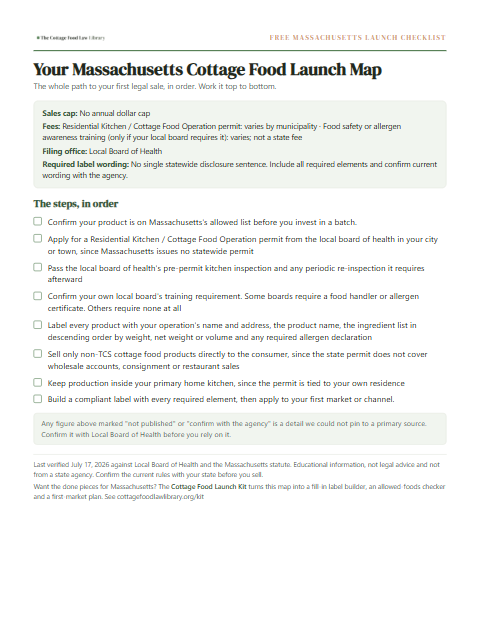
Get the free Massachusetts cottage food checklist
The one-page map of the steps, in order, so you can see the whole path at a glance.
Instant download, plus Massachusetts law-change alerts. Unsubscribe anytime.
Where can you sell in Massachusetts?
The venues and channels Massachusetts cottage food operators may use.
| Channel | Allowed in Massachusetts? |
|---|---|
| Direct to consumer in person (home, farmers markets, craft fairs) | With conditions. Permit required from the local board of health unless only exempt items are sold; farmers market and craft fair vendors need their own board approval to sell there. |
| Online orders shipped within Massachusetts | With conditions. Counts as a direct sale to the consumer and is allowed under the residential kitchen permit; check your local board for any added conditions. |
| Retail stores, restaurants and other wholesale accounts | No. The cottage food operation definition limits sales to direct-to-consumer only. Wholesale requires a separate Food Manufacturing Code permit from DPH under 105 CMR 500. |
| Shipping out of state | Not clearly authorized. Massachusetts sources do not clearly authorize interstate shipping. It likely crosses into federal FDA food-facility rules that state cottage food law does not address. Treat as unconfirmed and check with DPH or your board of health first. |
Local Board of Health has not settled every channel in one published place. Confirm your specific channel, for example online or out-of-state shipping, with Local Board of Health.
Registration, training and inspection
Registration and permits. A Cottage Food Operation must get a permit from the local board of health in the city or town where the kitchen is located before selling. Only whole uncut produce, unprocessed honey, pure maple products and refrigerated farm eggs are exempt from the permit. Those items are not cottage food products under the state definition.
Food safety training. State guidance exempts a cottage-food-only kitchen from needing a Certified Food Protection Manager on staff. Individual local boards of health set their own additional training or certificate requirements as a condition of the permit. Boston, for example, asks for both a Food Protection Manager certificate and an Allergen Awareness certificate; many other towns ask for less or nothing beyond the inspection.
Kitchen inspection. The local board of health must inspect the residential kitchen before issuing the permit and on a periodic basis after that. This applies statewide; Massachusetts does not offer an uninspected cottage food track.
The fees a Massachusetts cottage food seller can expect.
| Item | Cost |
|---|---|
| Residential Kitchen / Cottage Food Operation permit | varies by municipality |
| Food safety or allergen awareness training (only if your local board requires it) | varies; not a state fee |
Not published centrally. Confirm the current amount with Local Board of Health. Confirm the exact course or certificate Local Board of Health accepts before you enroll.