Rhode Island Cottage Food Law (2026): Rules, Limits and How to Start
Do you need a license to sell homemade food in Rhode Island?
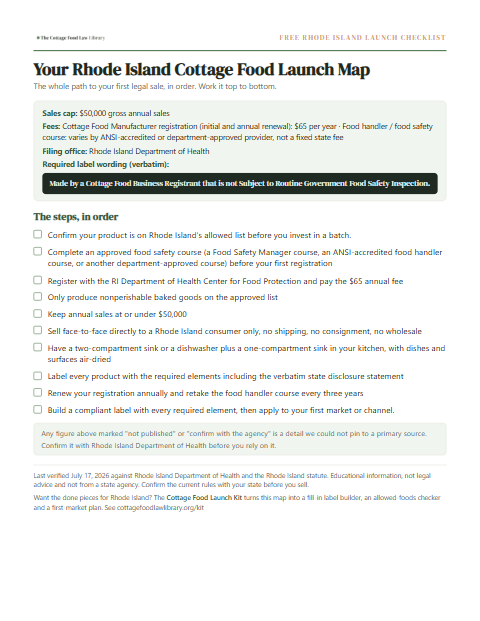
Rhode Island was the last state to pass a cottage food law and it stays narrow. You can only sell nonperishable baked goods. You must register with the Department of Health for $65 a year, complete a food handler course first and stay under a $50,000 annual sales cap. Sales have to be face-to-face with a Rhode Island consumer, no shipping and no stores.
Rhode Island lets you sell homemade food once you register with Rhode Island Department of Health. There is no commercial-kitchen requirement, so foods like baked goods that do not require refrigeration or time/temperature control for safety. the statute says "including but not limited to", so the list below is illustrative rather than closed and double crust pies can come straight from your own kitchen after you complete the registration and label step below.
Rhode Island caps annual cottage food sales at $50,000 gross annual sales. Exceeding $50,000 requires a food processor license or ceasing cottage food operations.
The parts new Rhode Island sellers most often get wrong are the exact label disclosure wording, the food safety course and the registration step. Each one has its own row below, with the official source beside it.
How much can you sell? The Rhode Island sales cap
The annual sales limit for a Rhode Island cottage food operation.
| Item | Rhode Island rule |
|---|---|
| Annual sales cap | $50,000 gross annual sales |
| How it works | Exceeding $50,000 requires a food processor license or ceasing cottage food operations. The cap applies per cottage food manufacturer registration. Re-verified 2026-08-15 against the statute text: "Total annual gross sales for a cottage food operation shall not exceed fifty thousand dollars ($50,000) per calendar year." Note it is per CALENDAR year, which is slightly more specific than a rolling gross annual figure. |
What foods can you sell in Rhode Island?
Allowed and prohibited categories under current Rhode Island law.
| Allowed (examples) | Prohibited |
|---|---|
| Baked goods that do not require refrigeration or time/temperature control for safety. The statute says "including but not limited to", so the list below is illustrative rather than closed; Double crust pies; Yeast breads; Biscuits, brownies, cookies and muffins; Cakes that do not require refrigeration or a temperature-controlled environment; Other shelf-stable baked goods such as pretzels, crackers, granola and rolls, which the statute does not exclude. | Jams, jellies and preserves; Candy; Anything requiring refrigeration or time/temperature control for safety; Cream or custard-filled baked goods. |
Rhode Island cottage food label requirements
Every package you sell needs a label with the elements below in legible print.
- Name, address and telephone number
- The ingredients of the cottage food product, in descending order of predominance by weight or volume
- Allergen information as specified by federal and state labeling requirements, such as milk, eggs, tree nuts, peanuts, wheat and soybeans
- The disclosure statement (verbatim above) in at least 10-point type, clear and conspicuous, providing contrast to the background label
- The disclosure statement is not required where the products have been prepared in a commercial kitchen licensed by the department
Rhode Island requires this disclosure statement, word for word:
Made by a Cottage Food Business Registrant that is not Subject to Routine Government Food Safety Inspection.
Reproduced from Rhode Island's cottage food labeling requirements. Confirm the current wording with Rhode Island Department of Health before you print a run of labels.
From the team behind this library
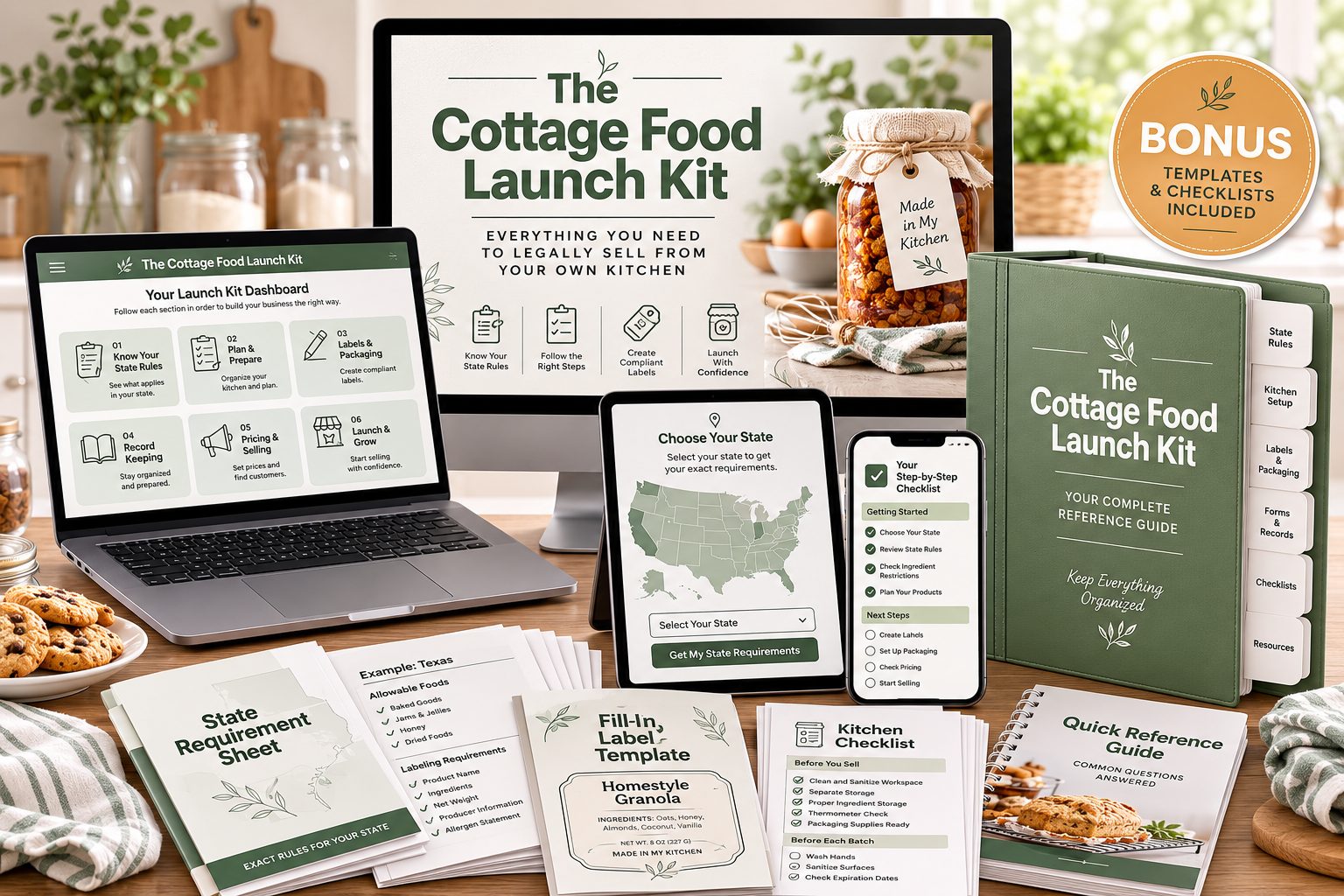
The Cottage Food Launch Kit
Want the whole path in one place? The kit turns everything on this page into one ordered walkthrough for Rhode Island: your state requirement sheet, a fill-in label template with the exact required wording, the allowed-foods checker, the ordered checklist and your first-market plan. Follow it in an evening.
Where can you sell in Rhode Island?
The venues and channels Rhode Island cottage food operators may use.
| Channel | Allowed in Rhode Island? |
|---|---|
| Direct, face-to-face sale to a Rhode Island consumer | Yes. Online advertising and ordering is fine, but the actual transfer of goods must be face-to-face |
| Shipping by mail or carrier (USPS, UPS, FedEx, etc.) | No |
| Grocery stores, restaurants, group homes, daycare facilities, schools, long-term-care facilities | No |
| Consignment or wholesale sales | No |
| Farmers markets and temporary events | With conditions. One source reports an additional Retail Food Peddler License may be required; not independently confirmed |
Rhode Island Department of Health has not settled every channel in one published place. Confirm your specific channel, for example online or out-of-state shipping, with Rhode Island Department of Health.
Registration, training and inspection
Registration and permits. Must register as a Cottage Food Manufacturer with RIDOH's Center for Food Protection, including proof of completed food safety training, before selling. $65 annual fee.
Food safety training. A Food Safety Manager course, an ANSI-approved food handler course, or another department-approved course is required before the first registration and must be retaken every three years.
Kitchen inspection. The director of health or a designee may inspect a cottage food operation at any time to confirm compliance and may investigate in response to a foodborne illness outbreak, consumer complaint or other public health emergency.
The fees a Rhode Island cottage food seller can expect.
| Item | Cost |
|---|---|
| Cottage Food Manufacturer registration (initial and annual renewal) | $65 per year |
| Food handler / food safety course | varies by ANSI-accredited or department-approved provider, not a fixed state fee |
Not published centrally. Confirm the current amount with Rhode Island Department of Health. Confirm the exact course or certificate Rhode Island Department of Health accepts before you enroll.
Wondering how Rhode Island compares? See what a cottage food license costs in every state, from the no-fee states to the priciest permits.