Montana Cottage Food Law (2026): Rules, Limits and How to Start
Do you need a license to sell homemade food in Montana?
Montana runs two separate paths for home food sales. Under the Local Food Choice Act you can sell almost any homemade food, including many potentially hazardous foods, directly to an informed local consumer with no permit, no cap and no packaged label, as long as you stay in Montana and tell the buyer the product is unlicensed and uninspected. The older Cottage Food Operation path covers a narrower list of shelf-stable foods with wider market access after a one-time $40 registration and a printed disclosure label.
In Montana the path depends on what you make and how you sell it. Many home producers of foods like under the local food choice act: most homemade foods sold directly to an informed consumer, including many potentially hazardous items, subject to separate meat, poultry and dairy rules and under the cottage food operation path: baked goods such as breads, rolls, cakes, cookies, crackers, granola and most pies need no state license at all, while some foods or channels trigger a registration. The rules below sort out which one is yours.
Montana sets no dollar limit on cottage food sales, so the ceiling on your growth is your own kitchen and time rather than a statutory cap. The other rules that matter, the label, the allowed foods and where you can sell, are in the tables below.
The parts new Montana sellers most often get wrong are the exact label disclosure wording. Each one has its own row below, with the official source beside it.
How much can you sell? The Montana sales cap
The annual sales limit for a Montana cottage food operation.
| Item | Montana rule |
|---|---|
| Annual sales cap | No annual dollar cap in Montana |
| How it works | Neither the Local Food Choice Act nor the Cottage Food Operation registration currently imposes an annual sales or gross income cap. Secondary sources describe an earlier cap having existed and later been removed by legislative change, but the research agent could not confirm the bill number, year or dollar figure against a primary source, so no historical cap figure is asserted here. |
Not published as one current figure everyone cites. Confirm this year's cap with Local Environmental Health Agency before you scale.
What foods can you sell in Montana?
Allowed and prohibited categories under current Montana law.
| Allowed (examples) | Prohibited |
|---|---|
| Under the Local Food Choice Act: most homemade foods sold directly to an informed consumer, including many potentially hazardous items, subject to separate meat, poultry and dairy rules; Under the Cottage Food Operation path: baked goods such as breads, rolls, cakes, cookies, crackers, granola and most pies (not custard, fresh-fruit-topped or refrigerated pies); Dried fruit; Standardized jams, jellies, preserves and fruit butters made with an approved fruit list; Dry herb, spice, tea, coffee and soup mixes; Popcorn, popcorn balls and cotton candy; Fudge, candies and confections that need a cook step and no refrigeration; Molded chocolate made with commercial chocolate melts; Honey. | Alcohol and alcohol-infused products (still governed by Montana liquor control law); THC and marijuana-infused products (still governed by Montana marijuana law); Dairy products and eggs (not eligible under the Cottage Food Operation path); Fermented foods such as lacto-fermented pickles; Freezer jams or jellies and any product that needs refrigeration; Custard or cream pies, pumpkin pie and cheesecake; Pet treats; Sale to a retail store, restaurant or wholesaler under either path; Any sale to a buyer located outside Montana. |
Montana cottage food label requirements
Every package you sell needs a label with the elements below in legible print.
- Name, address, city, state and zip code of the cottage food operation
- Name of the cottage food product
- Ingredients listed from highest weight to lowest weight, with sub-ingredients in parentheses
- Net quantity, weight, count or volume
- Allergen labeling for common allergens (milk, wheat, eggs, peanuts, tree nuts and soy)
- The disclosure statement above, printed in 11-point type or larger (Cottage Food Operation path)
- Under the Local Food Choice Act, no printed label is required. The producer must instead directly inform the buyer the product is not licensed, permitted, certified, packaged, labeled or inspected
Montana requires this disclosure statement, word for word:
Made in a home kitchen that is not subject to retail food establishment regulations or inspections.
Reproduced from Montana's cottage food labeling requirements. Confirm the current wording with Local Environmental Health Agency before you print a run of labels.
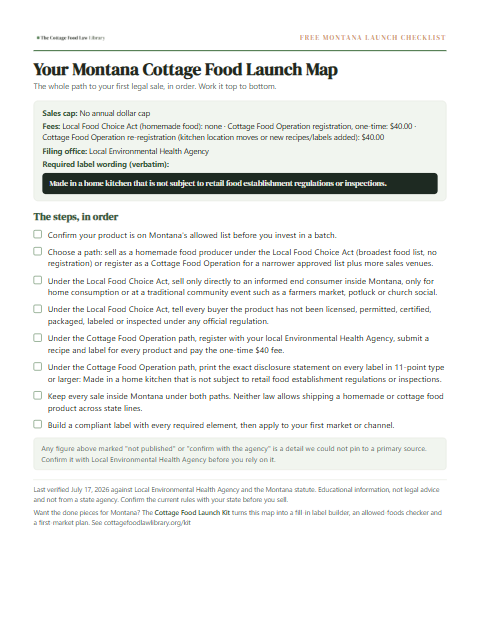
Get the free Montana cottage food checklist
The one-page map of the steps, in order, so you can see the whole path at a glance.
Instant download, plus Montana law-change alerts. Unsubscribe anytime.
Where can you sell in Montana?
The venues and channels Montana cottage food operators may use.
| Channel | Allowed in Montana? |
|---|---|
| Direct to consumer at the producer's home | Yes. Both paths |
| Farmers markets, bazaars, fairs and traditional community events | Yes. Qualifies under the Local Food Choice Act's traditional community event definition; also a standard Cottage Food Operation venue |
| Roadside stand or parking lot table | With conditions. Allowed under the Cottage Food Operation path subject to local permit ordinances and property owner permission. The Local Food Choice Act limits sales outside the home to a traditional community event, so an ordinary roadside table does not clearly qualify |
| Online orders with face-to-face delivery or pickup | With conditions. Advertising online is fine but the sale must be a face-to-face, in-person transaction. Courier, mail and marketplace shipping (USPS, UPS, FedEx, Amazon, eBay) are not allowed |
| Retail stores, restaurants and wholesale accounts | No. Prohibited under both paths (the Local Food Choice Act carries a narrow exception for raw, unprocessed fruit, vegetable and aquaculture products sold at retail) |
| Mail order, shipping or any sale across state lines | No. Both paths keep transactions inside Montana only |
Registration, training and inspection
Registration and permits. No registration under the Local Food Choice Act. Registration with the local Environmental Health Agency, plus a one-time $40 fee, is required only if operating under the older Cottage Food Operation path instead.
Food safety training. Neither the Local Food Choice Act nor the Cottage Food Operation path requires a food handler course, certification or training in any primary source reviewed.
Kitchen inspection. No inspection authority at all under the Local Food Choice Act beyond general disease-outbreak investigation. A Cottage Food Operation registrant is not routinely inspected but signs the registration agreeing to allow a home inspection if a complaint or illness is linked to a product.
The fees a Montana cottage food seller can expect.
| Item | Cost |
|---|---|
| Local Food Choice Act (homemade food) | No state fee |
| Cottage Food Operation registration, one-time | $40.00 |
| Cottage Food Operation re-registration (kitchen location moves or new recipes/labels added) | $40.00 |