North Dakota Cottage Food Law (2026): Rules, Limits and How to Start
Do you need a license to sell homemade food in North Dakota?
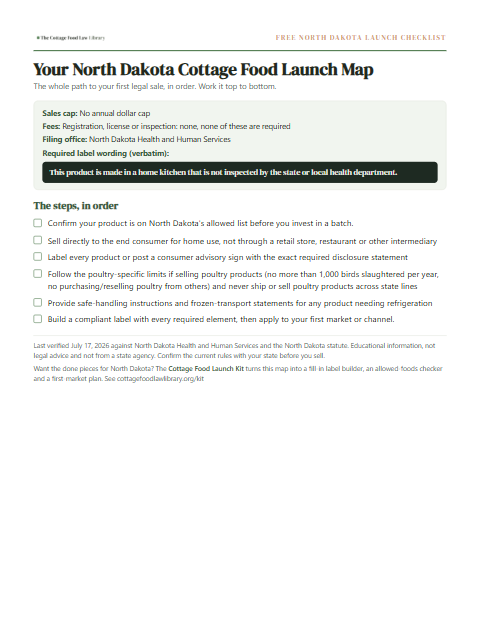
North Dakota runs one of the broadest food freedom laws in the country. You need no license, no permit and no inspection to sell homemade food directly to a consumer. Senate Bill 2386 (2025) removed the old ban on interstate commerce and on internet, phone, mail and consignment sales for cottage food generally, but it added a new, separate ban on interstate sales of poultry products specifically. You just have to label the product as coming from an uninspected home kitchen.
North Dakota runs one of the more permissive cottage food laws in the country. You can start selling foods like home-cooked meals and prepared main courses and baked goods from your own kitchen with no state permit to file and no dollar ceiling on your sales. Once you meet the labeling step below you are clear to sell.
North Dakota sets no dollar limit on cottage food sales, so the ceiling on your growth is your own kitchen and time rather than a statutory cap. The other rules that matter, the label, the allowed foods and where you can sell, are in the tables below.
Senate Bill 2386 took effect March 21, 2025. North Dakota let cottage food producers sell across state lines and by internet, phone and mail for the first time. The law specifically kept uninspected poultry out of interstate commerce. This page reflects the rule in force today; the full history sits in the law-updates log.
How much can you sell? The North Dakota sales cap
The annual sales limit for a North Dakota cottage food operation.
| Item | North Dakota rule |
|---|---|
| Annual sales cap | No annual dollar cap in North Dakota |
| How it works | No revenue or unit sales cap exists under the Food Freedom Act. A 1,000-bird-per-calendar-year slaughter limit applies to poultry meat under NDCC 23-09.5-02(3)(b)(1). Eggs sold direct to the end consumer are exempt from North Dakota egg dealer licensing with no flock-size threshold. Correction 2026-08-15: this file previously carried a 3,000-bird annual limit on egg sales. No such limit exists in North Dakota law. The complete text of NDCC chapter 23-09.5 contains exactly one bird-count provision, the 1,000-poultry slaughter limit and the words egg, eggs and laying hen appear nowhere in it, while the Department of Agriculture's own Egg Dealer reference (revised January 2026) scopes the licence to wholesale or other commercial use and notes "eggs sold to end consumer are exempt from egg dealer's licensing and requirements". The 3,000 figure appears to have been imported from the federal FDA egg safety threshold of 3,000 laying hens. |
What foods can you sell in North Dakota?
Allowed and prohibited categories under current North Dakota law.
| Allowed (examples) | Prohibited |
|---|---|
| Home-cooked meals and prepared main courses; Baked goods; Jams, jellies and canned goods including low-acid canned goods; Nonalcoholic beverages; Poultry products from operator-raised birds (subject to the 1,000-bird annual limit, in-state sale only); Eggs (exempt from North Dakota egg dealer licensing when sold direct to the end consumer; no flock-size limit in state law); Fresh, uncut fruits and vegetables. | Uninspected meat products other than the operator's own limited-scale poultry; Poultry products sold in a transaction that involves interstate commerce, regardless of bird count (added by SB 2386, 2025; confirmed against the enrolled bill's amendment text); Resale of products purchased under the Food Freedom Act, or their use as an ingredient in another cottage food product. |
North Dakota cottage food label requirements
Every package you sell needs a label with the elements below in legible print.
- The disclosure statement (verbatim above), either on a product label or a consumer advisory sign at the point of sale
- Safe-handling instructions and a frozen-transport statement for any product requiring refrigeration
North Dakota requires this disclosure statement, word for word:
This product is made in a home kitchen that is not inspected by the state or local health department.
Reproduced from North Dakota's cottage food labeling requirements. Confirm the current wording with North Dakota Health and Human Services before you print a run of labels.
From the team behind this library
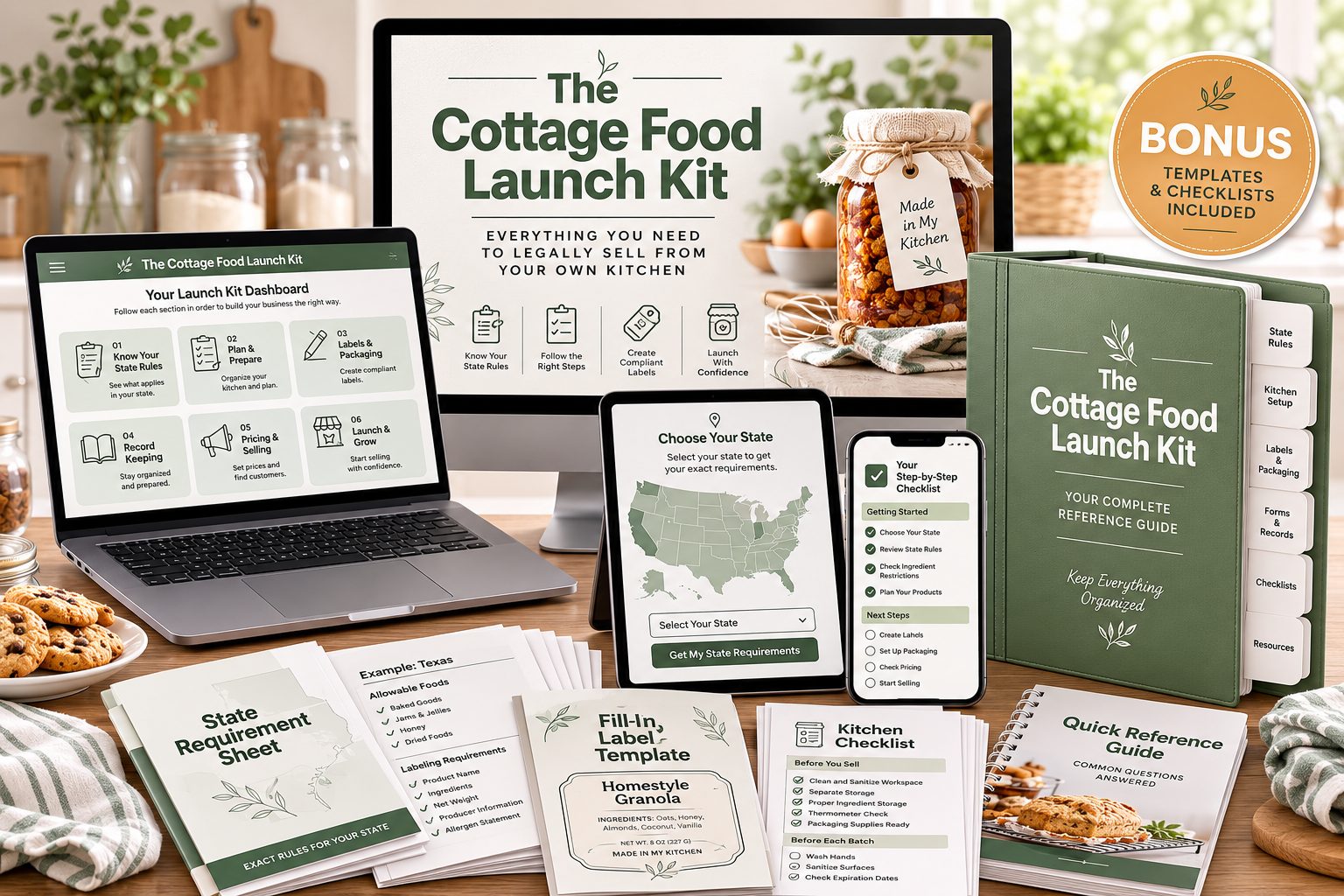
The Cottage Food Launch Kit
Want the whole path in one place? The kit turns everything on this page into one ordered walkthrough for North Dakota: your state requirement sheet, a fill-in label template with the exact required wording, the allowed-foods checker, the ordered checklist and your first-market plan. Follow it in an evening.
Where can you sell in North Dakota?
The venues and channels North Dakota cottage food operators may use.
| Channel | Allowed in North Dakota? |
|---|---|
| Direct to consumer (farm, ranch, farmers market, farm stand, home-based kitchen) | Yes |
| Delivery to the consumer | Yes |
| Online and phone orders | Yes. The pre-2025 statute expressly barred transactions 'conducted over the internet or phone, through the mail, or by consignment'; SB 2386 (2025) repealed that ban outright. Confirmed by direct comparison of the enrolled bill's struck and added text against the current codified statute. |
| Out-of-state shipping / interstate sales (non-poultry cottage food) | Yes. The pre-2025 statute expressly barred transactions that 'involve interstate commerce'; SB 2386 (2025) repealed that general ban. Confirmed against the enrolled bill text. |
| Out-of-state shipping / interstate sales of poultry products specifically | No. SB 2386 (2025) added a new, separate prohibition: transactions may not 'include the sale of poultry products if the transaction involves interstate commerce.' This directly contradicts several news and secondary sources that described the bill as extending shipping to poultry nationwide; the enrolled bill's own struck-and-underlined amendment text confirms the opposite for poultry. |
| Retail stores, restaurants and other intermediaries | No. Food Freedom Act sales must be direct to the end consumer |
Registration, training and inspection
Registration and permits. No registration, permit or license is required under the Food Freedom Act.
Food safety training. No food safety training or certification is required under the Food Freedom Act.
Kitchen inspection. State and local agencies are barred from requiring a kitchen inspection as a condition of producing or selling cottage food. HHS may investigate in response to a specific complaint.
The fees a North Dakota cottage food seller can expect.
| Item | Cost |
|---|---|
| Registration, license or inspection | none, none of these are required |
Wondering how North Dakota compares? See what a cottage food license costs in every state, from the no-fee states to the priciest permits.